The United Nations has declared that May 22 is Biodiversity Day. The goal this year is to publicize biodiversity. After studying the text of the UN Convention on Biodiversity, I believe that the UN is doing little or nothing for biodiversity. I have studied plants and animals for many years. What I’ve seen, and what others report, is that all of nature is in steep decline. Humans are the cause. I fear that people might be led to believe that the United Nations is taking effective action to protect biodiversity. It is not.
The theme of the UN Convention on Biodiversity is sustainable development. It’s text has lofty goals with vague strategies for their attainment. The text makes clear the Convention’s desire for acceptance by even the most growth oriented government. Each Article begins with phrases such as: “Each Contracting Party shall, in accordance with its particular conditions and capabilities. . . .” and this: “Each Contracting Party shall, as far as possible and as appropriate. . . .” Since human desires are the conditions that define what is appropriate, the phrases prohibit no “contractor” from full-bore growth and development if they say that these are needed to provide jobs and improved standards of living.
This is the UN’s definition of the Convention:
Signed by 150 government leaders at the 1992 Rio Earth Summit, the Convention on Biological Diversity is dedicated to promoting sustainable development. Conceived as a practical tool for translating the principles of Agenda 21 into reality, the Convention recognizes that biological diversity is about more than plants, animals and micro organisms and their ecosystems – it is about people and our need for food security, medicines, fresh air and water, shelter, and a clean and healthy environment in which to live (United Nations).
Biodiversity is definitely not about the needs of only one species. It is a general term that gives equal importance to all species. By placing humans ahead of all other species, the Convention’s definition replaces biological validity with the human bias that is destroying the Earth.
This year’s meeting focus is on promoting biodiversity. The meetings never do much more than report on small achievements. They serve as an opportunity to search for funding for their development-friendly activities and they let governments reward their environmental managers with a two-week vacation in an international resort.
Homo sapiens’ unrelenting rape of the Earth and the rapid decline of biodiversity is taking us toward the greatest mass extinction of all time. No one has found an effective means to stop this. In 1992, the United Nations decided to formalize their support for continued devastation by sugar-coating human impacts with the term “sustainable.” A genuine Biodiversity Day would focus on curtailing human:
Population growth
Habitat destruction
Material aspirations
Over and over, our leading biologists call for emergency responses to our impacts on the Earth. This blog has more than a thousand well-reasoned warnings and suggestions related to biodiversity. However, biodiversity decline continues. What do we do? Even as our impacts grow beyond the hope of remediation, our environmental managers lay by the pool sipping rum punch, eying the pretty young servers, and discussing funding proposals and plans for more meetings.
What can we do for biodiversity?
I intend to look for ways to oppose development, call for population control, live a simpler life, and learn more about plants and animals.
A reduction in the amount of oxygen dissolved in the oceans due to climate change is already discernible in some parts of the world and should be evident across large regions of the oceans between 2030 and 2040. — The National Center for Atmospheric Research in a press release on April 27th.
*****
Loss of oxygen in the world’s oceans. It’s one of those really, really bad effects of a human-forced warming of our world. One of the those climate monsters in the closet that Steve Pacala talks about. The kind of thing we really don’t want to set loose on our world.
Deoxygenated Oceans as Major Killing Mechanism During Hothouse Extinctions
The damage caused by ocean oxygen loss is multi-variant and wide-ranging. The most obvious harm comes in the form of generating environments in which oxygen-dependent life in the oceans can no longer breathe. Any living creature that…
Unaware of the consequences of its behavior, the growing human population is erasing sixty-five million of years of biodiversity recovery since the massive extinction that eliminated dinosaurs and most other species. This is without doubt the greatest issue of our time, perhaps of all time. In the article below, Quentin Wheeler points out that biodiversity is not even being mentioned by our current presidential candidates.
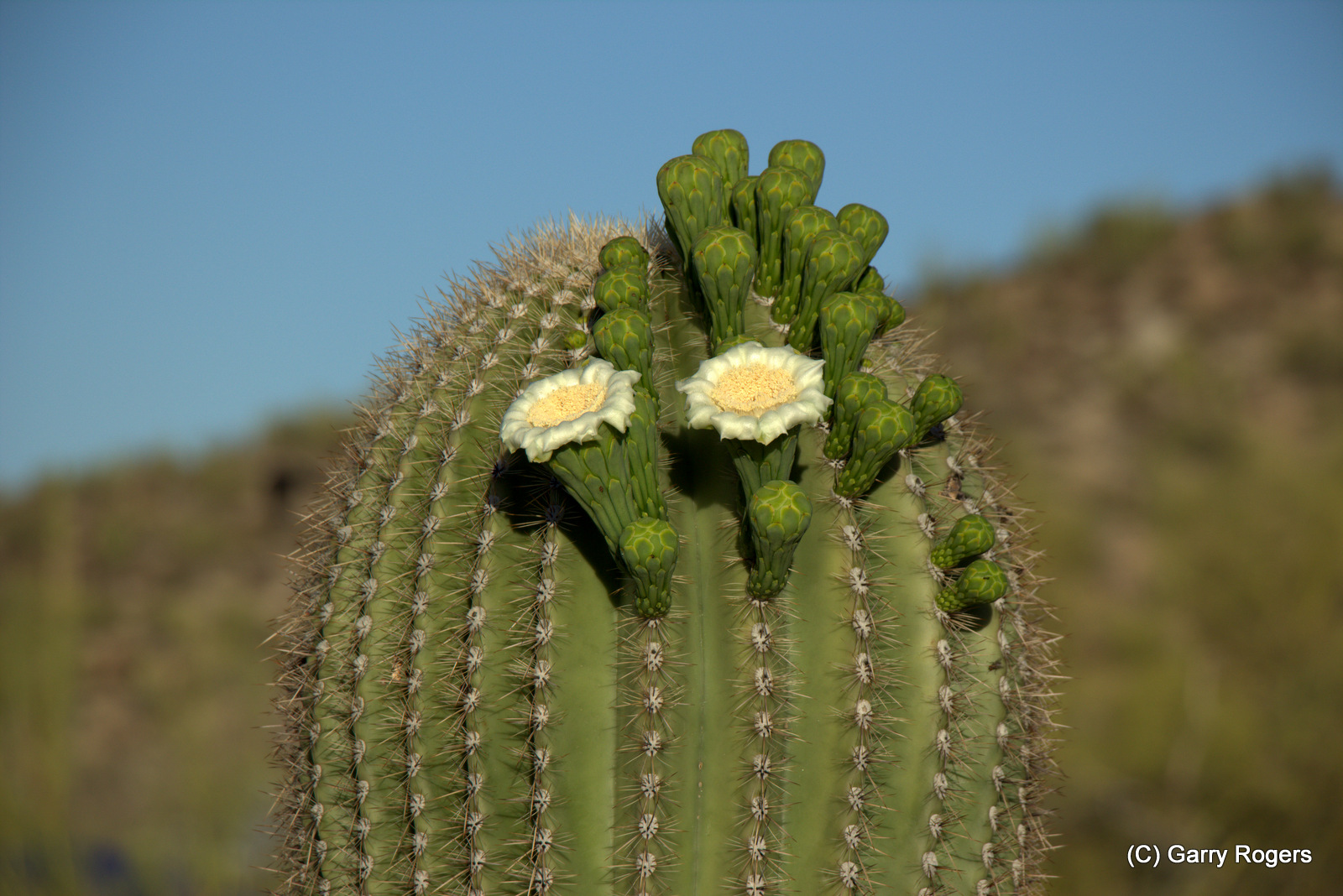
Saguaro, the iconic species of the Sonoran Desert, blooming in April, two months earlier than usual (Rogers, 2016).
Global warming, deforestation, desertification, environmental pollution, and ocean acidification are familiar labels for human-caused destruction of biodiversity and stability of Earth ecosystems. They are all connected to the attempt by our billions of people to satisfy their desires for food, reproduction, safety, and convenience. Allowed uncontrolled expansion, any one of them can achieve planet-wide destruction of biodiversity. Consider that even if this year’s great climate-change treaty achieves a sudden shift to safe energy and stops global warming, it will not save life on Earth. No single-issue approach can.
“It’s unlikely that presidential candidates will ever utter the word “biodiversity” while campaigning this year.
“Yet among emerging environmental challenges, none has fewer facts or more enduring threats than the large-scale loss of biodiversity. That’s why we need a visionary investment in fundamental exploration to create knowledge and options.
“And our elected representatives should lead vigorous discussions about what we can and should do about it. From Jefferson to Kennedy, from the Northwest Territory to the depths of space, presidents of vision have opened new frontiers to exploration.
“Serious environmental problems are a bipartisan challenge that deserves to be in every presidential platform. While scientific questions should be firewalled from politics, what we do with scientific knowledge should not. The best solutions should emerge from the rough and tumble of public debate.
“Biodiversity belongs in our public discussion because we have so much to learn from the Earth’s species – both what it means to be human and the knowledge encapsulated in nature – as we plot our future in a time of great change.”
“This is not the first time that earth has weathered such a mass extinction event. There have been five previously, the most recent occurring 65 million years ago, marked by the disappearance of the great dinosaurs.
“In each case, evolutionary processes have restored high levels of species diversity, but this should give us little comfort. Biodiversity recovery takes place over tens of millions of years. And in the meanwhile, there can be enormously chaotic consequences for ecosystems.
“It’s estimated that 10 million more species could be described or redescribed in greater detail.andreaskay/flickr, CC BY-NC-SA”
“Our knowledge of the species with which we share planet Earth is dangerously limited, meaning that we make decisions and policies in near complete ignorance of basic facts. Our best guess is that there are 10 million living species, more or less, excluding the single-celled bacteria and Archaea.
“Of these, fewer than two million are known to science. And of documented species, most are known by little more than a few diagnostic features and a name. While the rate of species extinction has greatly increased, the pace at which we are exploring species has not.
“In one of the original “big science” ideas, the Swedish naturalist Linnaeus set out in the mid-18th century to complete a global inventory of all the kinds of animals and plants. That inventory continues today, but at an unacceptably slow pace. We discover about 18,000 species each year, a rate unchanged since the 1940s in spite of technological advances.
“This need not be so. Given appropriate technical support and coordinated teamwork, it has been estimated that 10 million species could be described or redescribed in greater detail in no more than 50 years.
“As global environments are stressed, we need reliable knowledge of species diversity upon which to detect and measure changes. Ironically, we have mapped the rocky surface of Mars in greater detail than the living biosphere of our own planet.
“Unless we know what species exist and where, how are we to recognize invasive species, measure rates of extinction or even know whether our conservation strategies are working or not? How are we to understand or restore complex ecosystems when we are ignorant of the majority of their functioning parts? And how much are we willing to risk losing by not undertaking a comprehensive biodiversity moon shot?”
Half the Earth?
“Three major benefits would accrue from a NASA-scale mission to explore the biosphere.
“First would be baseline documentation of the species that exist early in the 21st century, including how they assemble into complex networks in ecosystems. Such baseline data would be transformative for ecology, conservation biology, and resource management, and establish a detailed point of comparison for whatever changes come in the future.
“Second is unleashing the full potential of biomimicry. For 3.8 billion years natural selection has maintained favorable adaptations and weeded out unworkable ones. Among the millions of such adaptations, engineers and innovators can find inspiration for entirely new designs, materials, products and processes.
“The extent to which we succeed creating a truly sustainable future – from renewable energy to degradable materials to cities that function like efficient ecosystems – may well depend on how much knowledge we gather from other species, including those about to go extinct.
“Last, but not least, is knowledge of our origins. Anthropologists continue to fill gaps in our knowledge of the emergence of modern humans, but that is only the most recent chapter in our story. Every attribute that we think of as uniquely human was modified from characteristics of earlier mammals. And features supposedly unique to mammals were similarly modified from even earlier ancestors and so forth, all the way back to the first single-celled species from which the diversity of life around us evolved.
“We can no more understand what it is to be human without exploring this whole history than we could account for why Earth is as it is in the absence of knowledge of the universe.
“We stand a much better chance of slowing the rate of extinction and reducing the percentage of species ultimately lost if we complete a planetary species inventory. And by preserving evidence and knowledge of those species that are lost, we can continue to learn from them.
“New tools, such as those from information science and molecular genetics, can help speed species exploration, but are most powerful when used in combination with detailed descriptive studies of species that reveal their evolutionary novelties.
“E.O. Wilson’s new book, “Half Earth,” proposes that half our planet be reserved for all the other species. His suggestion has unassailable common sense and is perhaps the most workable solution holding promise for millions of other species.
“If we accelerate species exploration, we can add value to “their” half of the world by better understanding and appreciating its residents while finding nature-inspired solutions to sustainably meet our needs in the confines of our half.
“The sooner we act, the greater our chances to avoid a sixth extinction event and preserve nature’s vast library of clues to better ways to meet human needs in an era of rapid global environmental change.”
A short hand-drawn animation created in Adobe Flash and After Effects about one mans reflection on his life. Music by Guided by Voices. From: www.youtube.com
GR: I missed this. In the end, Man gets his just reward from visiting aliens. Nice, but it’s more likely that toxic wastes (including CO2) and all their combined effects on Earth systems will simply choke us to death. Thanks to Peter (pdeppisch, http://entangledreality.blogspot.ca/) for pointing it out.
GR: Carbon storage in soils equates to fertility. Over most of the Earth’s land surfaces, grazing and farming lead to loss of topsoil, the upper soil layer that holds the carbon. It will be very difficult to improve the current wasteful practices since the growing human population is urgently demanding more meat and potatoes. Unlike disaster movies with a positive conclusion, our waste of the soil will lead to a bad ending. Unlike the alien invaders in the movie Independence Day, we humans cannot move on when our resources are exhausted.
Study quantifies climate benefits of sustainable land use
Staff Report
Switching to more sustainable forms of land use management could significantly boost the carbon-storing capacity of the planet’s soils — by up to 8 billion tons of greenhouse gases, scientists reported in a new study. Previous research shows that soils currently lock away around 2.4 trillion tonnes of greenhouse gases, which are stored underground as stable organic matter.
The measures identified by the researchers include growing crops with deeper root systems and using charcoal-based composts. Widespread adoption sustainable land use practices and and application of best available technologies could help soils store up to 80 percent of greenhouse gases released by fossil fuel combustion, the researchers calculated.
We are living in the Anthropocene age, in which human influence on the planet is so profound – and terrifying – it will leave its legacy for millennia. Politicians and scientists have had their say, but how are writers and artists responding to this crisis?
Climate-change projections published by scientists at the Columbia University Earth Institute have shifted from warnings to emergency alarms. The scientists are ringing the emergency bell because of the coming loss of human health and lives. However, the real disaster lies with natural ecosystems. Earth’s webs of life constructed of interacting plants and animals will suffer far greater and more important loses than will human civilization. For one thing, humans can emigrate (if their neighbors let them) from landscapes becoming uninhabitable. Plants and most animals cannot. (If you want a refresher course on climate change, this is an excellent review: Global Warming Basics.)
In addition to the U. S. Southwest:
The tropics and the Middle East in summer are in danger of becoming practically uninhabitable by the end of the century if business-as-usual fossil fuel emissions continue, because wet bulb temperature could approach the level at which the human body is unable to cool itself under even well-ventilated outdoor conditions.[3]—James Hansen and Makiko Sato
The ecosystems of the tropics are the most diverse and complex. Desertification there is an incomprehensible tragedy for the Earth.
“Discussion: We conclude that continued business-as-usual fossil fuel emissions will begin to make low latitudes inhospitable. If accompanied by multi-meter sea level rise,[11] resulting forced migration and economic disruption could be devastating.
The overall message that climate science delivers to society, policymakers, and the public alike is this: we have a global emergency. . . . We argue that country-by-country goals, the approach of the 21st Conference of the Parties[13] cannot lead to rapid phasedown of fossil fuel emissions, as long as fossil fuels are allowed to be the cheapest energy. It will be necessary to include a carbon fee that allows the external costs of fossil fuels to be incorporated in their price. Border duties on products from countries without a carbon fee, would lead to most nations adopting a carbon fee.”–James Hansen and Makiko Sato.
Fossil Fuel CO2 Emissions
(a) Updates of Figure 5 in Hansen and Sato (2001) “Trends of measured climate forcing agents” (also in PDF) and (b)same quantities as in (a) but in linear scale (also in PDF.) [Last modified: 2015/08/07]
Updates of Figure 16 in Hansen (2003), “Can we defuse the global warming time bomb?” [Figure also in PDF. Last modified: 2015/08/08]
[Figure also in PDF. Last modified: 2015/08/08]Data source: Boden, T.A., G. Marland, and R.J. Andres. 2015. Global, Regional, and National Fossil-Fuel CO2 Emissions. Carbon Dioxide Information Analysis Center, Oak Ridge National Laboratory, U.S. Department of Energy, Oak Ridge, Tenn., U.S.A. doi 10.3334/CDIAC/00001_V2015. Digital data are available at CDIAC web pages and used for 1751-2011. BP Statistical Review of World Energy 2015 data are used for extensions to 2014.
Alexander von Humboldt was the most influential man of his age. His contributions helped unify our understanding of nature and how human alterations could lead to dangerous changes. Heads of government, scientists, engineers, artists, and authors were inspired by and consulted with him on a range of topics. Around the world, there are more cities, parks, mountains, and rivers named for Humboldt than anyone else that ever lived.
Dr. Ulloa Ulloa (front, left) and field assistants at the Humboldt statue on Chimborazo in 2009.
Humboldt’s strengths were his curiosity, his tireless desire to record his experiences, his ability to see connections, and his ability to write about objective facts with lyrical prose. He described nature as a web of life, noting and mapping the plant and animal changes with elevation on Mount Chimborazo in Ecuador a century before C. Hart Merriam mapped life zones in central Arizona. He invented isotherms, the lines on maps connecting areas of equal temperatures, and he warned that human destruction of nature was having widespread consequences. He described the drop in stream flow, lake level, and general climate change resulting from cutting forests and diverting streams for monoculture farming. Humboldt influenced and inspired Goethe, Darwin, Hooker, Bolivar, Thoreau, Muir, and many more. Without Humboldt’s books, Darwin might never have gone to sea, South America might have remained a slave-holding Spanish colony for another century, and nature conservation might have lagged even farther behind human alteration of the land.
Humboldt’s zonal flora and fauna map of Chimborazo.
I am delighted to report that my grandson born in October, 2014 bears the name Alexander. Alex’s birthplace is just 15 miles west of my home in Humboldt, AZ.
The essay introduced below provides links to some the books by and about Humboldt. The one by Andrea Wulf is one of my all-time favorite biographical works.
Humboldt and Bonpland’s Essai sur la géographie des plantes and its significance
By: Randy Smith, Image Technician | Metadata Librarian. Peter H. Raven Library, Missouri Botanical Garden
“Over 210 years after Alexander von Humboldt and Aimé Bonpland’s work titled Essai sur la géographie des plantes was published, climate science, book conservation, and botanical research have converged around this 1805 work. This book was digitized and made available in 2008 by the Missouri Botanical Garden for the Biodiversity Heritage Library.
Modern science meets historic data
“In 2015, scientists published a paper detailing their findings as they retraced the path that Humboldt and Bonpland took on their ascent up the dormant volcano, Chimborazo, in Ecuador. The paper, “Strong upslope shifts in Chimborazo’s vegetation over two centuries since Humboldt,” utilized the data and map contained in Essai sur la géographie des plantes and presented modern data from the same locations as detailed in Essai to reveal the effects of climate change on the volcano.
“As Stephen T. Jackson writes in the 2009 book, Essay on the geography of plants, the significance of Humboldt and Bonpland’s work describing their ascent up Chimborazo lies in the detailed data they collected at various elevations. Jackson and historian Andrea Wulf have noted that while most people have forgotten Humboldt, his significance in unifying early scientific disciplines into an inter-connected web of life cannot be understated. Measurements taken on Chimborazo include light intensity, temperature, barometric pressure, and gravitational force. Descriptions of the flora and fauna at various levels of Chimborazo were described and illustrated on the map contained with Essai sur la géographie des plantes.” Continue reading.





 GarryRogers Nature Conservation