Don’t let drought or other severe weather tempt you to feed wildlife

See on Scoop.itGarry Rogers Nature Conservation News (#EcoSciFi)

Feeding often makes things worse, especially when done half-heartedly-
Expect predators to show up-
Perhaps millions of Americans feed the birds, squirrels, feral cats, much larger animals too, such as deer.

See on www.thewildlifenews.com

Legislative Effort to Reduce Drought Impact on California Birds

Step in the Right Direction to Reduce Drought Impact on California Birds

February 19th, 2014 · by Garrison Frost

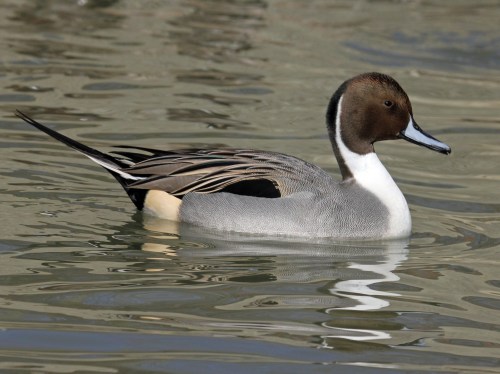
Northern Pintail (Wikimedia Commons)

Northern Pintail (Wikimedia Commons)

<

p>Audubon California today expressed support for new legislation authored by California Senate Leader pro tem Darrell Steinberg and Assembly Speaker John Pérez to address impacts from the California drought. The legislation would allocate about $680 million toward a variety of programs to alleviate the impacts of the drought on communities, farmers and the environment that supports birds.

“California’s drought impacts everyone, and the legislative package announced today represents an effort to offer support to the hardest hit areas,” said Brigid McCormack, executive director of Audubon California. “We’re pleased to see these steps being taken to alleviate the tremendous human toll that the drought is taking on families and the economy, especially in disadvantaged communities. We’re also pleased that the bill considers urgent bird habitat needs – and would certainly like to see more attention paid in this area.”

McCormack noted that while the drought relief package offers a number of short-term solutions, it does not create the same kind of long-term problems created by legislation recently passed out of the House of Representatives. That bill would upend longstanding agreements on water policy, suspend Endangered Species Act protections and roll back the restoration of the San Joaquin River. A subsequent bill out of the Senate showed more promise, and Audubon California is looking forward to working with the authors on that bill.

California’s network of refuges and wildlife areas have been hit particularly hard by the drought and McCormack noted her organization’s interest in seeing more water allocated to these vital habitats for birds.

“Central Valley refuges depend on full allocations of water to support the millions of birds that need them for breeding and migration,” said McCormack. “Congress made a promise to these natural places that it needs to keep.”

About Audubon California
Audubon California is building a better future for California by bringing people together to appreciate, enjoy and protect our spectacular outdoor treasures. With more than 50,000 members in California and an affiliated 48 local Audubon chapters, Audubon California is a field program of the National Audubon Society.

More information is available at http://www.ca.audubon.org.

What the 3 Amigos should really talk about today: monarch butterflies – The Globe and Mail

See on Scoop.itGarry Rogers Nature Conservation News (#EcoSciFi)

Garry Rogers insight:

“Wherever there is injustice, you will find us”

(Ned Nederlander).

See on m.theglobeandmail.com

Developing Grazing Systems

See on Scoop.itGarry Rogers Nature Conservation News (#EcoSciFi)

Restoring the Planet, one Native Plant at a Time! (by Conservation Seeding & Restoration INC)

Garry Rogers insight:

Of course, resource harvest by cows will reduce wildlife numbers and spread invasive weeds.

See on nativeplants.wordpress.com

Mexican Wolves (2) Will be Released in Arizona

 Releases to replace Mexican wolves illegally shot between 2011 and 2013

(from Arizona Game and Fish Department)

The U.S. Fish and Wildlife Service (FWS) and the Arizona Game and Fish Department (AZGFD) have initiated actions for the release of two Mexican wolves in Arizona to replace wolves illegally shot, as directed by the Arizona Game and Fish Commission in 2012 and to increase the genetic diversity of the wild population. Continue reading

Garry Rogers Nature Conservation News

What is the Nature Conservation News?

VultureMy online Scoop.It newspaper, Garry Rogers Nature Conservation News began operating last September.  It presents news stories called scoops.  My scoops are mostly concerned with animals and their interactions with humans.  I sometimes scoop interesting items about writing, and I scoop the rare items of science fiction news that involve stories and books with a nature conservation theme.  This post is a request for your help with scoop suggestions.  (Visit the news). Continue reading

Arizona Wildlife Notebook Second Edition

Arizona Wildlife Notebook Introduction

Base Layer for Notebook Cover

Base Layer for Notebook Cover

The second edition of my “Arizona Wildlife Notebook” will be off to the printer (CreateSpace) as soon as I finish the cover.  This edition has introductions and checklists for 12 groups of Arizona animal species:  Amphibians, ants, bats, birds, butterflies and moths, dragonflies and damselflies, fish, grasshoppers, lizards, mammals, snakes, and turtles.  Groups in bold type are new to the Notebook.  The introduction to each group covers the group’s conservation issues and provides references for printed and online field guides.  The checklist for each group includes scientific and common names and conservation status.  I alphabetized each checklist by scientific name, and I included an index for all the common names. Continue reading

Barn Owl Disaster

Barn Owl Roost Falls

1-P1000076Nine years ago I found a Barn Owl feather lying in the front yard.  Since then I have often seen the owl’s silhouette sitting in trees and sailing silently across the yard.  Four years ago a second feather turned up.  Two years ago, I brushed the spruce tree beside the house and a Barn Owl flapped out.  It perched in a nearby Cottonwood tree and watched nervously while I took the 1-IMG_3088photograph at left.

Last summer a windstorm toppled two of the tall willow trees shading my driveway.  We had seen a Common Barn Owl (Tyto alba) roosting in the thickest tangle of overlapping bra nches between the trees.  It’s been seven months since the trees fell, and I have seen no signs of the owl.
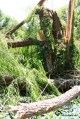
Fallen Trees

About the Barn Owl

Barn OwlBarn Owls are the most widely distributed of all owl species.  They are only absent from Antarctica and the coldest and hottest places elsewhere.  They live on small rodents, and never take anything as large as a house cat or dog.  Barn Owls range from 10″ to 18″ in height.  The one in the picture at left is 15″ from crown to wing tips.  If you have a Barn Owl living nearby, you have probably heard its “shree” call that’s nothing like the hoots and toots of other common owls.

Barn Owls hunt at dusk and during the night.  Though they have excellent nighttime vision, their hearing is so good they can find prey by sound alone.  This lets them detect and capture rodents beneath snow, grass, and brush. The Barn Owl practices elaborate courting and parenting behavior that involves dancing, singing, nest-building and decorating, and surplus food storage.  I recommend the beautifully detailed account of Barn Owl behavior by Anita Albus (2005) .

Barn Owl Benefits

A single Barn Owl family will consume thousands of rodents every year, making the  owl one of the most beneficial predators a farmer can attract.  Rodent control benefits everyone.  We humans are mouse magnets. Our dwellings are like tiny rodent resorts with walls that provide shade and narrow strips of moist soil and vegetation where rainwater collects.  Without owls and other mouse predators, our gardens would become toxic or they would become walled fortresses, and our houses would be besieged in winter by hoards of wild mice looking for a warm bed.

Barn Owl Conservation

Over the past half century, Barn Owls have declined.  Belfries and lofts where owls once nested are now mostly screened and closed (Albus 2005).  The leading causes of the owl decline, however, are the  toxic pesticides in the air, water, and tissues of rodents.  Some people recognize the dangers of pesticides, but heavy use continues in most yards and farms.  The pesticides might do a more thorough job than the owls, but when all the mice and owls are gone, we might find that our produce has lost its flavor.

Barn Owls are nearing extinction in some places (World Owl Trust, Dear Kitty, Doward 2013).  Seven U. S. states recognize the owl is endangered, and this status is spreading.  You might be able to help the owls by developing neighborhood support.  If you can convince your neighbors to drop pesticides, it would be worth your effort to attract a Barn Owl family.   Click here to learn how to invite barn owls to your neighborhood.

Barn Owl References

Albus, A.  2005.  On rare birds.  Lyons Press, Guilford, CN.  276 p.

Arizona Bird Conservation.

Cornell Lab of Ornithology:  http://www.allaboutbirds.org/guide/Barn_Owl/id/ac

Doward, Jamie.  2013.  Battle to save barn owl after freak weather kills thousands.  http://www.theguardian.com/environment/2013/dec/14/barn-owls-threatened-freak-weather

Konig, C., J-H. Becking, F. Weick.  1999.  Owls:  A guide to the owls of the world.  Yale University Press, New Haven, CN.  462 p.

The Owl Pages:  http://www.owlpages.com/owls.php?genus=Tyto&species=alba.

Wikipedia.  http://en.wikipedia.org/wiki/Barn_Owl.
Cooper’s Hawk

Like other predatory birds, this young Cooper’s Hawk, resting near my bird feed station, let me get quite close before leaving to let the Mourning Dove and White-crowned Sparrow flocks return. Continue reading