Climate Impacts From Farming Are Getting Worse | Climate Central

By John Upton.–  “As signs emerge that the global energy sector is beginning to rein in what once had been unbridled levels of climate-changing pollution, new United Nations figures show pollution from farming is continuing to get worse.

“Greenhouse gases released from the growing of crops and livestock directly increased by a little more than 1 percent in 2014, compared with a year prior, the newly updated data shows.

“Burning fossil fuels for energy grew by about half that amount during the same period, research published in December showed, with further reductions anticipated for 2015. That’s seen as a key first step toward achieving the vast pollution reductions needed to start to stabilize the climate.

“Historically, it’s been the opposite — fossil fuel emissions have grown exponentially and agricultural emissions have grown linearly,” said Francesco Tubiello, a team leader in the statistics division of the Food and Agriculture Organization of the United Nations, which compiles the data.

“The new U.N. figures do not include greenhouse gas impacts from deforestation or other clearing of land to make space for farms, which are slowly being reduced overall.”  Continue reading:  Climate Impacts From Farming Are Getting Worse | Climate Central

Save

Save

May Marks 8th Consecutive Record Hot Month in NASA’s Global Temperature Measure | robertscribbler

According to NASA, the world has just experienced another record hot month.

May of 2016 was the warmest May since record keeping began for NASA 136 years ago. It is now the 8th record hot month in a period that has now vastly exceeded all previous measures for global temperature tracking.

The month itself was 0.93 C above NASA’s 1951-1980 baseline measure. It’s the first month since October that readings fell below the 1 C anomaly mark. A range that before 2015 had never before been breached in the 136 year climate record and likely during all of the approximate 12,000 year period that marks the Holocene geological epoch.

It’s a reading that is fully 1.15 C above 1880s averages. A very warm measure in its own right but one that is thankfully somewhat removed from the 1.55 C monthly peak back during February of 2016. To this point, it’s worth noting that hitting 1.5 C above 1880s temps in the annual measure is the first major temperature break that scientists consider to be seriously threatening to human civilization and the life support systems of planet Earth. And we’re getting close to that mark now. However, considering the fact that El Nino is now transitioning toward La Nina, it appears that 2016 averages may peak closer to 1.2 C.

Continue reading: May Marks 8th Consecutive Record Hot Month in NASA’s Global Temperature Measure | robertscribbler

Save

Alpine soils storing up to a third less carbon as summers warm – Carbon Brief

Robert McSweeney, 13.06.2016:  The top metre of the world’s soils contains three times as much carbon as the entire atmosphere. This means that losing carbon from the soil can quicken the pace of human-caused climate warming.

A new paper, published today in Nature Geoscience, finds this is already happening in the forests of the German Alps. Soils there are losing carbon as summer temperatures rise, the researchers say.

In the last three decades, soil carbon across the German Alps has decreased by an average of 14% – and by as much as 32% for certain types of soils.  Source: Alpine soils storing up to a third less carbon as summers warm – Carbon Brief

Save

Carbon dioxide levels in atmosphere forecast to shatter milestone | Environment | The Guardian

Arthur Neslen, Monday 13 June 2016:  Scientists warn that global warming target will be overshot within two decades, as annual concentrations of CO2 set to pass 400 parts per million in 2016

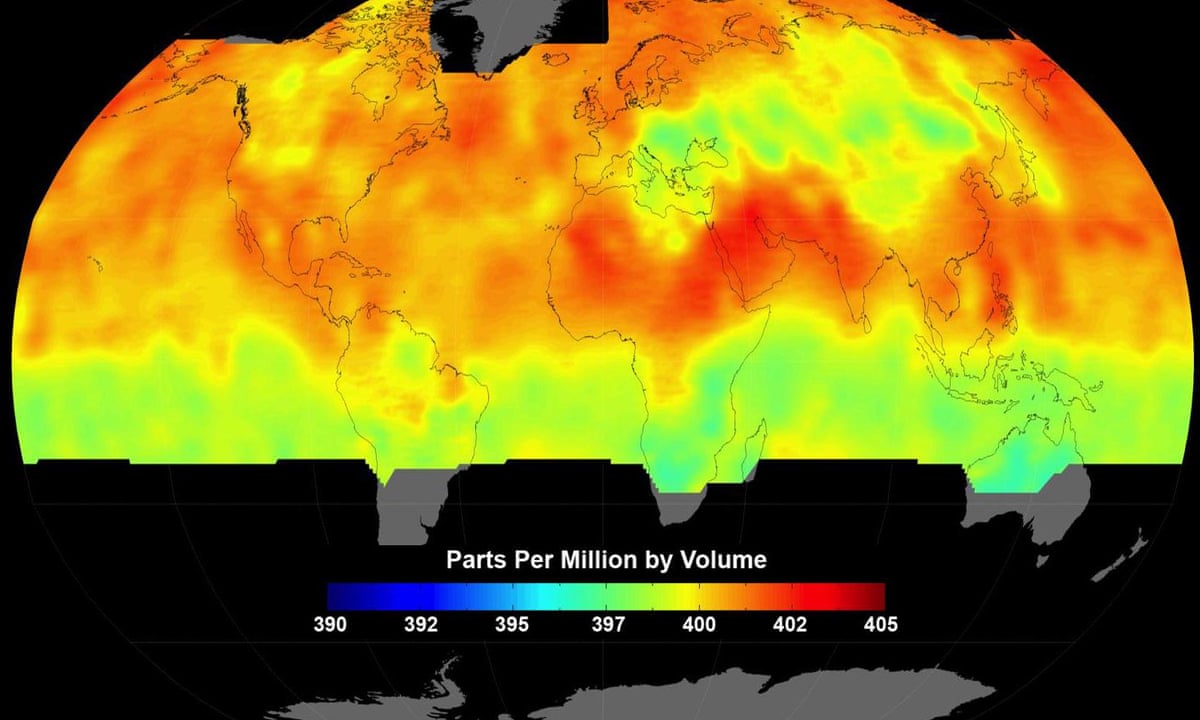
Atmospheric concentrations of CO2 will shatter the symbolic barrier of 400 parts per million (ppm) this year and will not fall below it our in our lifetimes, according to a new Met Office study.

Carbon dioxide measurements at the Mauna Loa observatory in Hawaii are forecast to soar by a record 3.1ppm this year – up from an annual average of 2.1ppm – due in large part to the cyclical El Niño weather event in the Pacific, the paper says.

The surge in CO2 levels will be larger than during the last big El Niño in 1997/98, because manmade emissions have increased by 25% since then, boosting the phenomenon’s strength.

Source: Carbon dioxide levels in atmosphere forecast to shatter milestone | Environment | The Guardian

Save

Alaska is way, way hotter than normal right now ‹ Reader — WordPress.com

Alaska just can’t seem to shake the fever it has been running. This spring was easily the hottest the state has ever recorded and it contributed to a year-to-date temperature that is more than 10 degrees F (5.5 degrees C) above average, according to data released Wednesday by the National Oceanic and Atmospheric Administration.

Source: Alaska is way, way hotter than normal right now ‹ Reader — WordPress.com

Save

Connecting the climate change dots | Summit County Citizens Voice

Pole to pole and across the world’s oceans and mountains, climate change impacts are adding up

By Bob Berwyn:  For any Summit Voice readers not following my Twitter or Facebook feeds, here’s a list of links to my recent stories for InsideClimate News.

Of greatest interest here in the West is a new University of Utah study that projects a dramatic upward shift of the snowline in the Rockies and coastal ranges in California, Oregon and Washington. Less spring snowpack at lower elevations has huge effects on we manage our water, and could also result in more early season wildfires: Unabated Global Warming Threatens West’s Snowpack, Water Supply.

In mid-May I wrote about the latest update to NOAA’s annual greenhouse gas index, which showed that atmospheric CO2 concentration showed its biggest annual increase on record in the past year. The index also showed a surge in Methane, an etremely potent heat-trapping pollutant: Far From Turning a Corner, Global CO2 Emissions Still Accelerating.  Continue reading: Connecting the climate change dots | Summit County Citizens Voice

Save

France to formally ratify Paris climate accord on June 15 – Minister | Reuters

President Francois Hollande will formally sign the Paris climate agreement on Wednesday, June 15, making France the first industrialized nation to ratify the landmark accord, Environment Minister Segolene Royal said on Friday.

France’s Senate adopted a bill authorizing the government to ratify the agreement on Wednesday after a near unanimous vote by the lower house in May, Royal told a carbon pricing forum in Paris.  Source: France to formally ratify Paris climate accord on June 15 – Minister | Reuters

Save

Record Drop in Coal Burning Raises Question — Is Peak Fossil Fuel Use Happening Now? RobertScribbler

Peak oil, gas, and coal.

It’s a possibility that many who believe the fossil fuel industry’s false dependency mantra look at with fear and trembling. Because, for years, that industry, through various public relations efforts, has perpetuated a myth that a loss of access to fossil fuels would ruin the modern global economy. That fossil fuels were so high-quality no other energy source could effectively replace them.

It’s a myth that, in many ways, competes with the threat of human-caused climate change for space in the public’s collective imagination. One that is not without a few valid supports. For the shifting of energy use away from one set of sources and on toward another set is a massive, disruptive undertaking even in the case where the new energy sources are superior to the old.

.. (This is what a real existential threat to global civilization looks like. From the 1880s to the six month cold season of 2015-2016, global temperatures warmed by 1.38 degrees Celsius. At the end of the last ice age, it took about 3,000 years for as much warming to occur as human fossil fuel burning has achieved over just the last 136 years. Dealing with what is a problem of geological scale ramping up with lightning speed will require a necessarily rapid reduction to zero fossil fuel burning over the coming decades. Recent swift curtailments of coal use provide some hope that such a reduction may be possible. But rates of fossil fuel use will have to peak soon and be cut even more swiftly to prevent a very rapidly intensifying global emergency. Image source: NASA GISS.)

Source: robertscribbler | Scribbling for environmental, social and economic justice

Save

Bay Area Voters Approve Tax to Fix Marshes As Seas Rise | Climate Central

GR:  Individuals, not the corporations responsible for the problem are paying this tax.  Hey, Republicans, why not reverse fossil-fuel subsidies and let the fossil-fuel industry’s past profits help pay to clean up polluted air, water, and land?

John Upton:  Voters in the San Francisco Bay Area approved an unprecedented tax Tuesday to help fund an ambitious vision for restoring lost marshlands, handing electoral victory to shorebirds, crabs and advocates of a muddy strategy for adapting to rising seas.

Measure AA is projected to raise an estimated $25 million a year for 20 years. As of Wednesday morning, 69 percent of voters in the nine Bay Area counties supported it, with only a small number of votes left to be counted. The $12 annual tax proposed for each parcel of property owned in the Bay Area needed two thirds of votes to pass.  Read more:  Bay Area Voters Approve Tax to Fix Marshes As Seas Rise | Climate Central

Save