Explore the science and strategy behind preserving Earth’s biodiversity. This section covers critical topics in nature conservation, including habitat restoration, endangered species protection, and the maintenance of biosphere integrity. Read updates on the Biosphere Integrity Metric (BIM), the Refugia Playbook, and other projects dedicated to sustaining the systems that support life on our planet.
Photos and text from: Rob Stott, BuzzFeed News Reporter, Australia
Take a quick look at the Tourism Australia website and social media channels and you’ll find all of the things you’d expect from the Great Barrier Reef: glossy photos of divers, happy turtles, and coral. Lots of coral. But the Australian government has been working hard to make sure you don’t see just how badly damaged by climate change the reef has become.
The Australian government has even been caught trying to censor a UN report.
United Nations leaders say that famed World Heritage sites around the world are facing a significant threat from climate change. Increasing floods, melting glaciers and more wildfires are among the risks cited in a new report from UNESCO’s World Heritage Center.“Globally, we need to better understand, monitor and address climate change threats to World Heritage sites,” said the center’s director, Mechtild Rössler. “As the report’s findings underscore, achieving the Paris Agreement’s goal of limiting global temperature rise to a level well below 2 degrees Celsius is vitally important to protecting our World Heritage for current and future generations.”The report, “World Heritage and Tourism in a Changing Climate” was jointly released by UNESCO, the United Nations Environment Program, and the Union of Concerned Scientists.
Barry is an artist, both with words and with paint. He has been associated with our organization for nearly three decades and is our go-to guy for any wildlife question. He knows his animals — especially birds — and the issues that affect them. His blogs will give you just the tip of his wildlife-knowledge iceberg, so be sure to stay and delve deeper into his Canadian Project articles. If you like wildlife and reading, Barry’s your man. (And we’re happy to have him as part of our team, too!)
Even in the desert, fungi and other soil surface microorganisms are critical to ecosystem stability. They capture moisture and nutrients, block invasive species, and prevent soil erosion. Too bad that most have been destroyed by the hoves of grazing livestock and the movements of people on foot and in vehicles.
A new study helps map the relationships between forests and fungi on a large scale. @bberwyn photo.
New analysis offers important forest health information
Staff Report
Colorful mushrooms that pop up in forests around the world are much more than decorative baubles. Much more than realized, fungi are key components of forest ecosystems, helping to regulate the carbon cycle and driving the nutrient exchange between soil and trees.
New study helps resource managers plan for climate change
Groundwater is a huge factor in assessing climate change impacts on the Colorado River. @bberwyn photo.
Resource managers need as much information as possible about Colorado River flows to make sustainable management decisions.
Staff Report
Resource managers grappling with the vexing question of how to allocate Colorado River water to the thirsty cities, ranches and farms of the Southwest have some new food for thought. A new U.S. Geological Survey study published this week in the journal Water Resources Research shows that more than half the streamflow in Upper Colorado River Basin originates as groundwater.
The information is especially important in the context of how climate change — through increased temperatures and evaporation, as well as changing precipitation patterns — will affect the river. One recent study, for example, showed that warmer spring temperatures are reducing flows independently of winter…
A reduction in the amount of oxygen dissolved in the oceans due to climate change is already discernible in some parts of the world and should be evident across large regions of the oceans between 2030 and 2040. — The National Center for Atmospheric Research in a press release on April 27th.
*****
Loss of oxygen in the world’s oceans. It’s one of those really, really bad effects of a human-forced warming of our world. One of the those climate monsters in the closet that Steve Pacala talks about. The kind of thing we really don’t want to set loose on our world.
Deoxygenated Oceans as Major Killing Mechanism During Hothouse Extinctions
The damage caused by ocean oxygen loss is multi-variant and wide-ranging. The most obvious harm comes in the form of generating environments in which oxygen-dependent life in the oceans can no longer breathe. Any living creature that…
Unaware of the consequences of its behavior, the growing human population is erasing sixty-five million of years of biodiversity recovery since the massive extinction that eliminated dinosaurs and most other species. This is without doubt the greatest issue of our time, perhaps of all time. In the article below, Quentin Wheeler points out that biodiversity is not even being mentioned by our current presidential candidates.
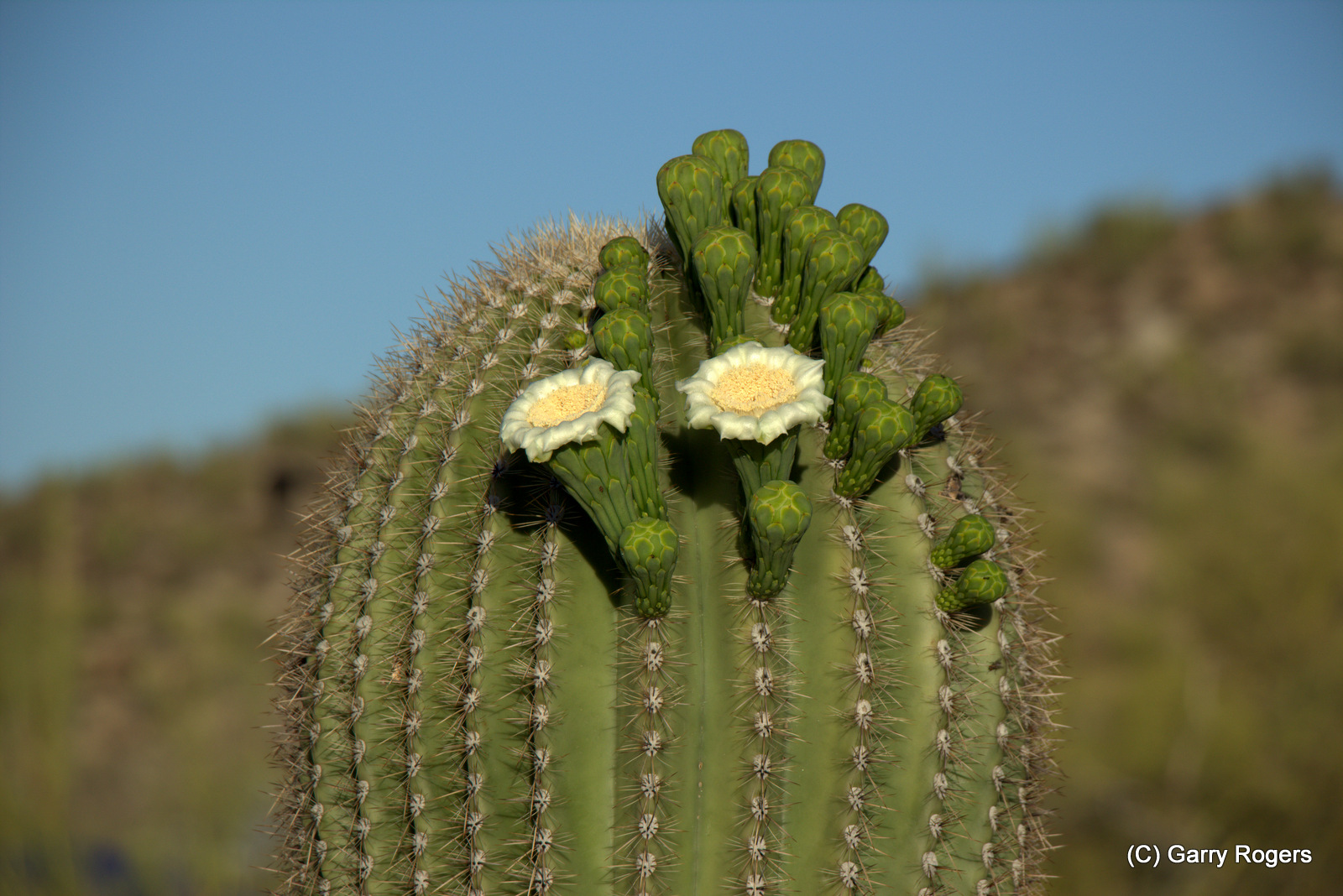
Saguaro, the iconic species of the Sonoran Desert, blooming in April, two months earlier than usual (Rogers, 2016).
Global warming, deforestation, desertification, environmental pollution, and ocean acidification are familiar labels for human-caused destruction of biodiversity and stability of Earth ecosystems. They are all connected to the attempt by our billions of people to satisfy their desires for food, reproduction, safety, and convenience. Allowed uncontrolled expansion, any one of them can achieve planet-wide destruction of biodiversity. Consider that even if this year’s great climate-change treaty achieves a sudden shift to safe energy and stops global warming, it will not save life on Earth. No single-issue approach can.
“It’s unlikely that presidential candidates will ever utter the word “biodiversity” while campaigning this year.
“Yet among emerging environmental challenges, none has fewer facts or more enduring threats than the large-scale loss of biodiversity. That’s why we need a visionary investment in fundamental exploration to create knowledge and options.
“And our elected representatives should lead vigorous discussions about what we can and should do about it. From Jefferson to Kennedy, from the Northwest Territory to the depths of space, presidents of vision have opened new frontiers to exploration.
“Serious environmental problems are a bipartisan challenge that deserves to be in every presidential platform. While scientific questions should be firewalled from politics, what we do with scientific knowledge should not. The best solutions should emerge from the rough and tumble of public debate.
“Biodiversity belongs in our public discussion because we have so much to learn from the Earth’s species – both what it means to be human and the knowledge encapsulated in nature – as we plot our future in a time of great change.”
“This is not the first time that earth has weathered such a mass extinction event. There have been five previously, the most recent occurring 65 million years ago, marked by the disappearance of the great dinosaurs.
“In each case, evolutionary processes have restored high levels of species diversity, but this should give us little comfort. Biodiversity recovery takes place over tens of millions of years. And in the meanwhile, there can be enormously chaotic consequences for ecosystems.
“It’s estimated that 10 million more species could be described or redescribed in greater detail.andreaskay/flickr, CC BY-NC-SA”
“Our knowledge of the species with which we share planet Earth is dangerously limited, meaning that we make decisions and policies in near complete ignorance of basic facts. Our best guess is that there are 10 million living species, more or less, excluding the single-celled bacteria and Archaea.
“Of these, fewer than two million are known to science. And of documented species, most are known by little more than a few diagnostic features and a name. While the rate of species extinction has greatly increased, the pace at which we are exploring species has not.
“In one of the original “big science” ideas, the Swedish naturalist Linnaeus set out in the mid-18th century to complete a global inventory of all the kinds of animals and plants. That inventory continues today, but at an unacceptably slow pace. We discover about 18,000 species each year, a rate unchanged since the 1940s in spite of technological advances.
“This need not be so. Given appropriate technical support and coordinated teamwork, it has been estimated that 10 million species could be described or redescribed in greater detail in no more than 50 years.
“As global environments are stressed, we need reliable knowledge of species diversity upon which to detect and measure changes. Ironically, we have mapped the rocky surface of Mars in greater detail than the living biosphere of our own planet.
“Unless we know what species exist and where, how are we to recognize invasive species, measure rates of extinction or even know whether our conservation strategies are working or not? How are we to understand or restore complex ecosystems when we are ignorant of the majority of their functioning parts? And how much are we willing to risk losing by not undertaking a comprehensive biodiversity moon shot?”
Half the Earth?
“Three major benefits would accrue from a NASA-scale mission to explore the biosphere.
“First would be baseline documentation of the species that exist early in the 21st century, including how they assemble into complex networks in ecosystems. Such baseline data would be transformative for ecology, conservation biology, and resource management, and establish a detailed point of comparison for whatever changes come in the future.
“Second is unleashing the full potential of biomimicry. For 3.8 billion years natural selection has maintained favorable adaptations and weeded out unworkable ones. Among the millions of such adaptations, engineers and innovators can find inspiration for entirely new designs, materials, products and processes.
“The extent to which we succeed creating a truly sustainable future – from renewable energy to degradable materials to cities that function like efficient ecosystems – may well depend on how much knowledge we gather from other species, including those about to go extinct.
“Last, but not least, is knowledge of our origins. Anthropologists continue to fill gaps in our knowledge of the emergence of modern humans, but that is only the most recent chapter in our story. Every attribute that we think of as uniquely human was modified from characteristics of earlier mammals. And features supposedly unique to mammals were similarly modified from even earlier ancestors and so forth, all the way back to the first single-celled species from which the diversity of life around us evolved.
“We can no more understand what it is to be human without exploring this whole history than we could account for why Earth is as it is in the absence of knowledge of the universe.
“We stand a much better chance of slowing the rate of extinction and reducing the percentage of species ultimately lost if we complete a planetary species inventory. And by preserving evidence and knowledge of those species that are lost, we can continue to learn from them.
“New tools, such as those from information science and molecular genetics, can help speed species exploration, but are most powerful when used in combination with detailed descriptive studies of species that reveal their evolutionary novelties.
“E.O. Wilson’s new book, “Half Earth,” proposes that half our planet be reserved for all the other species. His suggestion has unassailable common sense and is perhaps the most workable solution holding promise for millions of other species.
“If we accelerate species exploration, we can add value to “their” half of the world by better understanding and appreciating its residents while finding nature-inspired solutions to sustainably meet our needs in the confines of our half.
“The sooner we act, the greater our chances to avoid a sixth extinction event and preserve nature’s vast library of clues to better ways to meet human needs in an era of rapid global environmental change.”
A short hand-drawn animation created in Adobe Flash and After Effects about one mans reflection on his life. Music by Guided by Voices. From: www.youtube.com
GR: I missed this. In the end, Man gets his just reward from visiting aliens. Nice, but it’s more likely that toxic wastes (including CO2) and all their combined effects on Earth systems will simply choke us to death. Thanks to Peter (pdeppisch, http://entangledreality.blogspot.ca/) for pointing it out.
It’s a hard, tough thing to consider. One of those possibilities people justifiably do not want to talk about. This notion that a creature we’re fond of and familiar with — a glorious living being along with all its near and distant relatives — could be entirely removed from the web of existence here on Earth.
Our aversion to the topic likely stems from our own fear of death. Or worse — the notion that the entire human race might eventually be faced with such an end. But extinction is a threat that we’ll see arising more and more as we force the world to rapidly warm. For species of the world now face existential crisis with increasing frequency as atmospheric and ocean temperatures have risen so fast that a growing number of them have simply become unable to cope with the heat.
 Photos and text from: Rob Stott, BuzzFeed News Reporter, Australia
 Take a quick look at the Tourism Australia website and social media channels and you’ll find all of the things you’d expect from the Great Barrier Reef: glossy photos of divers, happy turtles, and coral. Lots of coral. But the Australian government has been working hard to make sure you don’t see just how badly damaged by climate change the reef has become.
 The Australian government has even been caught trying to censor a UN report.

 © U.S. Department of Agriculture





 GarryRogers Nature Conservation