Deforestation in Mexico butterfly reserve more than triples

In this Jan. 4, 2015 file photo, a kaleidoscope of Monarch butterflies hang from a tree branch, in the Piedra Herrada sanctuary, near Valle de Bravo, Mexico. Illegal logging has almost tripled in the monarch butterfly’s wintering grounds in …more.

“Illegal logging more than tripled in the monarch butterfly’s wintering grounds In central Mexico, reversing several years of steady improvements, investigators announced Tuesday.

“Almost all of the loss occurred in just one rural hamlet in the state of Michoacan. Loggers cut down 47 acres (19 hectares) of trees in San Felipe de los Alzati since last year’s gathering of butterflies. A total of 52 acres (21 hectares) of forest in the reserve were lost overall, including losses due to drought or pests.”

That’s the highest figure since 2009, well above the 20 acres (8 hectares) lost in 2014, according to the announcement by the World Wildlife fund and the Institute of Biology of Mexico’s National Autonomous University. The 2014 loss was about 12 acres (5 hectares) due to logging and 8 acres (3 hectares) to drought.

Sourced through Scoop.it from: phys.org

April 2015 ranks as 4th-warmest on record for Earth

Take note of the cold spot in the North Atlantic. From the movie The Day After Tomorrow: Terry Rapson: “We found something extraordinary… extraordinary and disturbing, that is. You recall what you said in New Delhi about how polar melting might disrupt the North Atlantic Current?”
Jack Hall: “Yes.”
Terry Rapson: “Well… I think it’s happening.”

Bob Berwyn's avatarSummit County Citizens Voice

Year to-date is record warm

sdfg Only a few small areas of the globe were cooler than average in April 2015.

Staff Report

FRISCO — April’s globally averaged temperature was the fourth-warmest on record, at 1.33 degrees Fahrenheit above the 20th century average, according to federal climate trackers releasing the monthly Global State of the Climate update.

View original post 203 more words

Prevent Extinction of Unique Butterfly Species

Target: U.S. Fish and Wildlife Service Director Daniel Ashe
Goal: Protect brilliant unsilvered fritillary butterfly species by declaring it an endangered species
The unsilvered fritillary is a species of butterfly native to California.  Source: forcechange.com

GR:  Please sign the petition.

Butterfly Indicators of Ecosystem Change

Butterfly Canaries in the Earth Ecosystem Coalmine

Two-tailed Swallowtail

Two-tailed Swallowtail

Guest post by Leslie Olsen

Predicting the effects of climate change and other human impacts on Earth ecosystems is a critical goal for policy makers, scientists, and environmentalists. Some effects, such as weather extremes and biodiversity decline are becoming clear to everyone. One group of species, the butterflies, is especially sensitive to environmental change, and scientists are using the group to gauge the effects of the changes on other species.

Like canaries in a coalmine, butterflies can serve as valuable indicators of significant changes. Butterflies are easy to see. Moreover, their metabolism and short life span make their numbers an especially sensitive gauge of environmental changes. When a butterfly population falls, other species may follow. Fluctuations in temperature patterns, temperature extremes, droughts, floods, and severe storms affect butterfly populations throughout North America. Studies on the impact of climate changes on insects and butterflies are particularly rare, but recent data and observations are spurring research.

Changes in butterfly emergence, range, life cycle, feeding habits and diversity can indicate harmful environmental changes are occurring. For example, butterfly life cycle stages are tied to the availability of certain plants; even subtle changes in plant species abundance is reflected in butterfly health, color, and number. The animals and birds dependent on butterfly populations are directly affected.

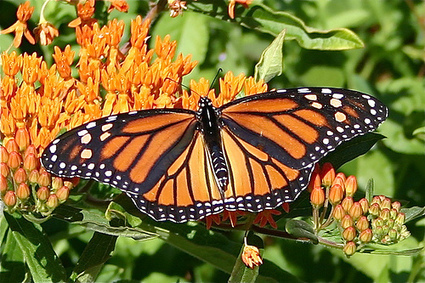
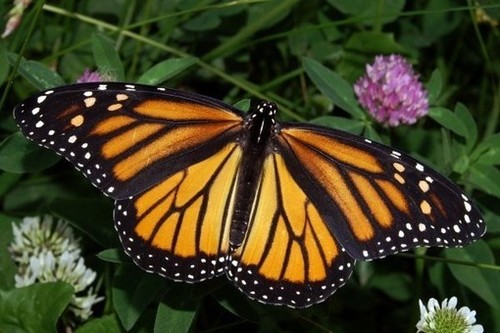
Monarch (Danaus Plexippus)

Monarch (Danaus Plexippus)

A familiar butterfly, the Monarch, migrates almost three thousand miles every year and has suddenly declined because of pesticides (first two references below) and forest thinning in its winter home territory in Mexico.

Another butterfly, the Poweshiek skipperling, once plentiful across the Canadian prairies had declined to fewer than 200 individuals, most of them in Manitoba (Toronto Star).
Last year, the United States Fish and Wildlife Service announced the extinction of two butterfly species, the Zestos skipper and the Rockland grass skipper.

Researchers from the University of British Columbia, the Université de Sherbrooke and the University of Ottawa, in a study of more than 200 species of butterflies and weather data from 130 years “found butterflies possess widespread temperature sensitivity, with flight season occurring an average of 2.4 days earlier per degree Celsius of temperature increase” (UBC. 2013).

Heather Kharouba, lead author noted that butterflies “provide an early warning signal for how other wildlife may respond to climate change” (UBC). The impact of warmer temperatures causes butterflies “to emerge and start their active flight season earlier in the year, and if they emerge too early, they could encounter frost and die. Or they might emerge before the food plants they rely on appear and starve” (Ibid).

As more researchers begin studying butterflies, the links to other species and whole ecosystems will become clearer and will help guide nature conservation plans and policies.  Thus, our floating jewels not only add grace and beauty to our lands, they are on the front line of our battle to save Earth’s wildlife and ecosystems.

Butterfly References

The WWFs report on the shockingly rapid decline in wildlife should surely move us to action | Michelle Nijhuis

We must all take responsibility for combating climate change.

Source: www.theguardian.com

GR:  This will not happen. First, the few that profit from the industries causing the problems feel insulated and protected from the consequences.  Second, the governments and political leaders hope the wealthy will give them enough of the wealth to achieve the same protection.

Tell USDA and President Obama to Stop Dow Chemical’s “Agent Orange” Crops

Stop Dow Chemical’s “Agent Orange” Crops

Over a hundred million additional pounds of toxic pesticides associated with cancers and birth defects are coming to a field near you. UNLESS YOU STOP IT!
“Agent Orange” crops are genetically engineered by Dow Chemical to promote the use of 2,4-D, one of the herbicides in the toxic mixture Vietnam veteran’s know as Agent Orange. The U.S. Department of Agriculture (USDA) is on the cusp of approval, even though they acknowledge the use of this toxic pesticide will skyrocket.
There is a 30-day public comment period and it MIGHT BE OUR LAST CHANCE to stop this chemical assault – Sign the petition today!

GR:  The dangers of pesticides are pervasive and worth repeating. Weed managers spray millions of gallons of pesticides on crops, along roads, and in parks. The U. S. Bureau of Land Management uses pesticides throughout the public lands of the 17 western U. S. states. The farm upstream from my home has weed-free zones that are probably maintained by pesticides. Bees serving as pollinators on the farm catch a full dose. Bees in yards and gardens downstream from the farm receive small doses that washed off the farm into the stream and into the groundwater. When home gardeners respond to the massive pesticide marketing efforts and use pesticides around their homes, they easily reach lethal levels.


Habitat loss in U.S. blamed for decline of monarch butterflies

The principal cause of the shrinking population of monarch butterflies is loss of habitat in their U.S. breeding grounds, scientists say in a study published in the Journal of Animal Ecology.

Planting milkweed in the south and central United States would provide the largest immediate benefit,”

Read or download the article here (free).

See on latino.foxnews.com

As monarch butterflies plummet, it’s time to rethink the widespread use of weed killers

Today NRDC is calling on EPA to re-examine the widespread use of glyphosate, commonly called Roundup, in light of its impacts on monarch butterflies.  Glyphosate was last approved by EPA in 1993 before the adoption of genetically modified crops that…

See on switchboard.nrdc.org

Monarch Butterfly conservation is in the news. AMAZING MATILDA is too!

READ ALL ABOUT IT! Award-winning Monarch Butterfly Picture Book ‘AMAZING MATILDA’ teaches life lessons Monarch Butterfly conservation is in the news. AMAZING MATILDA is too! Her storyline and illus…

See on 4writersandreaders.com