 Paula Kahumbu: A global alliance to end wildlife crime is within reach. Let’s start talking about how it can be made to work
Source: Together we can end wildlife crime | Environment | The Guardian
Paula Kahumbu: A global alliance to end wildlife crime is within reach. Let’s start talking about how it can be made to work
Source: Together we can end wildlife crime | Environment | The Guardian
 Indonesia’s national bird, the Javan hawk-eagle, is among 13 species threatened by illegal trade, warns a wildlife watchdog
Source: Indonesian birds face extinction due to pet trade – study | Environment | The Guardian
 Whether you live in the Sunshine State or are just visiting, as sea turtle nesting season hits Florida’s beaches, make sure you know what to do to keep these creatures safe.
Source: Spring Means Nesting Sea Turtles – Defenders of Wildlife Blog

Wolverine. By Robert Carleton.
GR: The pointless killing of this special individual from a rare species indicates just how total is our threat to nature.
M56 never made it to the silver screen, but he fascinated millions, trekking hundreds of miles and bringing much-needed attention to the plight of wolverines.
Source: The Other Wolverine Who Rivaled X-Men for Fame – Defenders of Wildlife Blog
“His movements were first recorded in Wyoming in 2008. He took off in 2009, heading south for hundreds of miles. He traveled across inhospitable lands looking for a place he might fit in and finally settled in Colorado. He wandered around Colorado for years, then headed north once again, possibly up to Montana. He trekked east across flat lands and found himself in North Dakota.
“This is no tale of a wandering, fugitive human, following some wanderlust or trying to find a job. This is M56. He’s a wolverine, the largest (and arguably the toughest) member of the weasel family. These fearless scavengers are incredible — they can drive grizzly bears and wolves away from carcasses, and have been documented climbing 5,000 vertical feet in the middle of winter in less than two hours. M56 was an ambassador for his species, captivating the entire state of Colorado with hope of a reestablished wolverine population, and inspiring all who learned of his immense travels and ability to traverse unlikely habitat. Sadly, wolverine M56’s remarkable life and unbelievable journey ended a few weeks ago near Alexander, North Dakota, where he was killed by a ranch hand who didn’t recognize what M56 was and thought he could threaten livestock.”
 “There are species going extinct today that have never been described,” Plotnick said. “Others are going extinct that are known only because someone wrote it down.” All such species would thus be unknown in the far future, he said, if the written historical record is lost — as it might well be.
The fossil record, Plotnick points out, is much more durable than any human record.
“As humanity has evolved, our methods of recording information have become ever more ephemeral,” he said. “Clay tablets last longer than books. And who today can read an 8-inch floppy?” he shrugged. “If we put everything on electronic media, will those records exist in a million years? The fossils will.”
Other authors on the study, published earlier this month in Ecology Letters, are Felisa A. Smith of the University of New Mexico and S. Kathleen Lyons of the National Museum of Natural History in Washington, D.C.
Media Contact:
Bill Burton
312-996-2269
burton@uic.edu
From: news.uic.edu
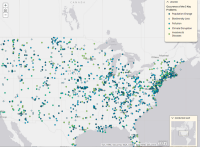
News Stories about global change.
“These six examples illustrate that there is no one-size-fits all approach for researchers to address today’s grand environmental challenges, but two common themes emerge. The first is that it is no longer enough to simply do the science and publish an academic paper; that is a necessary first step, but moves only halfway towards the goal of guiding the planet towards a future that is sustainable for both human civilization and the biosphere. To implement knowledge that arises from basic research, it is necessary to establish dialogues and collaborations that transcend narrow academic specialties, and bridge between academia, industry, the policy community and society in general. The second theme is that now is the time to rise to these scientific and communication challenges. The trajectories of population overgrowth, climate change, ecosystem loss, extinctions, disease, and environmental contamination have been rapidly accelerating over the past half-century. If not arrested within the next decade, their momentum may prevent us from stopping them short of disaster.” From: elementascience.org
Excellent post. The attrition of open space, wildlife, and natural ecosystems occurs slowly and quietly. Without vigilance and unrelenting effort, the attrition is unstoppable. Always, the urge to obtain immediate convenience or profit obscures the potential long-term consequences of our actions. Learning to take the long-term view is essential for managers of natural systems.
The grizzly bears that inhabit the Greater Yellowstone Ecosystem have played an important role in one of the nation’s greatest endangered species success stories. Since 1975, the bears have been beneficiaries of the Endangered Species Act that enabled the grizzly population to beat all odds after teetering on the brink of extinction. It grew from 136 bears in 1975 to around 700 in 2016, although estimates range from 674 to 839.
On March 3, 2016, the United States Fish and Wildlife Service announced its proposal to delist the Yellowstone area grizzlies, which includes Grizzly 399, from the federal threatened species list. It is expected to make a final decision by the end of 2016.
50,000
The number of grizzly bears that roamed between the Pacific Ocean and the Great Plains during Lewis and Clark Expedition, 200 years ago.
674-839
The approximate number of grizzly bears in…
View original post 150 more words
Survival of most species on Earth depends on balanced ecosystems. The balance will be achieved only when humans learn to respect other species. Respect isn’t compatible with killing.


PHOTO COURTESY OF BING IMAGES
Perhaps this otter is asking God to save humans from themselves
Despite its euphemistic title, the Sportsmen’s Heritage and Recreational Enhancement (SHARE) Act (H.R. 2406) represents a clear assault on wildlife both at home and abroad.” ~ Animal Welfare Institute
The Animal Welfare Institute issued an alert this past week: “Urge Your Representative to Protect Wildlife and Vote No on H.R. 2406.” This deadly bill has been passed by the House of Representatives.Its sister Senate bill, S. 405, can be stopped by an overwhelming public outcry now. It will be voted on by the entire Senate soon, although the date has not been disclosed.
Madravenspeak wrote against the “Bipartisan Sportsmen’s Act” of the same intent in 2014, and before that in 2012. Please examine these repeat efforts closely, as they defile our last peaceful refuges for intact living ecosystems and quiet hiking and reflection.
View original post 810 more words

BILLINGS, Mont. (AP) — “Environmental groups sued Thursday to force the Obama administration to impose more restrictions on oil and gas drilling, grazing and other activities blamed for the decline of greater sage grouse across the American West.
“A sweeping sage grouse conservation effort that the government announced last September is riddled with loopholes and will not be enough to protect the bird from extinction, according to the lawsuit filed in U.S. District Court in Idaho.
“It follows several legal challenges against the same rules from the opposite end of the political spectrum. Mining companies, ranchers and officials in Utah, Idaho and Nevada argue that the administration’s actions will impede economic development.
“The ground-dwelling sage grouse, known for their elaborate mating ritual, range across a 257,000-square-mile region spanning 11 states. From: bigstory.ap.org
GR: Once again, private funding is required to force a public agency to do its job. Human land use has already damaged much of the sage grouse habitat. This lawsuit is particularly important, because protecting the bird’s full range will protect the remnants of habitat needed by it and many other species.
One of the first human land uses that will have to end is cattle grazing. More lawsuits paid by private citizens will likely be required, but destructive grazing has already diminished the carrying capacity of the land so much that the number of cattle has declined substantially. Wildlife has declined even more. The reduced cattle production will dampen the desires of the livestock industry and their public government officials to fight to retain the right to continue the destruction. One day, sage grouse and other members of its ecosystem might be safe at home on the range.


 GarryRogers Nature Conservation