Wildfire critical in calculating carbon-payback time for biomass energy projects

Accounting for wildfire is essential in achieving an accurate and realistic calculation of the carbon payback period associated with converting forest biomass into energy, according to a new study.

Source: phys.org

GR:  It seems to me that there are some hidden assumptions that make the results questionable.  Perhaps the biggest IF is whether or not thinning to reduce fire danger is occurring.  Thinning is often a prelude to tree harvest.  IF it is, then the payback period would be increased by thinning.

Chilean Wildfires Ravage Rare Species

Chilean Wildfires Ravage Rare Species
Huge firestorms raging across parts of drought-stricken southern Chile have “wiped out” hundreds of rare plant species and threatened wildlife as well, according to environmental advocates.

Source: elispiritweaver.wordpress.com

The article points out that much more is spent on fighter jets than on protecting the country’s natural heritage.  In almost every country, our intraspecific wars and fears of war get much more attention and resources than do our wild plants and animals.  We have such small brains.

Australia: Of droughts and flooding rains

“MY COUNTRY”, a famed poem by Dorothea Mackellar, is known to generations of Australian schoolchildren. They will know by heart the stanza I love a sunburnt…

Source: www.economist.com

A report by the Commonwealth Scientific and Industrial Research Organisation (CSIRO) and the Bureau of Meteorology project that most parts of Australia will become hotter and dryer.  Soils will degrade, fires will increase, drought will continue, and floods will become more common.  Meanwhile, prime minister Abbot says it’s all normal, and coal burning should continue.

Wildlife and Fire in Australia and Shrinking Polar Sea Ice

Humans helping other species always seems like good behavior.  In the second part of this post dealing with polar bears, it seems that humans are harming other species.

Eli Spiritweaver's avatarEarth Report

South Australia Wildfires Kill and Injure Many Animals

Some of South Australia’s worst wildfires in 30 years killed or injured an untold number of animals earlier this month in addition to destroying at least 32 human homes and sending 100 people to hospitals.

Many surviving animals have been left without food, water or access to shelter.

Among the more heartbreaking images to come out of the firestorms near Adelaide were photos of koalas being treated for burnt paws.

The head of one animal rescue organization said that when caught in a wildfire, koalas “get to a point where they are in so much pain … they just sit at the bottom of a tree and scream.”

A public appeal for people to make mittens for the burnt marsupials was quickly heeded.

Most of the rescued koalas are expected to recover enough to be returned to the wild.

Ew150116c

Polar Bears Head…

View original post 170 more words

Even in restored forests, extreme weather strongly influences wildfire’s impacts

The 2013 Rim Fire, the largest wildland fire ever recorded in the Sierra Nevada region, is still fresh in the minds of Californians, as is the urgent need to bring forests back to a more resilient condition.

Source: phys.org

GR:  We have hypothesized for many years that fire is a natural, even a necessary, part of stable forests/shrublands.  But here we have a test that falsifies the hypothesis.  Perhaps we shouldn’t apply a single hypothesis to spatiotemporally complex forests and fires.

Why aren’t there more tests?  Should we be checking on the results of controlled and accidental fires to see if the results match our predictions?

The Brink of Mass Extinction

March through June 2014 were the hottest on record globally. While a single extreme weather event is not proof of anthropogenic climate disruption, the increasing intensity and frequency of these events is.

Source: www.truth-out.org

GR:  Excellent review of news on effects and responses to anthropogenic climate disruption (ACD).  Covers Earth, water, air, fire, and denial.

Global Warming and Fire

Northern Canada is On Fire, And It’s Making Global Warming Worse For the past few weeks, dry and warm weather have fueled large forest fires across Canada’s remote Northwest Territories. The extent of those fires is well above average for the year to-date, and is in line with climate trends of more fires burning in the northern reaches of the globe.

Of the 186 wildfires in the Northwest Territories to-date this year, 156 of them are currently burning. That includes the Birch Creek Fire complex, which stretches over 250,000 acres.

The amount of acres burned in the Northwest Territories is six times greater than the 25-year average to-date according to data from the Canadian Interagency Forest Fire Center.

Boreal forests like those in the Northwest Ter..

Source: elispiritweaver.wordpress.com

GR:  Increasing fire occurrence means that a site is more likely to be burned a second time before the vegetation can recover.  This quickly leads to a reduction in diversity and stability.

Arctic Wildfires In Winter: Norway Experiences Freakish Historic Wildfires In January

See on Scoop.itGarry Rogers Nature Conservation News (#EcoSciFi)

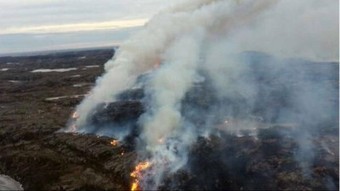
(Flatanger Fire during the long winter night in Norway. Image source: NRK) Major wildfires in California in winter are bad enough… Unfortunately, now we must include the Arctic to the anomalous t…

See on robertscribbler.wordpress.com

For Arizona and New Mexico, Climate Change Produces Winter Fires

See on Scoop.itGarry Rogers Nature Conservation News (#EcoSciFi)

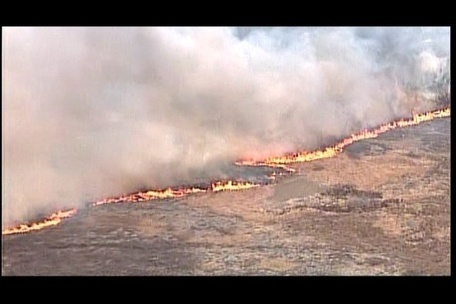
(500 acre wildfire burns near Isleta in New Mexico on February 19th. Image source: KOAT) It’s late winter in Arizona and New Mexico. Or at least that’s what the calendar says. During this time of y…

Garry Rogers insight:

Drought alone can increase fire frequency and size.  In AZ and NM, the continuing increase of fine fuel from alien weeds adds to the drought impact. 

See on robertscribbler.wordpress.com