Generation Anthropocene: How humans have altered the planet for ever

We are living in the Anthropocene age, in which human influence on the planet is so profound – and terrifying – it will leave its legacy for millennia. Politicians and scientists have had their say, but how are writers and artists responding to this crisis?

From: www.theguardian.com

Human Hothouse Spurs Longest Coral Die-Off on Record

It’s like a bad dream from which one cannot wake.

robertscribbler's avatarrobertscribbler

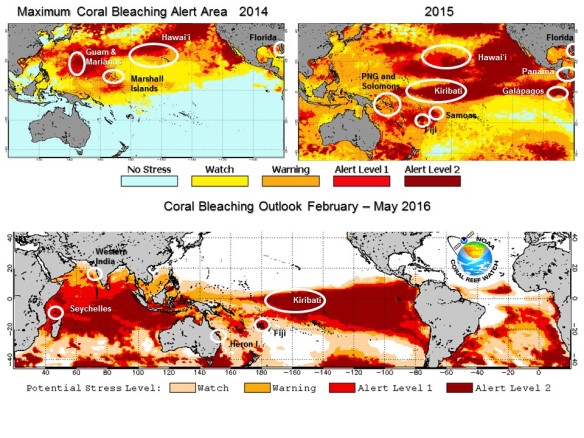
The big coral die-off began in the Western Pacific as a massive ocean temperature spike built up during 2014. Back then, ocean heat accumulation had hit a very high ramp. A vicious, century-and-a-half long increase in atmospheric greenhouse gasses re-radiated greater and greater portions of the sun’s energy hitting the Earth — transferring the bulk (about 90 percent) to the world ocean system.

Major Coral Bleaching Event

(A report out today from AGU finds that the world is now experiencing its longest coral die-off event on record. Image source: AGU.)

By 2015, as one of the strongest El Ninos on record began to extend its influence across the globe, a broad region stretching from the Western Pacific, through the Central Pacific and on into the Eastern Pacific and Caribbean were all experiencing mass coral die-offs. Into early 2016, die-off events again expanded taking in Australian waters and sections of the Indian Ocean off…

View original post 784 more words

NOVA documentary examines declining Krill populations in the Southern Ocean (VIDEO)

GR: I think that now we are going to start hearing more stories about failing ocean productivity. They appear so vast, but Earth’s oceans are no match for Homo sapiens.

Antarctic Krill_(Euphausia_superba)

Antarctic Krill (Euphausia superba)

Robert A. Vella's avatarThe Secular Jurist

By Robert A. Vella

Krill are small invertebrate shrimp-like crustaceans no bigger than your little finger.  They feed primarily on phytoplankton (i.e. bacterial algae, or cyanobacteria) which bloom in huge numbers particularly in the Southern Ocean waters surrounding Antarctica during summertime.  Together, these organisms form the productive base of a food-chain ecosystem of great diversity and importance.  Many species of whales, seals, penguins and other birds, as well as other marine life in the Antarctic and beyond, are dependent upon the krill for their survival.

But, this ecosystem is beginning to falter and krill populations – along with their predators – are in decline.  The cause appears to be climate change which is shortening the duration of the winter sea ice season that is crucial for the krill’s survival when its phytoplankton food supply isn’t blooming.

Watch the 1 hour video here, from PBS/NOVAMystery Beneath the Ice

View original post 139 more words

Climate study suggests rapid warming ahead for New England coastal waters

“Temperature surge likely to have dramatic impacts on aquatic life

“There may be more trouble ahead for New England-based fishermen, as a new NOAA study shows that ocean temperatures along the U.S. Northeast Shelf are projected to warm twice as fast as previously projected and almost three times faster than the global average. The findings are based on a complex analysis of several different climate models.”  summitcountyvoice.com

GR:  To counter attacks by the energy industry, climate scientists have been cautious with their projections.  They have avoided emphasizing worst-case possibilities. They have not thrown down their gloves and insisted that planners prepare for the worst. Consequently, continuing investigations keep turning up inarguable facts that conditions will be worse than projected. Like this one.

Climate: Extreme Greenland Ice Sheet melting episodes change runoff regime

“When warm temperatures in 2012 caused an extreme melting episode across much of the Greenland Ice Sheet, it may have fundamentally altered the way the near-surface snow layers absorb water, according to a new study published in Nature Climate Change.
“The melting resulted in the formation of a thick layer of ice atop the previously porous surface. Subsequently, meltwater ran off the surface and to the ocean, with potential impacts on sea level, according to York University Professor William Colgan.
“Because the models scientists use to project Greenland’s sea level rise contribution do not presently take firn cap-off into consideration, it means that Greenland’s projected sea level rise due to meltwater runoff is likely higher than previously predicted. Getting this newly observed physical process into these models is an important next step for the team.”  from: summitcountyvoice.com

GR:  This helps explain the rapid formation of the cold pool of water in the North Atlantic (https://garryrogers.com/2015/03/24/whats-going-on-in-the-north-atlantic/).


Demonstrate for an End to Global Warming

Climate-change demonstrations show our leaders that we want them to take steps to stop global warming. We must also ask our leaders to change the human activities that are causing climate change.

  1. We want them to block corporate control over our government and the decisions it makes.
  2. We want them to end international sales of weapons and begin to encourage peace and a focus on life style and resource use.
  3. We want them to discourage unsustainable resource harvests.
  4. We want them to encourage human rights and equality.
  5. We want them to speak out for wild animals and natural ecosystems.
  6. We want them to call for restoring the damaged lands and seas.
  7. And finally, we want them to oppose gender inequality and overpopulation.

Even if we stopped burning fossil fuels today, activities causing climate change would continue. Farming, deforestation, industrial fishing, desertification, construction, and growth of the human population would continue to waste the Earth and release CO2 and other greenhouse gases.

822e6515-ef8b-4ba3-840b-8d4921eca1b6.jpg

e867c623-988a-4361-ae66-a2bc07c7ba96.jpg

A Solution to Criminal Overfishing Comes Closer

The odds that American consumers will be able to go into a store and buy fish that’s safe and legally caught have begun to improve, perhaps dramatically, over the past week. At the same time, a new report from the World Wildlife Fund illustrates just how bad the situation has become: It estimates that 86 percent of global fisheries are now at high or moderate risk of pirate fishing.

The official term is IUU, for Illegal, Unreported, and Unregulated fisheries, and it means that those glistening imported fillets in your local market are highly likely to have been harvested in the wrong place or with the wrong methods. They may not even be the species advertised on the label. Or they could be contaminated with antibiotics, other drugs, or toxic chemicals used in some countries in farming or processing fish.

From: strangebehaviors.wordpress.com

GR:  Though stopping illegal fishing will guarantee safe seafood for some people for a while, the long-term outlook for most of the fish we eat is not good.  We only protect a small portion of the world’s oceans, and massive fish harvests with huge bycatch are continuing nonstop.  Already half our fish are gone, and projections are for increasing demand from our growing population.

Nature News Digests

GarryRogersNature News Digests:

We Need to Stop Eating the Oceans

from: Yana Rusinovich and Paul Watson

“For centuries, the oceans have fed humanity. But in the last century, humans has destroyed oceanic ecosystems with an ecological ignorance that is insane.

“The fisherman has now become one of the most ecologically destructive occupations on the planet. It’s time to put aside the outdated image of the hardy, independent, and hard-working fisherman working courageously to feed society and support his family.
No longer does the typical fishermen go to sea in dories with lines and small nets. Today’s industrial fishermen operate multi-million dollar vessels equipped with complex and expensive technological gear designed to hunt down and catch every fish they can find.

“One manufacturer of electronic fish locators (Rayethon) even boasts that with their product, “the fish can run but they can’t hide.
And for the fish, there is no safe place as poachers hunt them down mercilessly, even in marine reserves and sanctuaries.”  Read more at: exposingthebiggame.wordpress.com

GR:  We must also stop dumping our wastes in the ocean.  But most of all, we need to stop producing the CO2 that is raising ocean acidity.

See on Scoop.itGarryRogers NatCon News

Posted in Uncategorized | Tagged