More International Pressure On Wildlife Crime

GR:  Does anyone else feel that the poaching problem is growing worse?

[IPS] Quito -A surge in wildlife crime is fueling criminal syndicates, perpetuating terrorism, and resulting in the loss of major revenues from tourism and industries dependent on iconic species while also endangering the livelihoods of the rural…

Source: allafrica.com


World governments failing Earth’s ecosystems, says top conservationist


“Julia Marton-Lefèvre, director general of the IUCN, says political leaders have not properly embraced conservation.

“In its last update in 2012, the IUCN said the world’s protected areas have increased in number by 58% and in extent by 48%. However, only one in four of these protected areas are managed properly and half the world’s most important sites for biodiversity still have no protection.

“An IUCN report released this month says it would cost between US$45bn and US$76bn each year to adequately manage these protected areas. This figure equates to about 2.5% of global annual military expenditure.”

Source: , www.theguardian.com

GR:  No news here, but the Guardian’s wide reach might catch the attention of a few more people and help us edge closer to popular consensus.  Of course, some might say that the only edge here is the one we are sending our fellow creatures over.

Join the Global March for Elephants and Rhinos

If we can’t save these iconic creatures, imagine how likely we will fail to protect all the smaller species.

Oppose the Lawful Ivory Protection Act of 2014

Help Ban Ivory Sales throughout the U. S.

The Obama Administration’s announcement that it would ban ivory imports and sales in the U. S. was a big step on the way to protecting elephants.  Now, six months later, poachers have killed 15,000 more elephants, and the ban is still not in place,

Wildlife Conservation Society:  “Interest groups that value ivory sales over elephants’ lives have launched an all-out effort to weaken or eliminate any and all ivory bans. Right now there are bills in both the House and Senate that would not only kill a federal ban on ivory sales, but could effectively roll back any state efforts to ban ivory, including the recently enacted New Jersey State ivory ban.

“Each day we spend fighting these attacks means another 96 elephants are senselessly slaughtered. Tell your members of Congress to stand firm against any and all attacks on the federal ivory ban.”

U. S. Citizens go here to send the letter:

Celebrate World Elephant Day With 5 Great Organizations

GR:  Here are some elephant conservation organizations you can visit to show support.

“August 12 is World Elephant Day, which means it’s a great time to recognize the many ways elephants are important. After all, elephants are known as a “keystone species,” meaning that plants, other animals, and even ecosystems depend on them. Elephants help plants by spreading their seeds in their droppings. Even their footprints matter — when it rains, those huge prints become water troughs for other animals to drink from.”

Source: lifeorlunch.wordpress.com


14 Pgymy Elephants Poisoned in Malaysia! Let’s Remember that on World Elephant Day

It is World Elephant Day. Here are some things to do: http://bit.ly/1l07wcb.

gettingonmysoapbox's avatargettingonmysoapbox

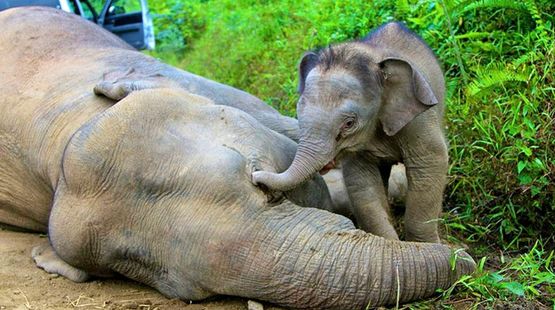
THIS IS ABOUT THE SADDEST PHOTO I’VE EVER SEEN (AGAIN)

A baby elephant standing over the body of its dead mother, touching her head with its trunk

OK, I’m not sure about this “news.”  But it IS World Elephant Day.

The below doesn’t say WHEN these 14 elephants were poisoned or whether it was recent.  Over a year?  In a week?  In history?  But it does say they were FOUND over a period of about a month.  Nevertheless, it deserves a post and yet more public shaming against the Malaysian palm oil industry, which is a huge user of green-washing.   I DO believe this is an OLD picture, though.  Perhaps from March 2014.

At any rate, Malaysia and Indonesia MUST STOP ILLEGAL and NON-SUSTAINABLE PALM OIL.  And their officials must stop being a part of turning a blind eye to the graft, corruption and illegality that makes such murderous tactics happen.

It was a shocking sight for the rangers of the Gunung Rara Forest Reserve: a baby elephant trying in…

View original post 268 more words

5 Ways to Celebrate World Elephant Day

Please sign the petitions listed below.

Yesterday, August 12, was #WorldElephantDay. It’s an annual event that brings the world together to help elephants. Here’s a few simple ways YOU can get involved! #GoGrey – show your friends and family you are committed to saving elephants by changing your profile picture to a grey elephant. It’s a simple, and effective, way to spread elephant awareness with your social media friends and followers. Use one of the photos for your profile (just drag and drop or right click to “Save As…”).

Source: elephantopia.org

Please sign these petitions:

Wildlife photographer, Paul Goldstein makes an impassioned plea to the public about elephant conservation – using his majestic photo album

More than 20,000 elephants were killed on the continent last year for their ivory tusks – which earn a fortune as they are traded illegally in China and south-east Asia.

Their tragic situation has led British wildlife photographer, Paul Goldstein, to make an impassioned plea to the public about elephant conservation – using his majestic photo album, taken over 25 years of watching the animals.

Source: theboldcorsicanflame.wordpress.com

GR:  The photo slide show is great.

But what are we going to do?  Taking an animal’s life for food or for a small body part is common human behavior.  This makes it difficult to enlist local protection for endangered wildlife.  There are examples of local people fighting to protect their land. The motivation is usually fear of change, or economic self-interest blended with appreciation for the land.  There must be cases where the fight was purely out of love for the animals, but I don’t know this.  Anyway, such cases are too rare to reverse the great extinction that is underway.

Perhaps the answer to elephant, pangolin, rhino, tiger, and wolf protection is to relocate people who care to the places of need.  Just as Peace Corps volunteers go to help the people, Wildlife Corps volunteers could go to help the animals.  Social and political problems would be huge, but not insoluble.
Desperate Times, Desperate Measures in Battle to Save Rhinos

“The latest development from Kruger National Park is the possibility of moving approximately 500 rhino in an effort to stop the slaughter. Although no details are confirmed with this massive relocation, there is speculation that Botswana may be one of the destinations.

“Botswana is one of a few countries who have adopted the controversial shoot-to-kill policy in answer to relentless poaching.  …the policy appears to deter poaching.”

Read more on shoot-to-kill policies: fightforrhinos.com

GR:  We must hope that a possible escalation by poachers can be suppressed by the game rangers.