 I am sitting in a large meeting room at Pretoria University in South Africa at a conference to discuss the trade in rhino horn. Expecting a fierce debate pitting conservationists against hunters and traders, instead I find myself confronting my own impotence against the most horrific poaching of rhinos. What is happening in South Africa is truly in a league of its own.
I already knew that over 1000 rhino are being poached each year in South Africa. But these were just statistics. The fact that it was happening in a far away country made me feel that this was not my problem. Besides, those are white rhinos, the South African species that is still relatively numerous. In Kenya we are mostly concerned about our own species, the critically endangered black rhino.
In short I had many reasons and excuses to not engage with this ‘South African’ problem. Now I am seeing the photos of heartbreaking suffering that poachers are inflicting on rhinos. Faces hacked open, blood saturated soil.
Then, just when I think I am getting used to the images, the videos start flowing.
 In one, an animal, barely recognisable as a rhino because its head is just a bloody pulp, moves and tries to get up. I cover my face, then turn to watch, tears streaming down my face. The pain I feel in every cell of my body can not be a fraction of what this once beautiful animal was experiencing.
I look around the room of 50 or so participants, rhino owners, conservationists, scientists, veterinarians, hunters. Every face is a mask of horror and despair.
The rhino without a face tries to walk.His front left leg is broken and he stumbles and snorts in pain, it is a high pitched squeak that sends bubbles of blood out of the hole that was his horn.
He struggles painfully, in circles, he can’t see the bush he stumbles into because his eyes are gone, cut out by the poachers. I can’t bear it and have to rush to the bathroom to cry. In the hall there is not a dry face in sight.
The vet and wildlife campaigner Johan Marais showed us these photos and videos to illustrate how some poached rhinos can be rescued, their horrendous wounds will eventually close if careful care is given.
It will take months, maybe a year. What is left is a strange deformed creature, with a sad expression, and most of its face missing. It will be scarred for life; the horns will never grow back again. Marais’s work is heroic; rhinos’ lives are saved, but at what cost?
Ironically I was at the conference called by the organization Outraged SA Citizens Against Poaching (OSCAP) to discuss the South African government’s proposal to sell rhino horn.
The Department of Environmental Affairs says it has done the maths. South Africa has 20,000 white rhino and their horns can be ‘harvested’ sustainably, without killing the animals. Selling rhino horn will generate the funds needed to support rhino conservation.
Whether wildlife conservation is really the motivation for this proposal – rather than simply making money – is open to question. The South African government did not even bother to send a delegation to the major inter-governmental conference on illegal wildlife trade in London this February.
Moreover, South Africa has form as a trader of products from endangered species. In 2000 the government put forward a similar proposal for the sale of ivory.
It argued that the country’s good management of elephant populations should be rewarded. CITES approved the sale of ivory by four southern African countries first to Japan and then, in 2008, to China.
Just as conservationists at the time had warned, that sale triggered a massive demand in China and Southeast Asia leading to uncontrolled poaching that is currently decimating elephant populations across Africa. Now South Africa wants to sell rhino horn. This proposal is utterly outrageous. Here are three reasons why.
First, legalising sales will simply make life easier for the organized crime cartels that already control the trade in rhino horn.
In 1968, South Africa began allowing sport hunting of rhino, once again ostensibly to raise funds for conservation. Trophy hunting arouses strong emotions. Some conservationists, including the US Fish and Wildlife Service, argue that controlled hunting can play a role in protecting species and ecosystems.
Others despise the rich white males who need to kill big animals to demonstrate their masculinity, and are outraged at the idea of them coming to Africa to do it. Nevertheless trophy hunting does generate a lot of money and this has motivated some land owners to breed rhinos.
But the fact is that, of the 200 South African rhino hunts in 2013, only 15 were genuine hunts. The rest were rhinos shot by mostly Vietnamese ‘pseudo hunters’, who pay for the privilege of trophy hunting but have no intention of ever mounting their trophy on a wall.
The economics are simple: the cost of hunting is about US $20,000, but the 3.5 kg horn is worth many times more when ground up into a fine dust, for sale as a ‘medicinal’ product. Current prices are estimated at up to US $75,000 per kg.
The scam is widely prevalent and has been exposed as highly organized crime by investigative journalist Julian Rademeyer in his best-selling book ‘Killing for Profit’.
He tells how the Vietnamese cartels operate, how they subvert justice, how powerful they are, and how helpless rhino owners are against this foe. Owning rhinos has become a liability: it attracts criminals to your property.
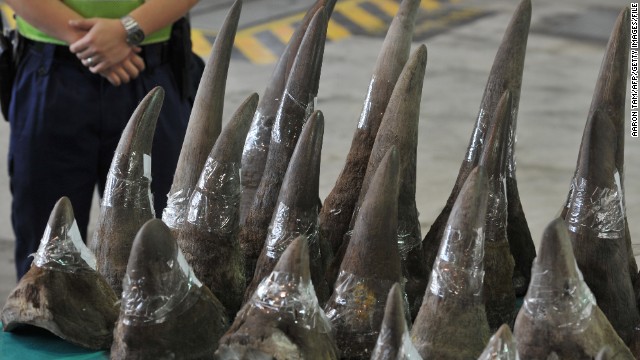
At present, trade in rhino horns is illegal. The proposal to allow legal trade will simply open the floodgates to allow millions of dollars of poached rhino horn – indistinguishable from the ‘legal’ product’ – onto the market.
Exactly the same happened when ivory trade was legalised at the start of the century, initiating a catastrophic decline in elephant populations across the continent.
Secondly, the idea that regulated trade in rhino horn will work as a strategy against poaching is preposterous. According to a study supporting the South African proposal, existing ‘demand’ could be met by moving 2000 adult rhinoceros – 10% of the wild population – to fenced enclosures covering a total of 400,000 ha. These a poor animals would then have their horns ‘humanely’ removed once every two years over their lifespan of 35 to 50 years.
But in reality there is no way that the supply from farmed rhino could come remotely close to meeting the demand, which is growing exponentially as consumers in the principal markets in Southeast Asia become richer.
Anyway, the criminal cartels that control the trade have no reason to buy expensive ‘farmed’ rhino, when they could just as easily poach it, or help themselves to more of the dwindling wild population in poorly protected national parks. Violence is deeply entrenched in the traffickers operations and they have no interest in the conservation of the species.
In the short term, the rarer rhinos become, the more prices will rise. Then, when rhinos are extinct, the traffickers will move on and invest their profits somewhere else. Their business model is an apocalyptic vision of asset stripping on a grand scale.
Finally, from an ethical standpoint, what is worst about this proposal is that it is based on peddling a lie. In Southeast Asia, rhino horns have been used in traditional medicine for centuries.
It is now known that rhino horns have no medicinal value at all; chemically they are indistinguishable from horses’ hooves and human toenails. But Vietnamese traffickers are fuelling demand by marketing new ‘benefits’ of rhino horn, as an aphrodisiac or a cure for hangovers, or cancer.
This is quack medicine. A mandarin-speaking colleague of mine recently got into conversation with a Chinese visitor to Kenya and asked him about the purpose of his visit. “I’ve come to get rhino horn,” the man replied. “My daughter is dying and the doctor says that rhino horn is the only thing that can save her.” By allowing rhino horn to be marketed, African nations would be complicit in this kind of cruel deception.
After the conference, shocked, deeply saddened, traumatized, paralysed, and numb, I returned to Nairobi and lay in bed thinking for two days. Then on Monday, I awoke to another beautiful dawn over Nairobi Park, home of black and white rhino, which poachers already have their eyes on. We cannot allow our leaders to be complicit in the desecration of our continent. My message to the South African government is simple: for God’s sake, stop before it is too late.
Paula Kahumbu is the executive director of WildlifeDirect.

 Richard Girling’s tale of an elusive burrowing mammal turns into a compelling study of humankind’s devastating cruelty to animals. In 1964, in Jowhar, Somalia, zoologist Alberto Simonetta stumbled on a disused bakery oven in which barn owls had made…



 GarryRogers Nature Conservation