Three Certainties: Death, Taxes, and a Warming Planet | Climate Denial Crock of the Week

GR:  Lost habitat and wildlife are not even included in the costs.

Take what you want and pay for it, says God. – Spanish Proverb

Peter Sinclair.–As the damages from a changing climate mount up in areas from Texas to Miami Beach, citizens of Planet Earth will be faced with greater and greater damages from coastal flooding, extreme storms, and other signals of a warming planet.While a favorite climate denier talking point is to rail against sensible taxes on fossil fuels, its an illusion to think we are not already paying the costs – in damage to infrastructure, homes, agriculture, health, and economic activity. A sober view of what we face in the real world is unfashionable in the Trumpiverse, but some communities will go ahead and face it anyway.  Continue reading:  Three Certainties: Death, Taxes, and a Warming Planet | Climate Denial Crock of the Week

Save

robertscribbler | Scribbling for environmental, social and economic justice

GR:  Impacts of declining monsoon rainfall will extend beyond India. As mentioned in the comments on this post, emigration will grow to become a gigantic problem as India’s 1.4 billion residents respond to food shortages.  Decreasing life span and emigration will help with the country’s massive population problem, but not the way anyone would want.


“It has been observed that since 2001, places in northern India, especially in Rajasthan, are witnessing a rising temperature trend every year. The main reason is the excessive … emission of carbon dioxide.” — Laxman Singh Rathore, the director general of the India Meteorological Department.


The reduction in India’s monsoon rains is a big deal. It generates systemic drought, creates a prevalence for heatwaves, and locally amplifies the impacts of human-caused climate change. For three years now, the Indian monsoon has been delayed. India is experiencing its worst heatwaves ever recorded and water shortages across the country are growing dire. The monsoonal rains are coming, again late. And people across India — residents as well as weather and climate experts — are beginning to wonder if the endemic drought and heat stress will ever end.

Historically, there was only one climate condition known to bring about a delay in India’s Monsoon — El Nino. And last year, a strong El Nino is thought to have contributed both to the Monsoon’s late arrival and to a very severe drought that is now gripping the state. What the 2015 El Nino cannot also account for is the 2014 delay and weakening of monsoonal rains. And during 2016, as India’s monsoon has again been held back by 1-2 weeks, and El Nino is now but a memory, it’s beginning to become quite clear that there’s something else involved in the weakening of India’s annual rains.

Source: robertscribbler | Scribbling for environmental, social and economic justice

Save

Connecting the climate change dots | Summit County Citizens Voice

Pole to pole and across the world’s oceans and mountains, climate change impacts are adding up

By Bob Berwyn:  For any Summit Voice readers not following my Twitter or Facebook feeds, here’s a list of links to my recent stories for InsideClimate News.

Of greatest interest here in the West is a new University of Utah study that projects a dramatic upward shift of the snowline in the Rockies and coastal ranges in California, Oregon and Washington. Less spring snowpack at lower elevations has huge effects on we manage our water, and could also result in more early season wildfires: Unabated Global Warming Threatens West’s Snowpack, Water Supply.

In mid-May I wrote about the latest update to NOAA’s annual greenhouse gas index, which showed that atmospheric CO2 concentration showed its biggest annual increase on record in the past year. The index also showed a surge in Methane, an etremely potent heat-trapping pollutant: Far From Turning a Corner, Global CO2 Emissions Still Accelerating.  Continue reading: Connecting the climate change dots | Summit County Citizens Voice

Save

The past week in Australian nuclear news

GR:  Here’s an opportunity to add your voice to the conversation on climate, nuclear power, and nature conservation.

Christina Macpherson:  With 3 weeks to go until the federal election, watching the performance of our major parties is a pretty unedifying sight. If I hear the words “Jobs and Growth” one more time, I will do an Elvis Presley, and throw a tomahawk at the TV set. (Did Elvis really do that? But I digress) Today PM Turnbull mouthed a few motherhood statements about climate, but no policy there. Labor is better, with a promising renewable energy policy. (Of course, neither are breathing a word about Australia importing nuclear waste. Nor is Nick Xenophon, the rising star who might hold the balance of power after the election) ) The Greens have an economically sound renewable energy plan.

I have emailed all Labor MPs, Senators and Candidates, asking each if they want to hold to Labor’s strong anti-nuclear policy, which bars importing nuclear waste, or if they would agree to change it. Few replies, so far, and most replies simply dodge the question Australians! You could send your own or use the sample at the end of this email. Contact details for Australian politicians and candidates are here.

On the State scene, South Australian Labor Premier Weatherill and Liberal Opposition Leader Steven Marshall are off together for a little nuclear lovefest in Finland, to look at Finland’s (not yet operative) nuclear waste repository.

The planned South Australian high level nuclear waste one will need to be up to 28 times the size of Finland’s. That’s around 112 square kms or 5,500 Adelaide ovals, 400 metres underground – and that’s not taking into consideration the 470,000 m3 of low and intermediate level nuclear waste.  Source: The past week in nuclear news « Antinuclear

Save

France to formally ratify Paris climate accord on June 15 – Minister | Reuters

President Francois Hollande will formally sign the Paris climate agreement on Wednesday, June 15, making France the first industrialized nation to ratify the landmark accord, Environment Minister Segolene Royal said on Friday.

France’s Senate adopted a bill authorizing the government to ratify the agreement on Wednesday after a near unanimous vote by the lower house in May, Royal told a carbon pricing forum in Paris.  Source: France to formally ratify Paris climate accord on June 15 – Minister | Reuters

Save

The Great Barrier Reef and the subtle power of ‘psychological distance’

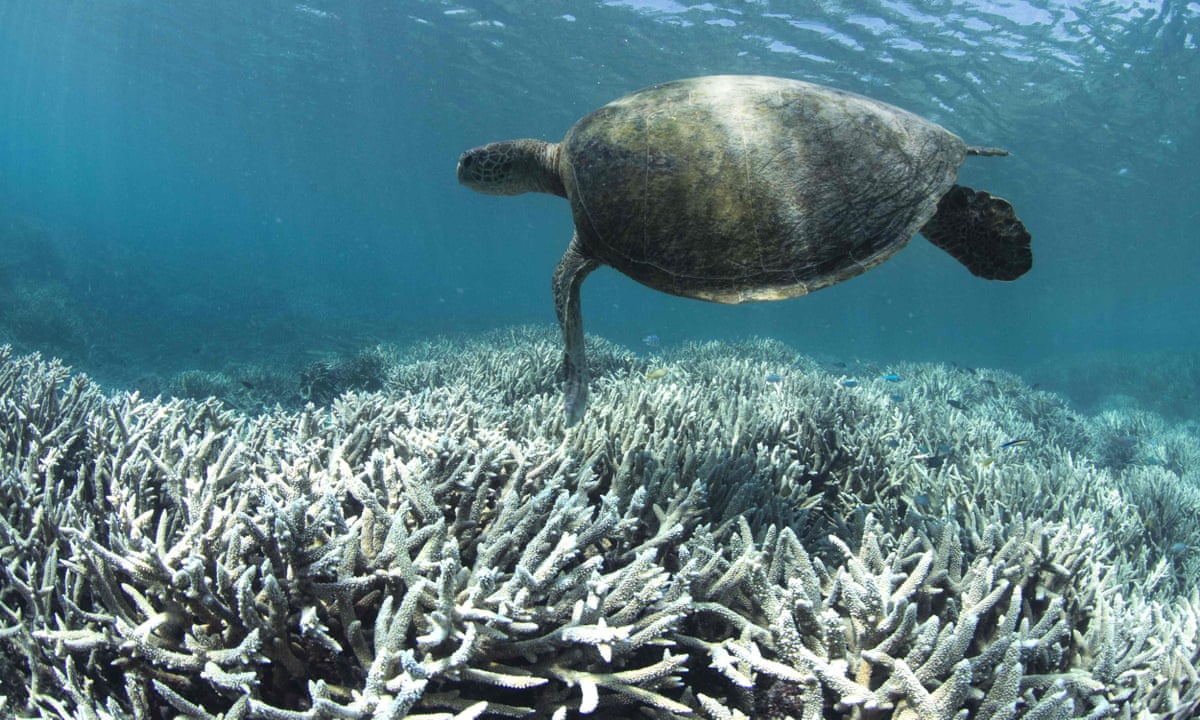
This photo released on 20 April, 2016 by XL Catlin Seaview Survey shows a turtle swimming over bleached coral at Heron Island on the Great Barrier Reef. Photograph: STR/AFP/Getty Images

Don HIne.–If the federal government wants Australians to ignore the Great Barrier Reef as it dies beside us, it has done a masterful job by scrubbing all mentions of the reef from the latest UN climate change report.

The government’s actions have been described as Soviet in style and intent but the political thuggery pales compared to the activation of a subtler and more powerful effect known as psychological distance.

Psychological distance is a construct that measures the “distance” of an event or object in terms of geography, time, cultural similarity and factual certainty. If something is nearby, likely to occur soon, involves people like you, and the facts are certain, that “something” is considered psychologically close. The closer it is, the more likely you are to perceive it as concrete and be willing and able to act on it.  Continue:  The Great Barrier Reef and the subtle power of ‘psychological distance’ | Don Hine | Australia news | The Guardian

Save

Australian researchers call for more coastal monitoring in the face of expected climate change impacts

Bob Berwyn–June storms highlight impacts of rising seas, shifting storm patterns.

Just after the Australian government announced massive cuts to the country’s science agency, researchers are warning that there’s more of a need than ever to track climate change impacts.

A series of recent storms that lashed Australia’s east coast are reminder that rising sea level presents a growing threat to coastal communities, according scientists with the University of New South Wales.

“The damage we’ve seen is a harbinger of what’s to come,” said Ian Turner, director of the Water Research Laboratory at the University of New South Wales. “Climate change is not only raising the oceans and threatening foreshores, but making our coastlines much more vulnerable to storm damage. What are king high tides today will be the norm within decades.”  Continue.– Australian researchers call for more coastal monitoring in the face of expected climate change impacts | Summit County Citizens Voice

Save

Record Drop in Coal Burning Raises Question — Is Peak Fossil Fuel Use Happening Now? RobertScribbler

Peak oil, gas, and coal.

It’s a possibility that many who believe the fossil fuel industry’s false dependency mantra look at with fear and trembling. Because, for years, that industry, through various public relations efforts, has perpetuated a myth that a loss of access to fossil fuels would ruin the modern global economy. That fossil fuels were so high-quality no other energy source could effectively replace them.

It’s a myth that, in many ways, competes with the threat of human-caused climate change for space in the public’s collective imagination. One that is not without a few valid supports. For the shifting of energy use away from one set of sources and on toward another set is a massive, disruptive undertaking even in the case where the new energy sources are superior to the old.

.. (This is what a real existential threat to global civilization looks like. From the 1880s to the six month cold season of 2015-2016, global temperatures warmed by 1.38 degrees Celsius. At the end of the last ice age, it took about 3,000 years for as much warming to occur as human fossil fuel burning has achieved over just the last 136 years. Dealing with what is a problem of geological scale ramping up with lightning speed will require a necessarily rapid reduction to zero fossil fuel burning over the coming decades. Recent swift curtailments of coal use provide some hope that such a reduction may be possible. But rates of fossil fuel use will have to peak soon and be cut even more swiftly to prevent a very rapidly intensifying global emergency. Image source: NASA GISS.)

Source: robertscribbler | Scribbling for environmental, social and economic justice

Save

Scientists Turn Carbon Dioxide Emissions to Stone | Climate Central

GR:  Carbon collects on basalt at the surface in just a few years, so why not underground.  Of course, the drilling and pumping might be as problematic as fracking.  Moreover, we have to be careful that the fossil fuel industry doesn’t see this as an excuse to continue destructive mining and burning.

Chemical engineer Magnus Thor Arnarson, Columbia University hydrologist Martin Stute and CarbFix project manager Edda Sif Aradottir inspect the CarbFix site, where carbon dioxide is injected 2,000 meters underground. Credit: Columbia University

By Bobby Magill–For the first time, carbon dioxide emissions from an electric power plant have been captured, pumped underground and solidified — the first step toward safe carbon capture and storage, according to a paper published Thursday in the journal Science.“This opens another door for getting rid of carbon dioxide or storing carbon dioxide in the subsurface that really wasn’t seen as a serious alternative in the past,” said study co-author Martin Stute, a hydrologist at the Lamont-Doherty Earth Observatory at Columbia University in New York.

Source: Scientists Turn Carbon Dioxide Emissions to Stone | Climate Central

Save