Exciting Update in Youth v. U.S. Climate Case

Our Children’s Trust is pleased to report that U.S. District Court Judge Ann Aiken scheduled oral argument in our youths’ landmark federal climate lawsuit for September 13, at 10 am in Eugene, Oregon. The 21 youth plaintiffs are excited for the opportunity to appear in court again and have their arguments presented to Judge Aiken, who will be reviewing U.S. Magistrate Judge Coffin’s April ruling in their favor.

We will be working hard to prepare for September 13 and we will update you this summer with more hearing details. We encourage you to mark your calendars in the event you are able to join us in Eugene for what will be a truly momentous day!  Source: Exciting Update in Youth v. U.S. Climate Case

Save

How Austrailia’s Great Barrier Reef got polluted – from farms and fossil fuels to filthy propaganda | Graham Readfearn | Environment | The Guardian

GR:  This is the best discussion of the cause of coral death in Australia’s Great Barrier Reef I’ve seen–it’s people.
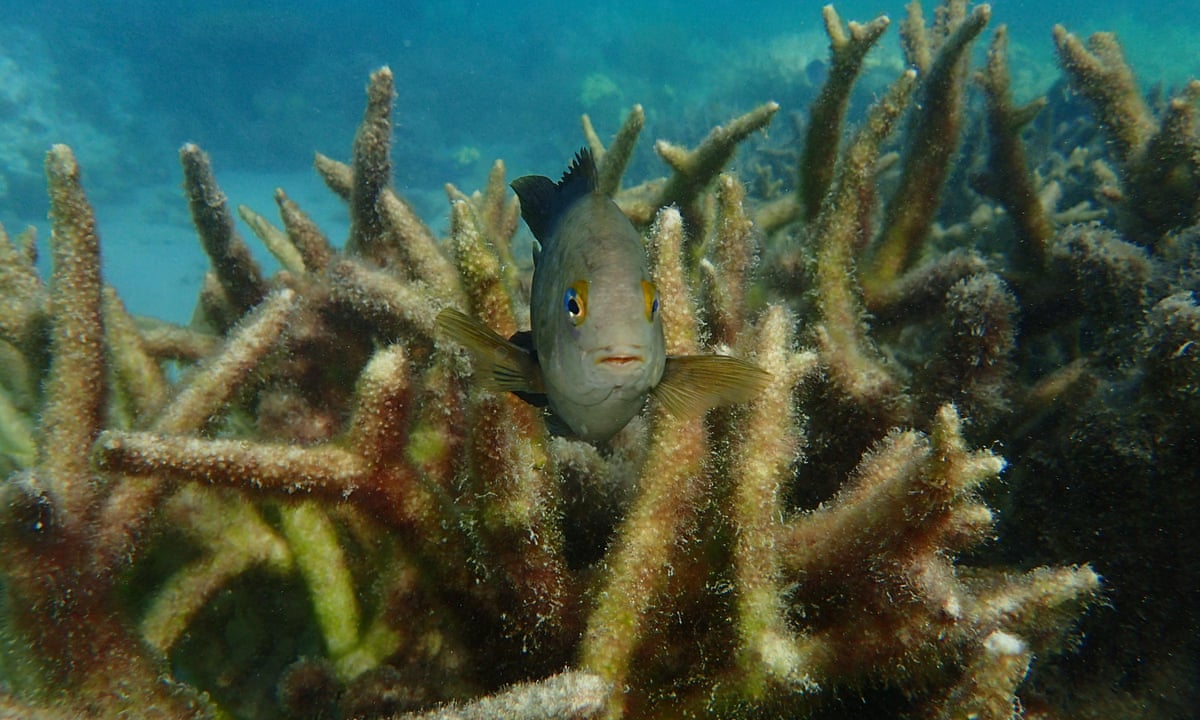
Coral bleaching at Loomis Reef, off Lizard Island, Great Barrier Reef, Australia. Photograph: Essential Median

Graham Readfearn:  In late November 2015, as corals across the northern section of the Great Barrier Reef started to bleach white, the game was finally up.

For years, Australians had been told the country’s jewel in the ocean’s crown was on the mend. Only months earlier the Coalition government had won a two-year fight to keep the reef off a United Nations list of world heritage sites in danger.

The stakes were high. International reputations and tourist dollars were at stake. The foreign minister, Julie Bishop, and the trade minister, Andrew Robb, had even attacked Barack Obama, who feared for the reef’s future.

The reef was not in danger, Bishop insisted. The president was misinformed, claimed Robb.

Conservative commentators hanging around News Corp media have said the dangers to the reef were overblown.

The mining industry cast the views of environmentalists as green propaganda, ignoring how for the most part, conservationists were echoing the findings of the government’s own scientists.

Now, about half the corals bleached in the once pristine northern section are dead or dying.  More– How the Great Barrier Reef got polluted – from farms and fossil fuels to filthy propaganda | Graham Readfearn | Environment | The Guardian

Save

Bay Area Voters Approve Tax to Fix Marshes As Seas Rise | Climate Central

GR:  Individuals, not the corporations responsible for the problem are paying this tax.  Hey, Republicans, why not reverse fossil-fuel subsidies and let the fossil-fuel industry’s past profits help pay to clean up polluted air, water, and land?

John Upton:  Voters in the San Francisco Bay Area approved an unprecedented tax Tuesday to help fund an ambitious vision for restoring lost marshlands, handing electoral victory to shorebirds, crabs and advocates of a muddy strategy for adapting to rising seas.

Measure AA is projected to raise an estimated $25 million a year for 20 years. As of Wednesday morning, 69 percent of voters in the nine Bay Area counties supported it, with only a small number of votes left to be counted. The $12 annual tax proposed for each parcel of property owned in the Bay Area needed two thirds of votes to pass.  Read more:  Bay Area Voters Approve Tax to Fix Marshes As Seas Rise | Climate Central

Save

Population matters for the world’s oceans – Population Matters

While oceans are in many respects the heart of our ecosystem, their sustainable existence is threatened by our actions.

The first World Oceans Day was celebrated in 1992 after the Canadian government proposed the idea at the Earth Summit in Rio de Janeiro. In 2008, the United Nations recognised the initiative officially.

“We have to ensure that oceans continue to meet our needs without compromising those of future generations. They regulate the planet’s climate and are a significant source of nutrition. Their surface provides essential passage for global trade, while their depths hold current and future solutions to humanity’s energy needs.”  More:  Population matters for the world’s oceans – Population Matters

Save

The Guardian view on the Great Barrier Reef: the crisis they prefer to downplay | Opinion | The Guardian

Many of the politicians fighting Australia’s election campaign talk about the economy and immigration but the world is listening for what they say about the impact of climate change.

If the rest of the world could vote in next month’s Australian election, there would almost certainly be one issue that would be raised to the top of the country’s political agenda: saving the Great Barrier Reef. Scientists say this year 93% of its reefs experienced some bleaching, and 22% of all of the reef’s coral was killed by unusually warm waters. Unheard of just three decades ago, large-scale bleaching has become a regular occurrence. Within 20 years the conditions that drove this year’s bleaching in Australia will occur every second year. A Guardian report illustrates in vivid detail the scale of the devastation unfolding beneath the surface. Over the past 34 years the average proportion of the Great Barrier Reef exposed to temperatures where bleaching or even death is likely has increased from about 11% a year to about 27% a year.

It is a constant struggle to motivate most people most of the time about climate change. The evidence accumulates slowly; despite being an emergency, it often . . . more:  The Guardian view on the Great Barrier Reef: the crisis they prefer to downplay | Opinion | The Guardian

Save

Arctic Sea Ice Breaks May Record . . . By A Lot | Climate Central

By Bobby Magill:  Arctic sea ice shrank to its fourth-lowest level in 50 years last month, setting a record low for the month of May and setting up conditions for what could become the smallest Arctic ice extent in history, according to National Snow and Ice Data Center data released Tuesday.

“We didn’t just break the old May record, we’re way below the previous one,” NSIDC Director Mark Serreze said.  More:  Source: Arctic Sea Ice Breaks May Record . . . By A Lot | Climate Central

Save

To save the Great Barrier Reef ‘we need to start now, right now’ – video | Environment | The Guardian

GR:  The video leaves us with a grim outlook.  Human wastes running into the oceans coupled with global warming will soon destroy all the reefs.  Do enough people care to force our governments to act?  Probably not.  Do you see any answers?

and , theguardian.com:  Jon Brodie from James Cook University says to give the Great Barrier Reef even a fighting chance to survive, Australia needs to spend $1bn a year for the next 10 years to improve water quality. If we don’t do that now, he says, we might need to just give up on the reef. ‘Climate change is happening much more quickly and much more severely than most scientists predicted’•

The Great Barrier Reef: a catastrophe laid bare – special report.    Source: To save the Great Barrier Reef ‘we need to start now, right now’ – video | Environment | The Guardian

Save

Green Conservatives call for earlier UK coal power phase-out | Environment | The Guardian

Damian Carrington:  The UK should close all its coal-fired power stations two years earlier than the government’s pledge of 2025, according to green Conservatives including former energy minister Lord Greg Barker.

The move would not cause the lights to go out, would cut both carbon emissions and air pollution and would boost cleaner energy projects, according to a report from Bright Blue, a thinktank of Tory modernisers.

The report also concludes that if the troubled Hinkley C nuclear plant is cancelled it could be replaced by renewable energy.  Source: Green Conservatives call for earlier UK coal power phase-out | Environment | The Guardian

Save

Great Barrier Reef: diving in the stench of millions of rotting animals – video | Environment | The Guardian

GR:  Watch this short video to get a clear idea of what’s happening to coral.

Richard Vevers from the Ocean Agency had never experienced anything like the devastation he witnessed in May diving around the dead and dying coral reefs off Lizard Island on the Great Barrier Reef. When his team emerged from the water, he says, ‘We realised we just stank – we stank of the smell of rotting animals.’ The reefs around the island have been ravaged by coral bleaching caused by climate change.  Special report by Josh Wall and Michael Slezak, theguardian.com.  Source: Great Barrier Reef: diving in the stench of millions of rotting animals – video | Environment | The Guardian

Save