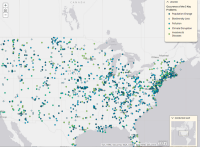
GMOs: Facts About Genetically Modified Food

A GMO is an organism that has had its DNA altered or modified in some way through genetic engineering.  From: www.livescience.com

GR:  Let’s be clear:  The great danger from GMO crops is the resistance to herbicides that allows increases in herbicice use.  Solid, repeatable research has shown the destructive effects of herbicides on bees, butterflies, other polinators, and the amphibians, birds, and bats that eat them.

A Warning: Wake Up World!

Resistance to change:  People don’t respond to warnings by strangers, including scientists and governments. At times, leaders must make repeated calls for change, and sometimes they must use rules and penalties to force change. In many instances, the rules are deceptively designed to benefit for-profit corporations, but when the only discernable winners are the people and the Earth, leadership achieves its highest calling.

Animalista Untamed's avatarAnimalista Untamed

The Earth sea level rising global warming Wake Up World!

Way back in 2010 an article appeared in the Guardian newspaper to make a vegan heart rejoice. It’s headline was UN urges global move to meat and dairy-free diet. I even printed it out and carried it around in my bag, in the hope of waving it in the face of any unfortunate omnivore who might question my choices. In the passage of time, it crumbled to bits, adding to the “fur” in the bottom of my bag. During the last five years, the report itself may just as well have crumbled into dust, for all the notice it seems to have been paid.

But the facts and figures in it were both compelling and alarming:

  • The global population is surging towards a predicted 9.1 billion by 2050
  • As developing economies grow, their consumption of meat and dairy products increases
  • Animal products cause more environmental damage than the production of…

View original post 959 more words

Many species now going extinct may vanish without a fossil trace | UIC News Center

“There are species going extinct today that have never been described,” Plotnick said. “Others are going extinct that are known only because someone wrote it down.” All such species would thus be unknown in the far future, he said, if the written historical record is lost — as it might well be.

The fossil record, Plotnick points out, is much more durable than any human record.

“As humanity has evolved, our methods of recording information have become ever more ephemeral,” he said. “Clay tablets last longer than books. And who today can read an 8-inch floppy?” he shrugged. “If we put everything on electronic media, will those records exist in a million years? The fossils will.”

Other authors on the study, published earlier this month in Ecology Letters, are Felisa A. Smith of the University of New Mexico and S. Kathleen Lyons of the National Museum of Natural History in Washington, D.C.

Media Contact:
Bill Burton
312-996-2269
burton@uic.edu
From: news.uic.edu

GR:  We are the cause of the current mass extinction, and most of us simply don’t care.  The research reported here shows that there will be no permanent record of most of the species that existed during our time on Earth.  But, of course, we don’t care.

To build a sustainable world, academics need to tear down the Ivory Tower

Avoiding societal collapse means building bridges between science and the rest of the world.  From: ensia.com

GR:  I don’t believe we should demolish ivory towers, but scientists whose research has obvious applications should spend more time making public presentations. Moreover, though science should never be constrained by the need to be practical or applicable, it might be appropriate to spend some time on critical social problems. Issues such as mass extinction and global warming have entered crisis stages. Guaranteeing a future for pure research justifies a little time spent on the problems.

Hot Winds Fan Massive, Unprecedented March Wildfire Burning 40 Mile Swath Through Kansas and Oklahoma

GarryRogersIn arid and semi-arid environments, introduced invasive plants fill openings left by fires. In the Great Plains, perennial grasses tolerate fires well. Where livestock grazing and other disturbances have broken soil surfaces, however, the fire increases the opportunities for invasive plants to establish. Fine fuel builds up. Shortened fire recurrence intervals can overcome the resistance of perennial grasses and lead to weedlands of little value for wildlife, wildlife, or soil stability.

robertscribbler's avatarrobertscribbler

It’s likely that we’ve never seen a March wildfire like the beast that just ripped through Kansas and Oklahoma over the past day. But in a world that’s now exploring a new peak temperature range near or above 1.5 C warmer than pre-industrial averages, a level of heat not seen in the past 110,000 years, we’d be out of our minds to expect the weather and climate conditions to behave in any kind of manner that could be considered normal.

We’re Probably Looking at the Worst Wildfire on Record for Kansas and Oklahoma

Kansas Oklahoma Wildfire March 2016

(Massive, unprecedented, wildfire burns along a 40 mile swath across Kansas and Oklahoma on Wednesday. Image source: NASA/MODIS.)

And abnormal absolutely describes what happened in Oklahoma and Kansas yesterday and today.

The first sign of trouble was a warning of severe fire risk by weather officials for a multi-state region of the Central US on Wednesday

View original post 789 more words

Dr James Hansen — Human Warming Pushing Seas Toward Exponential Rise of Several Meters This Century

Good expansion on the issue.

robertscribbler's avatarrobertscribbler

Continued high fossil fuel emissions this century are predicted to yield … nonlinearly growing sea level rise, reaching several meters over a timescale of 50–150 years. Statement from a new scientific study led by Dr James Hansen entitled Ice Melt, Sea Level Rise, and Superstorms.

******

This week, Dr James Hansen and colleagues published one hell of a groundbreaking bit of scientific research. It’s a multi-disciplinary study incorporating the work of 19 top climate scientists, glaciologists, paleoclimatologists, and other Earth Systems researchers. Scientists from NASA, GEOMAR, JPL, and other top research agencies including recognized names like Dr Eric Rignot and Dr Makiko Sato all appear on the contributors list.

Global mean sea level change

(Rates of sea level rise since 1900 and associated with a 1.1 C jump in global temperatures have already shown a non-linear progression. Ice Melt, Sea Level Rise, and Superstorms attempts to pin down just how fast glacial melt…

View original post 1,229 more words

Avoiding collapse: Grand challenges for science and society to solve by 2050

News Stories about global change.

News Stories about global change.

“These six examples illustrate that there is no one-size-fits all approach for researchers to address today’s grand environmental challenges, but two common themes emerge. The first is that it is no longer enough to simply do the science and publish an academic paper; that is a necessary first step, but moves only halfway towards the goal of guiding the planet towards a future that is sustainable for both human civilization and the biosphere. To implement knowledge that arises from basic research, it is necessary to establish dialogues and collaborations that transcend narrow academic specialties, and bridge between academia, industry, the policy community and society in general. The second theme is that now is the time to rise to these scientific and communication challenges. The trajectories of population overgrowth, climate change, ecosystem loss, extinctions, disease, and environmental contamination have been rapidly accelerating over the past half-century. If not arrested within the next decade, their momentum may prevent us from stopping them short of disaster.”  From: elementascience.org

All Star Science Panel Drops Bombshell Climate Paper

Homogenic climate change is already too rapid for Earth’s ecosystems. And now our experts are warning us that truly abrupt changes may be coming. How can we not act when unconscionable devastation of habitats and wildlife is already occurring?

greenman3610's avatarThis is Not Cool

The bombshell paper that James Hansen first released pre-publication last summer has now made it thru review to publication, in the journal Atmospheric Chemistry and Physics.(free online here)

The paper is significant for readers of this blog, because a year ago, I produced a video describing observations in the North Atlantic that are consistent with one of the main premises of the paper, a slowdown of Atlantic Overturning circulation – with scientists Stefan Rahmstorf, Michael Mann, and Jason Box. I’ve posted that video at the bottom.
Dr. Mann is quoted in the Washingon Post, (below) expressing some reservations about the new study, so room for a follow up there.

Above, in my December interview, Hansen gives a quick thumbnail. Below, his new video has a more detailed, illustrated description.

PBS Nova:

The world’s oceans could rise catastrophically as soon as 50 years from now, according to a new paper

View original post 1,668 more words

Patricia Randolph’s Madravenspeak: End hunting and give half the world back to wildlife

We must learn to take care with the world and its creatures.

dvoight09's avatarWisconsin Wildlife Ethic-Vote Our Wildlife

031816_image

PHOTO COURTESY OF BING IMAGES

“We fail to label the unnecessary killing of animals as gun violence, and instead we euphemize and romanticize it as ‘sportsmanship.’” ~ Jay Shooster, Huffington Post

Shooster, an animal and human rights advocate, continues on the blog: “But hunting is gun violence. “A bullet ripping through flesh, puncturing arteries, taking a life is violence to matter the victim’s species”.

Killers enjoy killing repeatedly and are enabled by citizen inaction. The suffering is unimaginable. It is baffling why people do not care enough to stop it when our pets have taught us the loving, curious, loyal and healing nature of our brothers and sisters in our animal fraternity.

There has been a lot of concern about lead poisoning of Flint, Michigan, residents. Lead affects wildlife too. Lead shot kills over a million songbirds annually, just in Wisconsin, according to Madison Audubon testimony at a Conservation Congress…
View original post 771 more words