The Patterns of Bird Population Irruptions


“An irruption is the sudden change in the population density of an organism. In North American birds, irruptions often refer to the movement of northern-wintering species to the south in years of low food availability. You can recognize irruptive movement patterns at your feeders: some winters you may see a species at your feeders in great numbers, but in other winters they don’t show up at all.”

Explore FeederWatch data and tell us what you can find

Source: www.birds.cornell.edu

GR:  Here’s a volunteer citizen naturalist opportunity for everyone, but especially for those who love birds.

Endangered Species Act Regulations Ruled Unconstitutional – Vermont Journal of Environmental Law

Endangered Species Act Endangered

On Nov. 5, 2014, a federal district court judge in Utah struck down regulations adopted under the federal Endangered Species Act protecting the Utah prairie dog on private land as an unconstitutional exercise of federal authority under the Commerce Clause (People for the Ethical Treatment of Property Owners [PETPO] v. U.S. Fish and Wildlife Service)…. Read more »

Source: vjel.vermontlaw.edu

GR:  The Endangered Species Act (ESA) only protects species that have reached critically low numbers.  It does not prevent other species with declining numbers, even when wildlife biologists consider the species imperiled.  The act by this Utah judge would weaken the ESA making it even less useful for protecting nature.  This is a useful baseline article for anyone wanting to follow this case.

Animals’ Week in Review

Animal Welfare Action

Remove Unethical Menu Options.  Save Polar Bears from Shell Oil.  Save Wolves from Cruel Predator-Killing Contest.  Applaud TV Station for Promoting Pet Adoption.  Ban Captive Hunting of Lions Success.  More. . . .

Source: donlichterman.wordpress.com

A “to-do” list for the animals.

Collaborative conservation plan eyed for Wyoming toad

Please send a note in support of this project.

Bob Berwyn's avatarSummit County Citizens Voice

A Wyoming toad. Photo via USFWS. A Wyoming toad. Photo via USFWS.

Voluntary conservation easements would protect habitat and traditional land use

Staff Report

FRISCO — Federal biologists are seeking input on a draft plan to protect habitat for the endangered Wyoming toad. The species was common in the Laramie plains area through the 1970s, when populations crashed, leading to an endangered species listing in 1984.

The proposed conservation would enable the USFWS to buy conservation easements and limited fee-title lands from willing sellers in the Southern Laramie River area whose lands provide important habitat for the endangered Wyoming toad and a variety of other fish and wildlife resources.

View original post 237 more words

New Report Shows Colombian Biodiversity Endangered by Humans

BOGOTA – Biodiversity in Colombia, one of the richest on the planet, faces a “discouraging” future after centuries of human degradation of the continental ecosystems, according to a report released in Bogota.

The 2014 Biodiversity Report, prepared by the Alexander von Humboldt Research Institute, offers an exhaustive analysis of the status, trends and challenges of biodiversity in Colombia.l

Source: laht.com

GR:  The human impact has many facets, but at its root is population growth.  Construction, invasive species, deforestation, toxic chemicals, and greenhouse gas are all increasing along with population.  Colombia, growing slower than many other countries, has tripled its population to near 50,000,000 since 1960, and shows no signs of slowing.

Save the Last Wolverines from Extinction

Rare and elusive wolverines are threatened by trapping and climate change. Help save these animals before the last 300 wolverines in the Lower 48 disappear forever.

Source: forcechange.com

GR:  Politics, wealth, power, and apathy will take away the wolverine and many other species that live in the western mountains.  Let them not go in silence.  Please take a moment and sign the petition.

Wildlife News from Coldwater Farm

Coldwater Farm Wildlife

Located on the Agua Fria River in central Arizona, Coldwater Farm is a tiny, 20 acre, refuge for wildlife. Despite being in the center of the Town of Dewey-Humboldt, the Farm is an ideal wildlife habitat. It has abundant surface water supplies and patches of dense vegetation.  The Agua Fria River flows above ground through the farm, and there are three large ponds. Willow thickets and a nice grove of tall cottonwood trees fill the river’s flood plain.

Mule Deer Visits
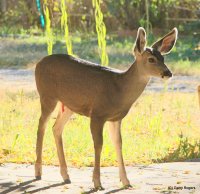
1-IMG_2203Last July, I wrote about two fawns that visited my back yard three days after they were born (see the post here).  Mule Deer became regular visitors last winter.  They are particularly pleased with the black sunflower seeds the birds miss.

The fawns just came again, and this time another pair of twins joined them. The photo shows one of them. I think the kid looks good for four months.

Barn Owl Box

Yesterday I finished setting up a nest box for the Barn Owls that live here. I’ve know the owls were here for about 10 years now. Last winter, wind blew down the best roosting tree, and the owls have lived in less protective trees. That’s when I decided to put up a nest box.

Barn Owls are unique in many ways. They tolerate humans, and in return for permission to sleep in barns and other buildings, they control the local mouse population. Wise farmers use Barn Owls, not mousetraps. Read the two earlier posts about the Coldwater Farm Barn Owls here, and the windstorm disaster here.

1-IMG_2241The nest box is about 12 feet above the ground.  My telescoping pipe plan would have put it at 16 feet, but the wind happened to be gusting to 30 MPH, and was creating too strong a sway.  Don’t want the owls to get seasick (or the pole to bend).  I bought the box from the Barn Owl Box company.  The box is white, intended to be installed in full sun, but I chose a shady spot and decided to paint the shell flat green.

The box is visible from my back door.  If I pay attention in the evenings, I hope to see owls coming and going now and then.

Other Coldwater Farm Wildlife News

1-DSCN0729Quail are trying to make a permanent home here.  They began stopping by three years ago, but the flock didn’t began sticking around until last winter.

The annual return of wild ducks to the ponds is going well.  Mallards, Ring Necks, and American Wigeon so far.  I started throwing out a little corn when I take this old dog down for his daily swim.

1-IMG_2237-001A hawk has stayed around the house for two months now.  This week he/she dropped onto the lawn and began eating grasshoppers.  We have a good late supply this year.  I guess they are easier to catch than the songbirds and gophers that the other hawks choose.  The hawk is about 22 inches.  If you recognize the species, please let me know.
Thank Ron Nirenberg for Conservation of Free-Tailed Bat Colony

“Target:  Ron Nirenberg, San Antonio District 8 City Councilman Goal:  Praise Ron Nirenberg’s efforts to save the largest colony of free-tailed bats in the world.

“On October 31, 2014, the City of San Antonio obtained 1,521 acres of land adjacent to BCI’s Bracken Bat Cave, the largest colony of free-tailed bats in the world, to protect the bats that live there. Applaud the city’s move to conserve these bats’ environment in the face of human expansion and development.

“The Bracken Cave is home to around 20 million Mexican free-tailed bats. Every night at 7:30, visitors see millions of bats fly out of the cave to hunt for bugs in nearby cornfields. The sight has been a source of awe and wonderment for many bat enthusiasts. The area, known as Crescent Hills, could not have been secured without the efforts of San Antonio District 8 City Councilman Ron Nirenberg, who led the effort, along with numerous conservation groups such as the Nature Conservancy and Bat Conservation International. Councilman Nirenberg called the efforts a “true conservation partnership.”

Source: animalpetitions.org

Texas bat protection continues.  Sign the thanks petition here.

World governments failing Earth’s ecosystems, says top conservationist


“Julia Marton-Lefèvre, director general of the IUCN, says political leaders have not properly embraced conservation.

“In its last update in 2012, the IUCN said the world’s protected areas have increased in number by 58% and in extent by 48%. However, only one in four of these protected areas are managed properly and half the world’s most important sites for biodiversity still have no protection.

“An IUCN report released this month says it would cost between US$45bn and US$76bn each year to adequately manage these protected areas. This figure equates to about 2.5% of global annual military expenditure.”

Source: , www.theguardian.com

GR:  No news here, but the Guardian’s wide reach might catch the attention of a few more people and help us edge closer to popular consensus.  Of course, some might say that the only edge here is the one we are sending our fellow creatures over.