
One of Zimbabwe’s largest wildlife reserves, the Bubye Valley Conservancy, recently announced that it was considering culling up to 200 lions as the c… From: www.outdoorhub.com
GR: Too many people; no place for lions.
One of Zimbabwe’s largest wildlife reserves, the Bubye Valley Conservancy, recently announced that it was considering culling up to 200 lions as the c… From: www.outdoorhub.com
GR: Too many people; no place for lions.
 In the past year, EPIC has talked a lot about the proposed Westside Project—a massive logging project on the Klamath National Forest. In case you haven’t heard, the Klamath National Forest has proposed logging approximately 6,800 acres of clearcuts near the Klamath River. The majority of these clearcuts—upwards of 70%—are scheduled for northern spotted owl critical habitat and/or “Late Successional Reserves,” lands set aside for northern spotted owls. You can find more at our archives, located here.
On Friday, February 19, 2016, the U.S. Fish and Wildlife Service issued its Biological Opinion on the Westside Project which detailed the amount of carnage this logging project would cause to northern spotted owls. The numbers are grim. All told, the Westside Project would “take” up to 103 owls; 74 adults and between 12–24 juveniles.
To put this number in perspective, this represents 1–2% of all northern spotted owls left. While this might not seem like a lot, rangewide populations of northern spotted owl are in increasingly steep decline. A recent demographic study estimates that northern spotted owl populations have declined by 3.8% per year from 1985 to 2013 and suggests the rate of decline appears to be increasing. You can read more about the plight of the northern spotted owl and EPIC’s efforts to help save the owl on our new blog post, located here. From: www.wildcalifornia.org
GR: The U. S. Forest Service strikes again! Simultaneous deforestation and attack on an endangered-species.
 GR: Human-introduced animals, plants, and disease organisms have destroyed many species and ecosystems. This aspect of the human impact on nature became a global disaster in the 1500’s as we began crossing the oceans. In the lands we reached, we rampaged about with no thought of the seeds stuck to our boots or the diseases carried by our livestock. Then we developed nature. We cut the soil and filled it with pipes and wires and then we entombed its microorganism ecosystem with pavement. We damned streams, dried up springs, cut the forests, stripped the land with cattle and sheep, and we poisoned the water and air. Now comes our grand slam: We’ve added sufficient greenhouse gasses to the atmosphere to give our climate warmer temperatures, droughts, fires, and stronger storms.
How do we react to all that we’ve done? In the current time of competition between oil producers, for example, the temptation to burn more of the cheaper gasoline doesn’t horrify us, no, we call the lower prices a consumer blessing. 
And so, in all that we do, our species appears to be striving for maximum destruction of earth ecosystems. Here are a few essays I wrote about how this works with invasive plants.
The following article is by Ken Cole on the Wildlife News website (February 19, 2016).
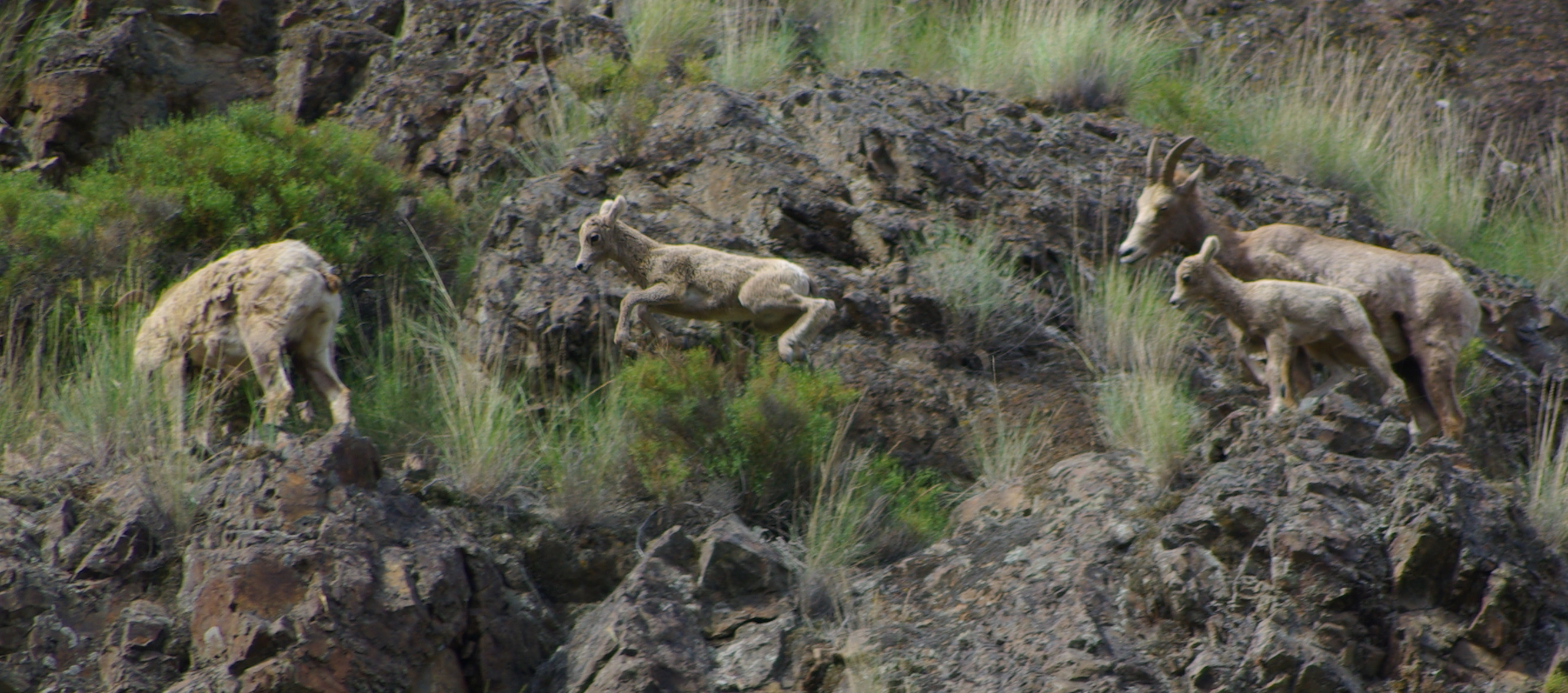
Bighorn sheep photo copyright by Ken Cole
“On Sunday and Monday, February 14-15, 2016, USDA Wildlife Services took to the skies and shot the remaining 24 bighorn sheep in the Montana Mountains of northwest Nevada at the request of Nevada Department of Wildlife.
“While the exact source of the disease outbreak is not known, it is not surprising that the bighorn sheep in this area are suffering this fate because there are two domestic sheep grazing allotments – the Bilk Creek allotment and the Wilder-Quinn allotment – in the middle of this area and BLM ignored the disease threat that they pose to bighorn sheep.
“In 2012 the BLM began the permit renewal process for one of the allotments – the Bilk Creek allotment – and Western Watersheds Project submitted comments notifying them of our concern about the risk that domestic sheep posed to bighorn sheep in this area. It is well know that domestic sheep are carriers of pathogens that result in deadly pneumonia to bighorn sheep and that even just one nose-to-nose contact between these related species can result in a disease outbreak that commonly kills up to 90% of a herd and kills the offspring of the remaining animals for up to a decade.
“In 2013 the BLM issued the Final Environmental Assessment that dismissed those concerns . . . . ” Read more at: http://www.thewildlifenews.com/2016/02/19/bighorn-sheep-die-off-in-montana-mountains-nevada-is-it-any-wonder.
 “DAKAR, Jan 28 (Reuters) – Mali’s elephants, one of just two remaining desert herds in the world, will be gone in three years unless the government does more to protect them, a conservation group said on Thursday.
“Poachers have taken advantage of the chaos from a growing Islamist insurgency and other unrest in the lawless north to step up ivory trafficking – a trade that the United Nations says funds militants.
“Sixteen elephants have been killed so far this month, adding to more than 80 slaughtered in 2015, said Susan Canney, director of Mali Elephant Project for the WILD Foundation.” www.scientificamerican.com
GR: These great animals indicate the consequences of our lack of concern for other species. Instead of protecting our fellow creatures, we eat up their habitats and harvest their body parts.
GR: We can’t seem to put the brakes on for wildlife or habitat. Our population growth and our homocentric lack of concern for other species is devastating nature.
South Africa DEA (Department of Environmental Affairs) has released the “official” 2015 rhino poaching statistics – 1175. This is a decrease from 2014 which was 1215.
Reason for optimism?
Keep in mind the following: Kruger is the size of Israel, not all carcasses are recovered in a timely manner, or at all. The statistics also do NOT include the following:
While the DEA pat themselves on the back for a “decline” in numbers, reality is this month, there have already been 37 poached at the time of this post, and the orphanages are seeing no shortage of rescued orphans.
In fact there had been a 10% INCREASE in poaching activity in Kruger National Park, where the majority of poachings occurred.
Instead of taking the numbers as a fact, we must look at them as only an…
View original post 28 more words
 The excellent article introduced below is about nature conservation from the human viewpoint. The argument is that the current mass extinction of wild plants and animals has harmful consequences for the future of the human species. It most certainly has, but the author’s desire to inform his audience misses its target because it gives a biased view of the problem. The article does not consider the rights of other species. This “homocentric” view of nature assumes that disappearance of other creatures is only important if it endangers humans.
Aldo Leopold and other conservationists realized that this viewpoint is unsustainable. Unless we accept the equality of all Earth’s species, including our own, our conservation efforts will always fail. With its runaway enthusiasm for untested proposals, our species will take chances with the lives of other species. Experiments aimed only at benefiting our species, experiments that do not respect the rights of other species, experiments that will sometimes have unforeseen consequences, will gradually nibble away at nature until our ecosystems collapse and wash into the sea (carrying us with it).
Unless we begin to respect the rights of all species, we will exert constant damage on the Earth and ourselves.

Former Alaska Gov. Sarah Palin, right, endorses Republican presidential candidate Donald Trump during a rally at the Iowa State University, Tuesday, Jan. 19, 2016, in Ames, Iowa. (AP Photo/Mary Altaffer)
“It’s an amazing fact that the contemporary world is marked by a growing number of problems that are genuinely global in scope. Some of these problems even have existential implications for the survival of human civilization — yet instead we spend too much time discussing smaller threats, including North Korea, ISIS, Oregon militias and even Sarah Palin. One such problem is anthropogenic climate change — a catastrophe whose effects are anticipated to be “severe,” “pervasive” and “irreversible.”
“But climate change isn’t the only problem of this sort. In fact, for many who spend their lives studying environmental issues, it can be frustrating to see climate change — a highly contentious issue among non-experts, despite a scientific consensus about its reality and causes — dominate the public discussion. The fact is that biodiversity loss constitutes an equally worrisome (albeit related) threat to the future of humanity.
“Consider some cold hard facts. According to the 3rd Global Biodiversity Report (GBO-3), the total population of vertebrates — a broad category that includes mammals, birds, reptiles, sharks, rays and amphibians — living within the tropics declined by a shocking 59% from 1970 to 2006. Take a moment to let this sink in. In only 36 years, more than half of the vertebrate population between the Tropic of Capricorn and the Tropic of Cancer disappeared.”— Read More: , Salon.
 “As one of the top 20 countries with the most biodiversity, Costa Rica is deeply committed to environmental protection and conservation.
GR: After all the protection efforts, Nature is never safe from human progress–sign the petition.

The last giraffes in the Democratic Republic of Congo are teetering on the brink of extinction, conservationists have warned, with only 38 animals left. . . . From: www.thetimes.co.uk
GR: There aren’t any words to describe this sad loss. Here’s a National Geographic story that provides more information on giraffes.

This post includes summary statements on several popular species. I’ve included grey parrots here as an example.
“The Democratic Republic of Congo (DRC) is currently the range State with the largest volume of exports of wild-sourced grey parrots. According to trade records reported by importing countries, DRC has exceeded the annual export quota for various consecutive years. There are no recent scientific studies on the status of the DRC populations of grey parrot, which can provide a science base for the establishment of quotas. There are however suggestions that the populations are declining. Furthermore, there exists an alarmingly high rate of mortality (50% or higher) in domestic transport before the export takes place.
“In the light of the current situation, the Standing Committee is asked to consider a recommendation for all Parties to suspend commercial trade in grey parrots from DRC until all the concerns and recommendations have been sufficiently addressed.” From: cites.org
GR: CITES appears to have no ability to reduce poaching or illegal trafficking in endangered species. The organization follows ponderously behind as popular species are captured or killed for fun, food, and profit. Of course, there have been valuable contributions by CITES, but Earth’s animals and plants are dying so rapidly now that the contributions have little meaning. One might argue that the damage caused by a gathering of 500 participants from across the globe exceeds the value of the organization’s continued existence.
So, what can we do to protect wildlife?
Most people might say that they appreciate wild animals and plants and want them to survive. People have paid for wildlife refuges, landscape linkages, inventories, ecological research, and interventions on behalf of endangered species. However, these conservation efforts have not offset the harm caused by air pollution, construction, invasive species, farming, livestock production, and trafficking. Will we act to increase spending for conservation? Will we act to begin reducing our population? Perhaps both answers are yes, but if we ask if our acts will be sufficient to protect wildlife, the answer is probably no.


 GarryRogers Nature Conservation