Improving Agriculture for Human Food Production (Dax Olfindo, Philippines)

“The Philippines is at the forefront when we talk about biodiversity, as it is one of the Megadiverse Countries; countries that are inhabited by most of the earth’s species. Location, climate and topography are the key factors as to why this country is abundant with life; and we’re not talking about plants and animals alone. Ranked 9th (for countries with population exceeding 10 million) and 38th overall, this Southeast Asian nation is one of the most densely populated areas in the world. With great number of people, comes great responsibility; feeding them.

“Blessed with conditions that are favorable to a wide host of species, this country has failed to take advantage of this fact; lagging behind in food production. Most of our farmers dream of moving closer to the city in order to find better paying jobs. This has resulted to untended lands, that otherwise could have been producing food. Some of these farmers have found success, most of them however fail. I know that this phenomenon is not unique to the Philippines and we need to reverse this trend soon. If we don’t do anything about it, there will be no more farmers left and we will all face a major crisis.”   From: blog.gfar.net

GR:  The lofty goal to produce more food could have short-term benefits for people.  Long term, however, population growth, land degradation, and climate change will destroy any hope for a better life.  What is important now for the Philippines and all other countries is to stop (yes, that’s stop) greenhouse gas emissions, and start reducing the human population and its need for food.

Invasive Species and the Bighorn Sheep Die-off in Montana Mountains, Nevada

Invasive Species

GarryRogersGR: Human-introduced animals, plants, and disease organisms have destroyed many species and ecosystems. This aspect of the human impact on nature became a global disaster in the 1500’s as we began crossing the oceans. In the lands we reached, we rampaged about with no thought of the seeds stuck to our boots or the diseases carried by our livestock. Then we developed nature. We cut the soil and filled it with pipes and wires and then we entombed its microorganism ecosystem with pavement. We damned streams, dried up springs, cut the forests, stripped the land with cattle and sheep, and we poisoned the water and air. Now comes our grand slam: We’ve added sufficient greenhouse gasses to the atmosphere to give our climate warmer temperatures, droughts, fires, and stronger storms.

How do we react to all that we’ve done? In the current time of competition between oil producers, for example, the temptation to burn more of the cheaper gasoline doesn’t horrify us, no, we call the lower prices a consumer blessing. Fuels Supplied

And so, in all that we do, our species appears to be striving for maximum destruction of earth ecosystems. Here are a few essays I wrote about how this works with invasive plants.

The following article is by Ken Cole on the Wildlife News website (February 19, 2016).

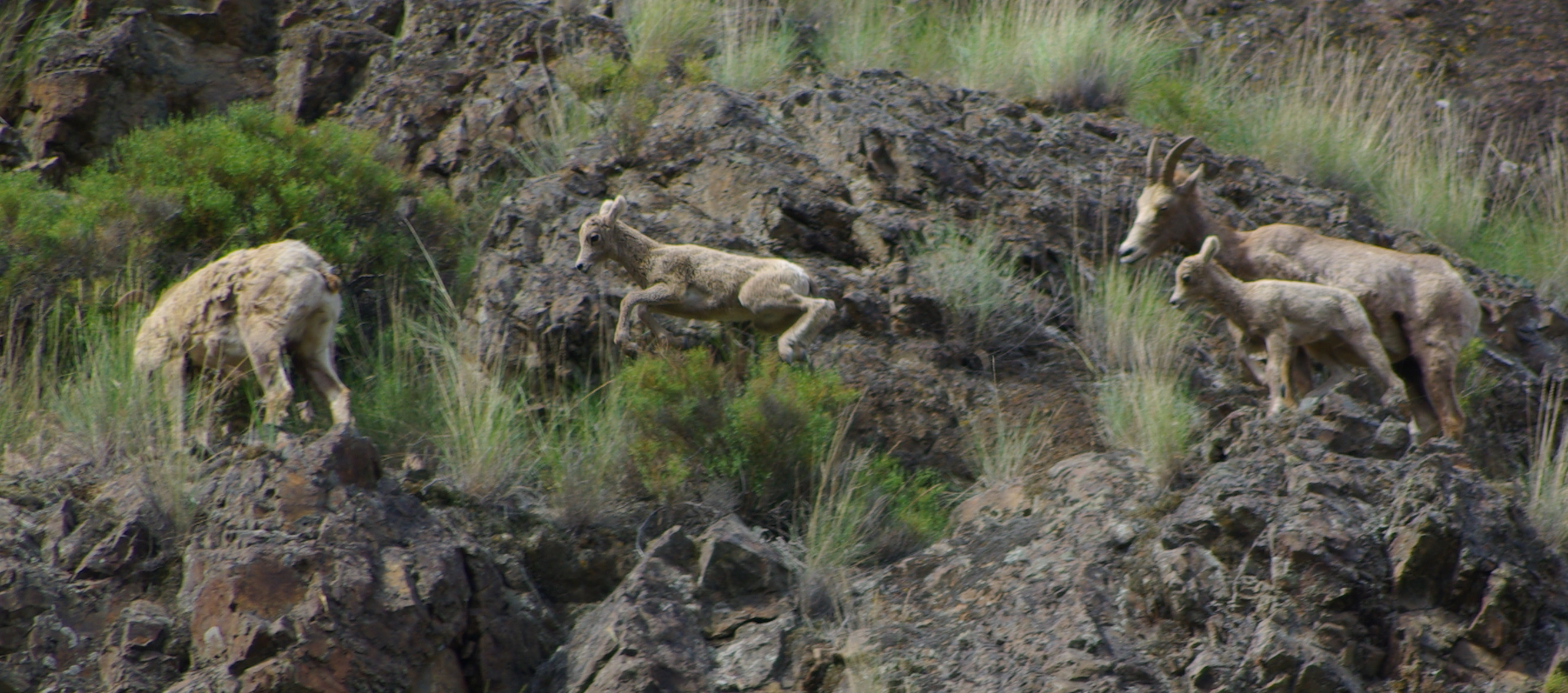
Bighorn sheep by Ken Cole

Bighorn sheep photo copyright by Ken Cole

“On Sunday and Monday, February 14-15, 2016, USDA Wildlife Services took to the skies and shot the remaining 24 bighorn sheep in the Montana Mountains of northwest Nevada at the request of Nevada Department of Wildlife.

“While the exact source of the disease outbreak is not known, it is not surprising that the bighorn sheep in this area are suffering this fate because there are two domestic sheep grazing allotments – the Bilk Creek allotment and the Wilder-Quinn allotment – in the middle of this area and BLM ignored the disease threat that they pose to bighorn sheep.

“In 2012 the BLM began the permit renewal process for one of the allotments – the Bilk Creek allotment – and Western Watersheds Project submitted comments notifying them of our concern about the risk that domestic sheep posed to bighorn sheep in this area. It is well know that domestic sheep are carriers of pathogens that result in deadly pneumonia to bighorn sheep and that even just one nose-to-nose contact between these related species can result in a disease outbreak that commonly kills up to 90% of a herd and kills the offspring of the remaining animals for up to a decade.

“In 2013 the BLM issued the Final Environmental Assessment that dismissed those concerns . . . . ”  Read more at:  http://www.thewildlifenews.com/2016/02/19/bighorn-sheep-die-off-in-montana-mountains-nevada-is-it-any-wonder.

Help save Britain’s seas from governments who make a mockery of marine conservation | George Monbiot

“Governments take the advice they want to hear. As they seek to avoid trouble and find the path of least resistance, they often look for advice that meshes with the demands of industrial lobbyists.

“This problem has afflicted the life of the sea for many years. Governments consult the scientists who tell them that high catches of fish are sustainable, and ignore more cautious assessments. This allows them to get the fishing lobby off their backs, while claiming to have based their decisions on science. Bad advice from scientists and selective hearing by government were among the factors that led to the collapse of the Grand Banks cod fishery off Newfoundland.

“One of the most destructive industries humankind has developed is scallop dredging. Scallop dredges are rakes with long steel teeth that are towed over the seafloor, ripping out not only scallops, but also much of the life and structure of the seabed. They have wrecked habitats all around our coasts.”  www.theguardian.com

GR:  Monbiot begins by pointing out that governments act on behalf of commercial interests.  It’s the same everywhere.  Elected to public office, humans gain power and enter the society of the powerful.  They become friends with industry and development.  Do people with the moral strength to refuse this transformation avoid politics, or are there just too few that have the strength to fill the available government posts?

‘Frightening’ findings foretell ills for ecosystems

“When it comes to determining the causes negatively affecting the biodiversity of our ecosystems, a new interdisciplinary study at Western is putting numbers behind the devastation. And it’s not good.

“The study’s lead author, recent PhD graduate Beth Hundey (Geography), showed, for the first time, that 70 per cent of nitrates in high mountain lakes in Utah are from human-caused sources – with fertilizers having, by far, the most impact at 60 per cent, along with another 10 per cent caused by fossil fuels. The research suggests these findings could apply to other mountain ranges in western North America.”   phys.org

GR:  Putting fine points on specific human impacts is truly important, but we also need to search for ways to pierce the polluters’ political armor. We need to act, and we need to do it now.

One More Time – Here Is A Video That Tells It Like It Is When It Comes To The Serious Threat This Thing Government Reps Call “Biodiversity Offsetting” Poses To Niagara’s Natural Wetlands

GR:  Experience has taught me that most governments represent business interests dominated by desire for short-term profits and growth-at-all-costs.  When individuals take public office, their new power over the wealth of the people elevates them to the society of investors and developers. Rather than becoming advisers that help the wealthy control their avarice, they become students and tools of the wealthy.  Whatever original thoughts they had about stability and sustainability fade away. There are exceptions, but they are rare and fleeting.

The only solution is heavy public participation and opposition to development proposals.  Without overwhelming threats from large numbers of people, individuals in governments will be most strongly influenced by their new society—the rich and ambitious.  Activism is the answer.

The following is by Doug Draper.

“The Niagara Peninsula Conservation Authority – a government body created by the Province of Ontario decades ago and stacked with board members appointed by municipal governments in the region – is floating the idea of destroying at least some of that’s left of Niagara’s natural wetlands to make way for more development.
Only about 10 to 15 per cent of Niagara’s wetlands – vital to the survival of many birds, fish and other wildlife – remain in Niagara and a regional ‘Conservation Authority” is now looking at “offsetting” to make way for development. Photo by Doug Draper

“Only about 10 to 15 per cent of Niagara’s wetlands – vital to the survival of many birds, fish and other wildlife – remain in Niagara and a regional ‘Conservation Authority” is now looking at “offsetting” to make way for development. Photo by Doug Draper

“The NPCA says it is thinking of taking this idea to the provincial government for approval under the guise of something called “biodiversity offsetting” which involves (as best as one can determine from an explanation offered by Conservation Authority’s chief administrative officer Carmen D’Angelo at a public meeting this January) replacing some wetland for development and replacing it somewhere else with something the same or similar that someone would construct.
More than 200 citizens attended the January meeting, many of them to express their concern or outright opposition to the idea. And when one citizen asked NPCA representatives flat out for a definition of “biodiversity offsetting,” one Conservation Authority member stood to say they do not yet have a full definition of the term.” niagaraatlarge.com

Population. Excerpt from Diana Coole

Population in Modern Political Economics

populationHere’s a helpful review of the background for the refusal of political leaders to recognize the massive population problem and to propose solutions.  The refusal has a lot to do with grow-or-die economics (my term).  For more insight to the consequences of population, you might also take a look at this book:  Overdevelopment, Overpopulation, Overshoot.

The following is from Joe Bish, Director of Issue Advocacy, Population Media Center.

“I have been meaning for several weeks now to recommend you read the latest from Diana Coole, Professor of Political and Social Theory at Birkbeck University of London. You may (or may not) recall the PMC Daily Email of September 7th, 2013, wherein I shared Professor Coole’s outstanding effort titled “Too many bodies? The return and disavowal of the population question“. (PDF)

“Her latest effort is published in the Oxford Handbook of Environmental Political Theory, and echoes many of the themes of found in “Too Many Bodies.” In other words, she starts by stating that “It would seem a logical inference that global ecologies would be more sustainable with a stable population and that population growth, especially when combined with rising living standards, is a significant factor in deteriorating environmental indicators,” — and then proceeds to map out why this obvious truth is continually fought tooth-and-nail by various ideologues and those with vested interests in the growth paradigm. In doing so, she provides a good history of population politics.

“Below, I have excerpted a few passages that should give you a sense of the chapter. Certainly, it is good to see this content in the Oxford Handbook, and hats off to Professor Coole for her important work.”–Joe Bish, Population Media Center


Population, Environmental Discourse, and Sustainability

“…The aims of this chapter are to present some of the arguments that have been made in favor of stable or declining numbers, to explain some of the reasons the issue has become so toxic, and to suggest some of the areas where it does seem pertinent to revisit this matter in the context of twentieth-first century conditions despite the significant obstacles to doing so.

“…If demographic remedies are rarely included among contemporary responses to scarcity (“insecurity”), another perspective that is noticeable for its absence from most policy reports is one that John Stuart Mill, another classical economist, introduced in the mid-nineteenth century. Mill blamed over-population for depressing working class wages but drawing on romantic poets like Wordsworth, he also articulated more explicitly ecological concerns about the detrimental existential, aesthetic, and affective effects of growth on everyday experience. In his Principles of Political Economy (1848) he acknowledged that there may be no fixed threshold beyond which numbers become unsupportable, but he also questioned the benefits of continued population and economic growth for their own sake.
“…The concept of limits to growth was popularized by the title of the book published by scientists at MIT and commissioned by the Club of Rome. Feeding data of current trends into their World3 computer model and interpreting their findings from the perspective of systems theory, the authors warned of positive feedback loops and system overload in a finite planet. The only sustainable scenario to emerge was a steady-state economy and stable population; even with optimistic technological possibilities factored in, continued growth overwhelmed the planet’s homeostatic mechanisms. The political problem was that modern Western culture “has evolved around the principle of fighting against limits rather than learning to live with them.” (Meadows and Meadows 1972: 150) This last observation was borne out by the derision with which limits-to-growth discourses were treated.  Clearly their principal thesis offended pro-growth economic ideologies, but the question remains why an argument that briefly prevailed in the mid-twentieth century when world population was half its current total has been so comprehensively reviled since.
“…In addition, as feminist attention shifted during the 1980s from gender equality to sexual difference women’s nurturing capacities were revalorized: a position that was not exactly pro-natalist but that did reject the former anti-natalism. The old Left remained suspicious of arguments that attributed social problems to population rather than over-consumption or maldistribution and, as attention shifted to developing countries, postcolonialists judged neoMalthusianism indelibly racist. (Hardt and Negri 2004: 165-9)  This equation, which renders it shameful to ascribe blame for social or environmental  ills to overpopulation, has arguably been the most potent reason for deterring critical thinkers and publics from engaging with population matters. (Coole, 2013) Critics invariably ask who is being judged excessive and thus blamed; usually, they answer, it is the poor, especially those from the global South. The New Left, meanwhile, suffered a common fate with other radical ecological and limits-to-growth exponents as their positions were dismissed by an ascendant New Right.
“…In particular, though, it was the emergence of anti-Malthusian demographic and economic arguments, for which population and economic growth are mutually and positively reinforcing and the promise of equilibrium is embedded in a teleological modernization narrative, that had the greatest transformative effect in disavowing a population issue. Several interlocking strands of this still hegemonic discourse may be identified.
“…Meanwhile, the prospect of stabilization is being actively challenged from the perspective of a fifth argument that is more explicitly pro-growth and unhappy with the idea of completing [demographic] transition. Transitional stages affect age structure and toward the end, fertility decline plus longer life expectancy result in population aging. Because this means a shrinking labour force and higher dependency ratio it presents an acute, albeit temporary, fiscal challenge for developed economies. Nations that compete to increase GDP growth in a competitive global economy, while also striving to balance their budgets, are responding by trying to rejuvenate their populations. (Coole 2012b) Their motivation is encapsulated in the concept of a “demographic dividend”: a temporary feature of low-dependency cultures as they pass through a stage where fertility has declined but the population has not yet aged, thus yielding a disproportionately large working-age population. Countries whose dividend is passing are understandably reluctant to abandon this productive advantage and therefore strive to avoid the stable or even reduced numbers that transition entails. Pronatalism and net migration are their main strategies. (Grant and Hoorens 2006) The first is usually promoted in the form of family-friendly policies but the second has quickly become immersed in the circuits of racist politics that are a legacy of earlier hostilities. Suffice it to say that policies designed to expand the populations of post-transitional, affluent regions run contrary to suggestions that this is where falling numbers could be most environmentally beneficial.
“…One factor remains incontrovertible: world population increased massively during the twentieth century and although the growth rate has slowed considerably, barring some unforeseen catastrophe the number of bodies that planet Earth must sustain on a daily basis by 2100 will be immense, at three to four billion more than currently according to the latest estimates. Worldwide, this will require huge changes in political and economic capacity. It will also place enormous demands on the biophysical world, whose contribution we have become used to rendering as “natural capital” or “ecosystem services” and whose deficits are increasingly framed in terms of securitization or business opportunities. The environmental areas most vulnerable to this spread of humanity are probably biodiversity, especially inasmuch as it defies or fails to contribute to economic reckoning, and, related to its loss, a gradual aesthetic-existential impoverishment of everyday experience as the presence of nonhuman otherness is attenuated. Inhabiting more crowded, congested spaces and coping with infrastructural deficits yields some economies of scale and metropolitan exhilaration, but beyond a certain threshold it simply makes ordinary life more difficult, unpleasant, and competitive for most humans, especially poor ones, as well as for other species.
“…In any case, population projections give little succor to complacency. The last two UN world revisions (in 2010 and 2012) both revised totals upward. The difference between low and high variant projections is 2.5 billion people in 2050 and ten billion by 2100: disparities that rest on an average of merely one child more or fewer per woman. (UN 2013a) The implication is that while transition to a stable population cannot be guaranteed, there is scope to hasten it and thereby also to reduce the level at which it occurs. In its 2012-Revision the UN is explicit that an eleven billion peak (its medium projection) is contingent on taking urgent action: “without further reductions of fertility, the world population by 2100 could increase by nearly six times as much as currently expected”. Were 2005-10 fertility rates to be sustained then closer to 28 billion could be the tally.
“…But even if stabilizing or reducing numbers were endorsed, could this feasibly be achieved without coercive methods or the framework of population control associated with them? During the mid-1990s, macro-level demographic concern was reframed as primarily an issue of women’s reproductive health rather than in terms of resource shortages and environmental harm, thus helping to foreclose what was now defined as a “numbers game” antithetical to couples’ right to choose their family size. (Campbell, 2007) An indication of how this issue might be renegotiated appears in Return of the Population Growth Factor. Its Impact upon the Millennium Development Goals, a report issued by Britain’s All-Party Parliamentary Group on Population, Development and Reproductive Health. In hoping that “we will find a way to speak, from a human rights perspective, about both the importance of population stabilisation and the importance of supporting the rights of individuals to reproductive freedom.”
“…Ultimately, whether a world with fewer people is more sustainable and more conducive to equality, social justice, and quality of life is not a question that can be settled solely by statistics, computer models, and objective calculations of capacity. It requires a sustained critical analysis of interests invested in population/economic growth and a holistic appraisal of its existential costs at the level of everyday lives and ecosystems. It invites normative reflection on the good life: a task for which political theorists are especially well-equipped. If they can construct a compelling, congenial vision of desirable lifestyles existing within realistic constraints under twenty-first century conditions, then today’s theorists might rescue overpopulation concerns from assumptions that they are solely the currency of pessimists, racists, and misogynists.  Or it may be the case that the conundrum mentioned at the start is simply irresolvable at present, especially as energetic migration flows vie with fertility as the main driver of population growth in developed regions and race combines with gender in new ways to render the topic unspeakable. In which case, Malthus might belatedly prove to have been right all along.”

How forest management and deforestation are impacting climate

“Two new studies reveal how altering the composition of trees in forests is influencing not only the carbon cycle, but air surface temperatures to a significant degree as well. The results highlight how human-made changes to forests hold more severe consequences than previously believed. Worldwide, reforested areas are increasingly prominent; for example, in Europe, 85% of forests were managed by humans as of 2010. Strong favoritism of foresters to plant more commercially valuable trees — such as Scot pines, Norway spruce and beech — has resulted in reforestation of 633,000 square kilometers of conifers at the expense of broadleaved forests, which decreased by 436,000 square kilometers since 1850.”  www.sciencedaily.com

GR:  Another look at this story.

Climate, disease, and Human Population Control

The Future of Population Control?

Population -- People massWe humans will eventually solve our population problem–not voluntarily–but by our own actions.  Here are some of the human-caused factors responsible for reduced births and longevity:

  • Insect vectors for human diseases are moving to new places as climate changes.
  • Disease organisms are developing immunity to antibiotics.
  • Heatwaves and lethal storms are increasing.
  • Radioactive isotopes and other toxic materials are spreading through Earth environments.
  • Biodiversity and ecosystem stability are declining.

In the post below, Scribbler reviews some of the diseases related to climate change.

Zika and the New Climate Dystopia — Human Hothouse as Disease Multiplier

“As of today, authorities in Brazil, Colombia, Jamaica, El Salvador and Venezuela were urging women to avoid getting pregnant… It is unthinkable. Or rather, it is something out of a science fiction story, the absolute core of a dystopian future.” — Bill McKibben in a recent statement on global warming and the now pandemic Zika virus.

“There are a plethora of diseases out there. Diseases we don’t know about. Diseases locked away in far-off, rarefied corners of the world. Diseases that operate in small niche jungle environments. Diseases that live in only cave systems or within a single species. Diseases that were locked away millions of years ago in the now-thawing ice. Diseases that, if given a vector — or a means to travel outside of their little rarefied organic or environmental niches — can wreak untold harm across wide spans of the globe.

Countries with Reported Active Zika Transmission

“(Countries with reported active Zika transmission. Until recently, Zika flare-ups had been isolated to Central Africa and French Polynesia. Now the virus is a global pandemic with World Health Organizations authorities concerned infections could top 4 million. Image source: The CDC.)” –Robert Scribbler.

The Arctic Is Melting And Big Business Is Ready To Dig In

“Standing at a podium before the World Economic Forum, Leonardo DiCaprio briefly smiled as he received an award for his leadership in tackling climate change. Once settled under the spotlight, he quickly moved away from his grateful statements, and began railing on corporate avarice.

“We simply cannot allow the corporate greed of the coal, oil, and gas industries to determine the future of humanity,” said DiCaprio last week while at Davos, Switzerland, where some 2,500 top global business leaders, politicians, and intellectuals gathered to discuss politics, economics, and social issues.

“Fossil fuels must be kept in the ground to avoid catastrophic climate change, he continued. “Enough is enough. You know better. The world knows better.”

“But while DiCaprio was cheered Wednesday as he stepped off the stage with his Crystal award, the international business community appears interested in venturing into new areas despite potential ecological costs. In fact, a day after recognizing environmental leadership, a World Economic Forum advisory group launched the Arctic Investment Protocol, and with that came a tacit push for extracting resources from one of the least-developed areas of the world.

“The Arctic Investment Protocol is a voluntary set of guidelines for nations looking to do business where diminished ice coverage from man-made climate change is allowing access to once-unreachable sea routes as well as vast mineral and fossil fuel reservoirs.

“The protocol calls for building resilient societies through economic development, pursuing measures to protect the Arctic environment, and respecting and including local communities, to name a few. The Guggenheim Partners, a major global investment and financial services firm, quickly endorsed the protocol, saying the Arctic represents one of the last great economic frontiers.”  From: thinkprogress.org

GR:  No place on Earth is safe from human avarice. DiCaprio mentions the greed of the coal, oil, and gas industries, but he could also have condemned the greed of the mining, farming, and logging industries. Financial interest will overwhelm the wisdom of switching from development to protection. We’ve stripped away the Arctic’s protective skin of ice and cold. Now we will feed on the carcass.