Roads Benefit People But Can Have Massive Environmental Costs

“Road-killed tapir in Peninsular Malaysia (photo © WWF-Malaysia/Lau Ching Fong).  Located in the wrong places, roads can open a Pandora’s Box of problems,” says William F. Laurance.

“In a recent Opinion in National Geographic News (14 October 2014), U.S. Ambassador Kenneth M. Quinn makes a compelling case that roads can have major benefits for rural people—improving access to modern farming technologies, education, and healthcare, and even limiting the influence of extremist groups that prey on isolated communities.

“However, Ambassador Quinn tells only half of the story. Yes, many roads or road improvements can yield major economic and social benefits. But other roads become environmental disasters—opening a Pandora’s Box of problems such as illegal logging, poaching, wildfires, and land speculation.”

Source: newswatch.nationalgeographic.com

GR:  Roads open areas to invasive species; they raise wildlife-disturbing noise levels, and they block wildlife movements.  In some areas, roads lead to ecosystem disruption by encouraging tourism, recreational travel, and hunting.  According to RoadFree.org, keeping wild areas free of roads is a remarkably cost-efficient way of preventing deforestation and protecting biodiversity.  Read more about road impacts.

Vulnerability of biodiversity hotspots to invasive species and climate change

biodiversity hotspots
Results

Our findings show that hotspots may experience an average loss of 31% of their area under analogue climate, with some hotspots more affected than others (e.g. Polynesia–Micronesia). The greatest climate change was projected in low-latitude hotspots. The hotspots were on average suitable for 17% of the considered invasive species. Hotspots that are mainly islands or groups of islands were disproportionally suitable for a high number of invasive species both currently and in the future. We also showed that hotspots will increase their area of pasture in the future. Finally, combining the three threats, we identified the Atlantic forest, Cape Floristic Region and Polynesia–Micronesia as particularly vulnerable to global changes.

Main conclusions

Given our estimates of hotspot vulnerability to changes, close monitoring is now required to evaluate the biodiversity responses to future changes and to test our projections against observations.

Source: http://t.co/t5iYsfgr7D

GR:  Invasive species and climate change threaten biodiversity everywhere. Invasive plants have already overrun one of my desert research areas in the central Great Basin Desert.  Invasive species are spreading in other desert areas now.

Irreversible damage from climate change seen in leaked UN paper

LONDON — Humans risk causing irreversible and widespread damage to the planet unless there’s faster action to limit the fossil fuel emissions that cause climate change, according to a leaked draft United Nations report.

Source: www.chicagotribune.com

GR:  Climate scientists such as James Hansen (http://wp.me/p26kDO-7c2) and biologists such as E.O. Wilson (http://wp.me/p26kDO-7ZO) believe we are in the midst of an emergency.  More than climate change, we are reducing habitat through construction, farming, and grazing; we are aiding the takeover by invasive species (http://wp.me/p26kDO-4we), we are eliminating fresh water supplies for wildlife, and we are polluting the land, air, and water.  Where is the emergency response?

Invasive Plants Are Destroying North American Desert Ecosystems

Invasive species, like storm troopers leading the surging ruin of global warming, are overwhelming Earth’s ecosystems.

Introduction to Invasive Plants in Deserts

One or a few species of invasive plants can replace native plant communities across entire landscapes. Biodiversity and stability of vegetation, soils, and wildlife decline dramatically. Once the replacement is complete, it is difficult to restore the original species. In some instances, the replacement is so widespread there are not enough resources available to achieve restoration. The loss is permanent.

Invasive non-native species are a central management concern for all wild land managers because they “threaten biodiversity and other ecological functions and values” (Warner et al. 2003). This statement represents a consensus by the scientists and land managers concerned with natural ecosystems (e.g., Mau-Crimmins et al. 2005). Native vegetation is more diverse, resilient, and persistent than invasive plant vegetation; it provides food and cover for wildlife, absorbs precipitation, increases water storage, protects soil, reduces flooding and sedimentation, and helps maintain air and water quality. According to the Sonoran Institute: “Invasive species are the second most significant threat to biological diversity after direct habitat loss”.

Full post with references: garryrogers.com

Invasive Palm Threatens Java Rhino To Extinction

The last of Indonesia’s critically endangered Javan rhinoceroses have survived poachers, rapid deforestation and life in the shadow of one of the archipelago’s most active volcanoes. But an invasive plant is now posing a new threat to the world’s rarest species of rhino.

“Once the most common of the Asian rhinoceroses, the Javan rhino (Rhinoceros sondaicus) started its decline at least 3,000 years ago with the growth of human populations and increased hunting pressures. With its horn fetching $30,000 on the black market, poaching is considered the driver of much of its decline in modern times.

“As few as 58 Javan rhinos exist in the world today, and the species is quite possibly the rarest large mammal on earth. All are found in one small population in Ujung Kulon — a sprawling 1,200-square-kilometer (463-square-mile) national park on the westernmost tip of West Java and the island of Panaitan. In addition the rhinos, the park is home to dozens of other mammals, more than 270 species of birds and 57 rare plant species.

“But a single species of plant is threatening the park’s fragile ecosystem.

“The issue in Ujung Kulon is not deforestation — but an invasive species called the arenga palm,” said Elisabeth Purastuti, WWF’s Ujung Kulon leader.

“Once covered in old-growth forest, the cataclysmic eruption of nearby Krakatoa in 1883 wiped out much of Ujung Kulon’s primary forest cover, creating a patchy network of secondary forest where the rhino thrived.”

Source: havehest.wordpress.com

GR:  Conservation biologists have been saying that construction (total habitat elimination) and invasive species are the greatest threat to Earth ecosystems.  Though we now must place climate change in the number two spot, invasive species continue to be one of humanity’s greatest destructive achievements.  Read more:

How should “Flathead National Forest 2.0” look?

Montana’s Flathead Forest is one of the most biologically diverse areas of our country, but it needs some work to become more effective for conservation.

“In the northwestern corner of Montana just next to Glacier National Park sits the 2.4 million acre Flathead National Forest. It’s a part of the massive and biodiverse “Crown of the Continent” ecosystem, and is part of a broader collection of protected areas stretching all the way down to Yellowstone. It’s home to more than one thousand native plant species, 70 mammals, and 260 birds. It’s home to iconic American megafauna, like grizzly bears and grey wolves, along with mountain lions, wolverines, lynx, and fishers.

“Starting in the 1930s, concerned citizens and government officials have worked to protect this region, and while it remains mostly unaffected by development, it is starting to suffer the effects of climate change. As glaciers disappear from nearby Glacier National Park, the region will see warmer winters and summers, decreasing snowpack, earlier spring melts, reduced stream flows, and a longer, more severe wildfire season. The animals there will increasingly need more space to roam as their food sources and habitats change with the climate.”

Source: conservationmagazine.org

Does Livestock Grazing Cause Plant Invasions?

By Garry Rogers

Livestock and Plant Invasions

Using natural landscapes for any purpose requires caution to prevent plant invasions.  An essential task for nature conservation is explaining this to the public.

Cattle in the Sonoran Desert.  Heavily trampled soil without soil microorganisms that can absorb and store moisture, convert solar energy to nutrients, increase plant root efficiency, and protect the soil surface from erosion and invasive plants. Photo by George Wuerthner.

Cattle in the Sonoran Desert. Heavily trampled soil without soil microorganisms that can absorb and store moisture, convert solar energy to nutrients, increase plant root efficiency, and protect the soil surface from erosion and invasive plants. Photo by George Wuerthner.

Most investigations of plant invasions assign responsibility to Humans.  In our ignorance, we introduce potentially invasive plants from foreign ecosystems, and then we disturb native ecosystems and help the introduced plants get established and spread.  We have learned that diseases, predators, competitors, and supportive soil microorganisms control plant growth.  Move plants to new locations where their natural controls aren’t present and they sometimes explode across the landscape.  Continue reading

Forest Threats Include Global Warming, Weeds, and Fire

Forest Threats Include Warming Climate, Spreading Weeds, and Increasing Wildfire

Humans have spread weeds to new habitats across Earth.  Most weed species grow well in sunny habitats typical of desert regions.  The weeds increase the quantity and continuity of fuel and they recover quickly after a fire.  Thus, they allow accidental and lightening caused fires to grow larger and become more frequent.  Anyone who follows the effects of a desert fire for a few years will see that many native plants recover too slowly to persist under the new weed-accelerated fire regime (Rogers and Steele 1980).
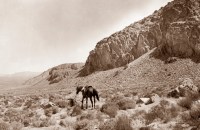
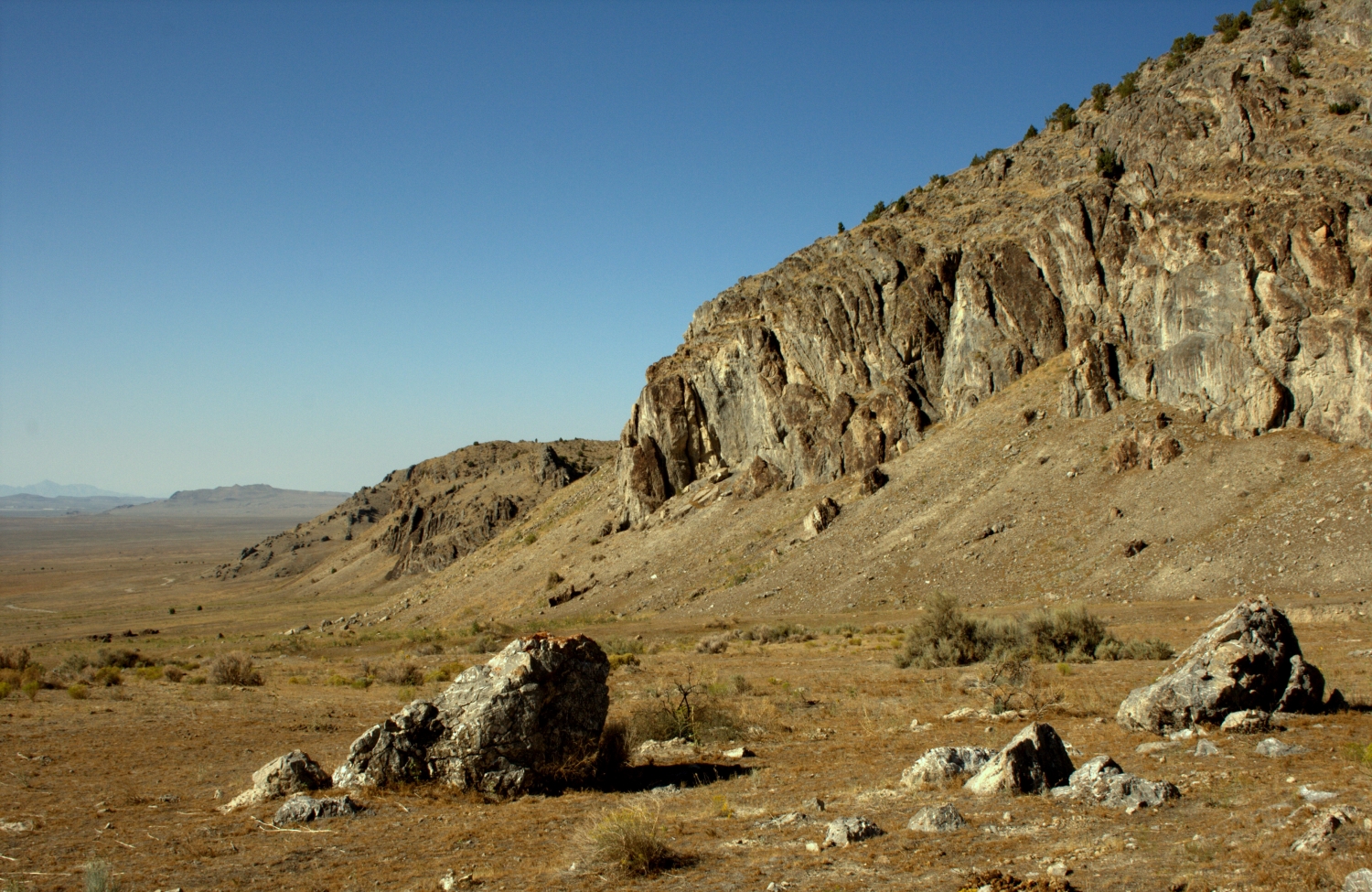
1901.  Cedar Mountains by G. K. GilbertThis pair of photographs from the Great Basin Desert illustrates what recurring fire can do in the desert.  (Click on the images for a larger view.)  The first photo was taken in 1901 by geologist G. K. Gilbert (USGS Photo Library).  It shows fairly even cover by the small native shrubs dominating the vegetation of the area.  In 1901 there was no travel in this area except by horseback or wagon.  Gilbert was fond of the horse, named her Sally, and included her in many of his documentary photos.

2008.  Cedar Mountains by Garry RogersThe second photo was taken in 2008 and shows that as far as the eye can see, most of the shrubs are gone.  They have been replaced by fire tolerant non-native weeds.  This area burns so frequently now that the U. S. Bureau of Land Management stewards of the land have begun burning the land themselves to help prevent surprise fires that disrupt traffic on the nearby interstate highway.

The second photo is presented below in color and larger size to give a clearer view of the extent of the barren weed/fire landscape.
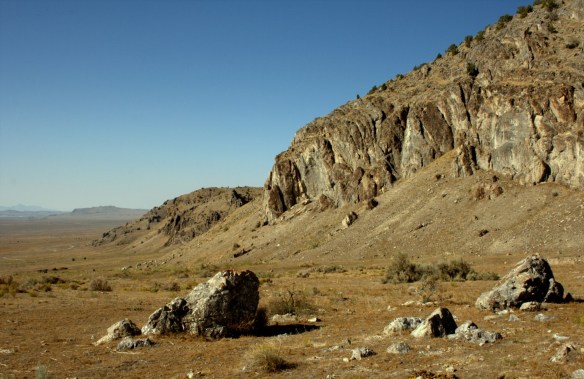
2008.  Cedar Mountains by Garry Rogers (color)

Forest threats include more than just warming climate.  Some climate models predict increased forest fire occurrence as climate warms (Smithwick et al. 2013:  2).  It is likely, however, that fire prone weeds will increase.  Invasive weeds do poorly in the shade of mature trees.  As domestic livestock, loggers, and drought continue to disturb forest soils and remove the shade cast by tall trees, weeds will increase.  As has happened in lower, drier habitats we may lose many native forest species.

References

Rogers, G. 1982.  Then and now:  A photographic history of vegetation change in the central Great Basin Desert.  University of Utah Press, Salt Lake City, UT.  152 p.

Rogers, G., and J. Steele.  1980.  Sonoran desert fire ecology.  Pages 15-19 in  Proceedings of the fire history workshop, USDA Forest Service GTR-RM81. 142 p.

Smithwick, E.A.H., et al.  2013.  Climate, fire and carbon:  Tipping points and landscape vulnerability in the greater Yellowstone ecosystem.  JFSP Project No. 09-3-01-47.
Go back

Your message has been sent

Warning
Warning
Warning
Warning

Warning.