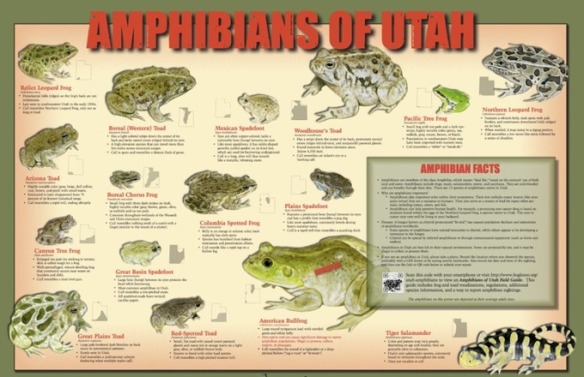
The season to spot frogs and toads has arrived, and Hogle Zoo is part of a nationwide, citizen-science effort to monitor them in Utah. The zoo’s Suzanne
Source: kuer.org

The season to spot frogs and toads has arrived, and Hogle Zoo is part of a nationwide, citizen-science effort to monitor them in Utah. The zoo’s Suzanne
Source: kuer.org
 “If you record or are interested in recording wildlife then we would love to hear from you. We can offer advice and support, access to some training and help with managing data and providing data to TWIC. If you would like maps, data or any other information to help you with your recording work then get in touch and we will see how we can help.
“Every year we organise survey work at a number of sites and are always looking for more recorders to help. We also organise public surveys, to encourage as many people as possible to get involved in recording. See the link to recording events to see reports of recent meetings and find out what is going on in the near future. We also occasionally put out special requests for sightings of particular species – see the Request for Data page.
“For help with the identification of particular groups see the ‘List of Local Experts’.”
Source: www.wildlifeinformation.co.uk
GR: Scotland has a smaller population than Arizona, my home state. Yet I am not aware of a comparable program here. If any of you Arizona readers know of a state supported program like this, please add a comment. Thank you.
P.S. Note that none of the wildlife information being collected could be acquired from space.
 ATHENS — Greene Land Trust and Cornell Cooperative Extension of Columbia and Greene Counties on Saturday invited residents to spend Valentine’s Day with nature by learning about the opportunities available in citizen science at the Willows at Brandow Point.
Source: www.thedailymail.net

“Launched in 2009, iSpot is a citizen science platform aimed at helping anyone, anywhere identify anything in nature. To date, around 42,000 people have registered as iSpot users and over 390,000 observations have been made, leading to the identification of more than 24,000 species.”
Source: www.sciencecodex.com

“Celebrate this Valentine’s Day outdoors by joining the 18th annual Great Backyard Bird Count, which begins Friday and ends Monday.
“It’s simple. Identify and count birds for at least 15 minutes on one or more days during the count and enter your sightings online at birdcount.org. The information gathered by tens of thousands of volunteers helps track changes in bird populations on a massive scale.
“Citizen science participation projects like the Great Backyard Bird Count are not only essential to helping us achieve conservation success across New York State, they also offer to opportunity to understand and appreciate nature on a much more personal level,” said Erin Crotty, executive director of Audubon New York, in a news release about the event.
“Last year’s count — a joint project of the Cornell Lab of Ornithology and the National Audubon Society with partner Bird Studies Canada — showed unprecedented numbers of snowy owls reported across southeastern Canada, the Great Lakes states, the Northeast and down the Atlantic Coast.
“This year’s is expected to show “higher than usual numbers of both snowy owls, pine siskins and redpolls, although not to the extent of last year’s snowy owl eruption,” according to the Audubon news release.”
 Great Falls Tribune: “The Montana Wilderness Association is looking for backcountry citizen scientists to help collect data on wolverines and other wildlife on the east side of the Continental Divide.
“Volunteers are needed to help with wildlife monitoring efforts by adopting one or more routes within the study area and surveying them throughout the winter.
“In past years, MWA, in partnership with Winter Wildlands Alliance, Wild Things Unlimited, Defenders of Wildlife and the Helena National Forest, has identified several wolverines, as well as lynx, grizzly bears and other forest carnivores west of the Continental Divide.
“However, little is known about wildlife presence or activity on the east side of the Divide near Nevada Mountain.
“Volunteers need to be backcountry-savvy and prepared to work and travel in a remote winter environment. Proper equipment (skis or snowshoes) is required.”
This journal is intended to be by scientists for scientists. Still, there might be an occasional practical insight or useful tidbit. Probably worth a bookmark.
Call for papers–Inaugural Issue and beyond
Citizen Science: Theory and Practice is a new open-access, peer-reviewed journal published by Ubiquity Press on behalf of the Citizen Science Association. It focuses on advancing the field of citizen science by providing a venue for citizen science practitioners and researchers—e.g., scientists, information specialists, conservation managers, community health organizers, educators, evaluators, urban planners, citizen scientists, and more—to share best practices in conceiving, developing, implementing, evaluating, and sustaining projects that facilitate public participation in scientific endeavors in any discipline.
We believe that a central space for scholarly exchanges across disciplines will provide greater visibility for citizen science and will help to strengthen and advance this rapidly growing field. The multi-disciplinary journal will ensure that key insights and exchanges can become part of an expanding body of broadly accessible academic scholarship rather than being shared narrowly among citizen science practitioners, evaluators, and funders within their existing…
View original post 308 more words

The Andean Cat Alliance has two priorities. The first is to learn the cat’s range, numbers, and ecology. The team hikes the mountains and monitors camera traps to find and count the cats. So little is yet known of the cat’s behavior, that sightings depends on luck. The second priority is community education. The group makes presentations to students, ranchers, and communities members across the vast territory occupied by the cats. The education goal is to encourage communities to practice sustainable agriculture and land use that will preserve the cat’s habitat.
The human population of the Andes is growing. The rate of loss of the Andean Cat’s habitat isn’t known, and after 15 years of organized effort, the size and stability of the cat’s population isn’t known. Like most species of wildlife worldwide, the Andean Cat could slide away into oblivion before we even understand how and where it lives.
What can we do? There are many opportunities to give money and volunteer time to survey and study wildlife. There are also many opportunities to urge management of the principal cause of the cat’s decline: human population and its environmental impacts.
This film by the Wildlife Conservation Network describes the 15-year effort by scientists, students, and volunteers to protect the Andean Cat.
Thanks to Fighting For Hope’s Blog for pointing out the film.
 A reader recently said they liked the opportunities appearing in this blog. There are opportunities to sign petitions, state opinions, give moral and financial support, and make suggestions. There are many many more. In most cities and towns you will find groups to join that regularly make efforts to study natural subjects. Below are more of the opportunities to help collect information needed to understand and protect wild plants and animals. Wikipedia, Scientific American, and the National Wildlife Federation list others. I haven’t investigated the opportunities enough to make recommendations. If you have personal experience, please add a comment. Thank you.
Citizen Naturalist Projects Table
Oceans 2 Earth–Opportunities worldwide

 GarryRogers Nature Conservation