Snowshoe hares face climate change challenge

GR: I have run out of digits on which to count the ways that humans are destroying wildlife and its habitat.

Snowshoe_hare_transitional_coloring

Bob Berwyn's avatarSummit County Citizens Voice

‘That mismatch does indeed kill’

Staff Report

For millennia, snowshoe hares have camouflaged themselves from predators by blending in with their surroundings, turning pure white in the winter to blend in with the snow, then brown in the summer.

But climate change is shifting the timing of the snow season, and the hares may not be able to adapt in time, according to a North Carolina State University study published in the journal Ecology Letters.

Based on field research with radio-collared snowshoe hares in Montana, mismatched snowshoe hares suffer a 7 percent drop in their weekly survival rate when snow comes late or leaves early and white hares stand out to predators like “light bulbs” against their snowless backgrounds.

View original post 309 more words

Reporting On Fire Sends Mixed Information

One can’t know what was really said by someone in a news report–reporters do get quotes wrong–but I would agree with the Chris Topik, TNC representative, that more people are living in the forest and thus vulnerable to fire. But I disagree with his implied solution that we need more logging of the forest, rather it rests with the county governments to limit home building in these areas, and to reduce the flammability of homes not the forest. We simply cannot log our way to a fire-proof forest.  www.thewildlifenews.com

GR:  Whenever the U. S. Forest Service claims that forests need to be logged, you can bet there is a large corporation that is going to profit.

Climate Change and Wildfire

Wildfire Ecology

I’ve been interested in natural vegetation response to wildfire for more than 40 years. Most of my work involves the desert shrublands and woodlands of western North America. From the beginning of my studies, I saw that Asian weeds brought by European sheep and cattle herders had heavily infested native vegetation. It soon became clear that added fuel provided by the weeds was allowing fires to increase in size and number. During the past century and a half, the weeds have replaced vast areas of native shrublands and woodlands that could not contend with the increasing wildfires.

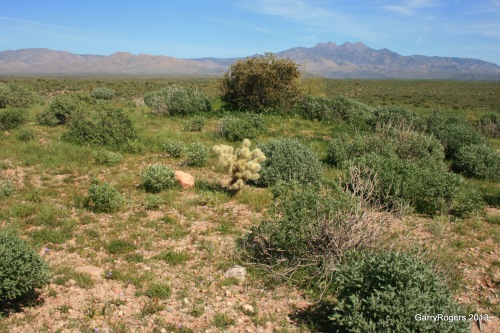
Fire-prone invasive plants fueled fires that converted this formerly diverse Sonoran Desert landscape of small trees and tall Saguaro cactus into an impoverished shrubland.

This is one of the study sites that Jeff Steele and I established in 1974.  Two fires (1974 and 1985), converted this formerly diverse Sonoran Desert landscape of small trees and tall Saguaro cactus into an impoverished shrubland.

Humans with their weeds and livestock led the first devastating wave of wildfire across the arid and semi-arid lands of the world. The next wave will come from human-caused global warming.

The following is from Global Warming Forecasts

[Click this link for my review of the Forecasts.  Below, I’ve include 2050 as an example of the forecasts.]

2050 Wildfires

“2050.  Forest wildfire burn area in the U.S. is projected to increase by over 50% and as much as 175% in some areas by 2050.  “The area of forest burnt by wildfires in the United States is set to increase by over 50% by 2050, according to research by climate scientists. The study [Impacts of climate change from 2000 to 2050 on wildfire activity and carbonaceous aerosol concentrations in the western United States], predicts that the worst affected areas will be the forests in the Pacific Northwest and the Rocky Mountains, where the area of forest destroyed by wildfire is predicted to increase by 78% and 175% respectively.

“The research is based on a conservative temperature increase of 1.6 degrees Celsius over the next 40 years [2010-2050]. Published in the Journal of Geophysical Research, scientists also say that the increase in wildfires will lead to significant deterioration of the air quality in the western United States due to greater presence of smoke. . . . This work was funded by the U.S. Environmental Protection Agency (EPA) and National Aeronautics and Space Administration. Dr. Dominick Spracklen carried out the research whilst at Harvard’s School of Engineering and Applied Sciences (SEAS) in collaboration with Jennifer Logan and Loretta Mickley.” (NASA press release, “Wildfires Set to Increase 50 Percent by 2050,” NASA Earth Observatory, Twitter NASA EO, Greenbelt, Maryland, July 28, 2009 reporting findings in D.V. Spracklen, L.J. Mickley, J.A. Logan, R.C. Hudman, R. Yevich, M.C. Flannigan, and A.L. Westerlin, “Impacts of climate change from 2000 to 2050 on wildfire activity and carbonaceous aerosol concentrations in the western United States,” Journal of Geophysical Research, Vol. 114, D20301, doi:10.1029/2008JD010966, published October 20, 2009.” Global Warming Forecasts

View Jennifer Logan’s PowerPoint presentation on wildfires.


A Blizzard Roars Out of Climate Change’s Heart — Polar Warming and A Record Hot Atlantic Ocean Brew Up Nightmare Storm for US East Coast

GR:  Here’s an informative article describing linkages between violent storms (the one on January 22-23, 2016 in particular) and human-caused global warming.  Good luck to everyone in this storm’s path.

robertscribbler's avatarrobertscribbler

There’s a historic blizzard in the form of Winter Storm Jonas setting its sights on the US East Coast. The storm is slowly coming together Thursday evening and now appears to be set to paralyze a 1,000 mile swath under 1 to 2.5 feet of snow even as it hurls a substantial storm surge and 40-60 mph winds at waterfront cities from Norfolk to Boston. A monster storm whose predicted formation has made headlines since Tuesday. But what you won’t hear most major news sources mention is the likelihood that this gathering storm has been dramatically impacted by a number of new climate features related to a human-forced warming of the globe.

Jonas Begins its Ocean-heat Fueled Rampage in Southeastern US

(Jonas begins its ocean-heat-fueled rampage on the evening of Thursday, January 21. Image source: NOAA.)

A Warming Arctic Shoves the Cold Air Out

To understand how climate change helped make Jonas so extreme, it’s best if…

View original post 1,282 more words

Mike Baird’s war on trees is threatening our biodiversity

“Not satisfied with these local assaults on trees, the NSW government is moving to declare wholesale war on the entire state. It is intent on abolishing the Native Vegetation Act, passed by Parliament in 2003 to stop broadscale land clearing. It will be replaced by a so-called Biodiversity Conservation Act that will apply many of the current tree destruction tools in the government’s armoury to the city and the country.

“Offsets are the new mantra and the weak “major projects offsets policy” will become the rule. This states that if you can’t find a “like for like” offset (inevitable in urban areas), then almost anything else will do, including developer payments to a fund or rehabilitating a mine site (when this should be entirely the responsibility of the mine owner). It’s a sure recipe for the extinction of more endangered habitat. The Native Vegetation Act, which has saved hundreds of thousands of hectares from the bulldozer and chainsaw, had scientifically based rules about what should be protected (red lights) or offset with integrity. But no more under this new legislation – you can buy your way out.”  www.smh.com.au

GR:  Sydney’s governmental war on trees is not unusual. Road and transmission corridor builders often appear to have less respect for nature than other government agencies.

Global Warming Forecasts | #climatechange

Expert Global Warming Forecasts

GR:  This reference covers global warming forecasts that scientists have made for the years 2015, 2020, 2025, 2030, 2035, 2040, 2050, 2080, 2090, and 2100.  Projections by well-known scientists and peer-reviewed publications make this a dependable resource.  Reading it, you might be amazed that there has been so much doubt and so little action on global warming.

“The colors on the map show temperature changes over the past 22 years (1991-2012) compared to the 1901-1960 average for the contiguous U.S., and to the 1951-1980 average for Alaska and Hawai’i. The bars on the graph show the average temperature changes by decade for 1901-2012 (relative to the 1901-1960 average). The far right bar (2000s decade) includes 2011 and 2012. The period from 2001 to 2012 was warmer than any previous decade in every region.” (U.S. Global Change Research Program)

This map shows what has actually happened in the U. S. “The colors on the map show temperature changes over the past 22 years (1991-2012) compared to the 1901-1960 average for the contiguous U.S., and to the 1951-1980 average for Alaska and Hawaii. The bars on the graph show the average temperature changes by decade for 1901-2012 (relative to the 1901-1960 average). The far right bar (2000s decade) includes 2011 and 2012. The period from 2001 to 2012 was warmer than any previous decade in every region.” (U.S. Global Change Research Program)

The following is from the Global Warming Forecasts website.

“Global warming forecasts trace their history back to the works of Swedish chemist Svante Arrhenius (1890s), American geologist Thomas Chamberlain (1890s) and British engineer Guy S. Callendar (1930s and ’40s).

“In the 1950s, after oceanographers Roger Revelle and Hans Suess published research findings concluding that “human beings are now carrying out a large-scale geophysical experiment” by discharging greenhouse gases into the atmosphere, Revelle, director of the Scripps Institution of Oceanography, recruited geochemist Charles David Keeling to begin the process of taking long-term measurements of carbon dioxide (CO2) concentrations in the atmosphere.

“When Keeling started taking CO2 measurements at the weather observatory at the top of the Mauna Loa volcano in Hawaii and on the continent of Antarctica, he established the baseline for collecting the data that would begin the modern era of global warming forecasting.

“Since Revelle’s and Keeling’s landmark work in the 1950s, global warming forecast research has expanded to develop projections based on concentrations of other greenhouse gases such as methane (the principal component of natural gas), carbon monoxide and nitrous oxide as well as temperature data, precipitation, weather patterns and specific ecosystems.

“Global warming forecasting and research formats, however, have tended to be linear or vertical in nature, i.e., focusing on observations of singular data sets over time such as:

[GR:  These links take you to some excellent articles.]

“Similarly, projections of climate change impacts have tended to focus on specific sectors such as water resources, energy supplies, energy usage, transportation, human health, food, specific ecosystems, geographic regions, countries and continents.

“Here and on the pages that follow is a look at global warming forecasts from a “confluence forecast” or “convergence forecast” perspective. Rather than the conventional vertical format, we look at multiple converging forecasts presented in a horizontal or more integrated “side-by-side” context.” — http://www.global-warming-forecasts.com/

 

Inside the US agency charged with killing a ‘mindboggling’ number of animals

“Wildlife Services funds the lethal control methods, but they don’t fund the nonlethal,” says Fox. “That in and of itself disincentivizes nonlethal methods, and incentivizes the reliance on the federal government for predator control. The reliance on an agency for that kind of subsidy is really, really hard to counter.” www.theguardian.com

GR:  The policies of the U. S. Department of Agriculture’s Wildlife Service demonstrate the way American land-use agencies place the interests of ranchers first and the interests of wildlife and the land second. It is clear now that as long as land managers must fear politicians controlled by special interests such as the National Cattlemen’s Beef Association (http://bit.ly/1Nkudid), and the National Livestock Producers Association (http://www.nlpa.org/), there can be no safety for wildlife and its habitats.  Of course, the destruction of nature by its appointed stewards is not limited to America; human governments worldwide conduct it. Will we ever see a government created for the good of the Earth and all its creatures? In the midst of the great human-caused mass extinction, it appears that we will not.

I write EcoSciFi, science fiction with an ecological theme. Here’s an idea for a story about the future of nature conservation:    As the destruction of wildlife becomes apparent to all people, privately funded wildlife-protection militias embedded with the animals will spread. Local governments will oppose these defenders of nature, arms manufacturers will sell to both sides, and violence will escalate. Humanity will have created another force behind its descending spiral to oblivion.

Saving the Maya rainforest

“The Selva Maya is home to immense biodiversity – and the ancient Maya city of Tikal. Today, the forest is under threat but NGOs and locals are working together to save it, along with their livelihoods.”  www.dw.com

GR:  Most of the Mayan rainforest is already gone. The nonsensical idea that it can be saved by teaching people to harvest the nuts from the trees sounds like greenwashing for GIZ, the German development organization.  The human population in the area is growing. The nuts will eventually become inadequate to support them, and the remaining trees will begin to disappear.

Cranky Parrots? Weird Island Animals Described in Long-Lost Report

“Although Pretorius’ letter touches on the various ungulates — including cattle, goats, pigs and deer — that the Dutch brought to Mauritius, the most enlightening portions of the text describe the island’s indigenous life.

“For instance, based on other reports, Hume had previously argued that the island’s raven parrot, which became extinct in 1675, had a blackish-brown body with a blue head and possibly a red beak. But based on Pretorius’ descriptions and a re-examination of other accounts, Hume now thinks the bird was brightly colored and predominantly red. [6 Strange Species Discovered in Museums]

“Pretorius’ account also suggests the raven parrot was behaviorally flightless (it couldn’t fly well, despite having the biology to do so) and that this flaw likely led to the creature’s demise. The bird was tough and aggressive — or “very bad tempered,” as Pretorius described it — and able to fend off introduced predators such as black rats and crab-eating macaques, but only for so long, Hume said.

“The parrot’s obstinate attitude also prevented it from being transported elsewhere. “When captive, it refuses to eat,” Pretorius wrote. “It would prefer to die rather than to live in captivity.”  www.livescience.com

GR: Bad tempered and refusing to eat in captivity, the Raven Parrot sounds like an admirable bird, but it was soon erased from the Earth by humans and the invasive species they brought to the island.