Warm Arctic Storm To Hurl Hurricane Force Winds at UK and Iceland, Push Temps to 72+ Degrees (F) Above Normal at North Pole

“These winds will bring with them extraordinarily warm temperatures for the High Arctic region during Winter time. By Wednesday, the North Pole is expected to see temperatures in the range of 1-2 degrees Celsius or 41-42 degrees C above average (73-75 degrees Fahrenheit above the normal daily temperature of -40 F for a typical Winter day). Such an extreme departure would be like seeing a 120 degree (Fahrenheit) December day in my hometown of Gaithersburg, MD. Needless to say, a 1-2 C reading at the North Pole during late December is about as odd as witnessing Hell freezing over. But, in this case, the latest wave of warmth issuing from a human-driven shift toward climatological hell appears to be on schedule to arrive at the North Pole in just a few more days.”  From: robertscribbler.com

GR:  Climatologists expect the arctic to warm faster than the rest of the planet. I remember in my Climatology class in 1970, the professor talked about drastic events that would occur if the cold polar high pressure system broke down. It appears to be broken. I guess this type of storm will become common as the Earth warms and climate changes.
Where Have All the Goldfinches Gone?

Lesser Goldfinches (Spinus psaltria) Decline

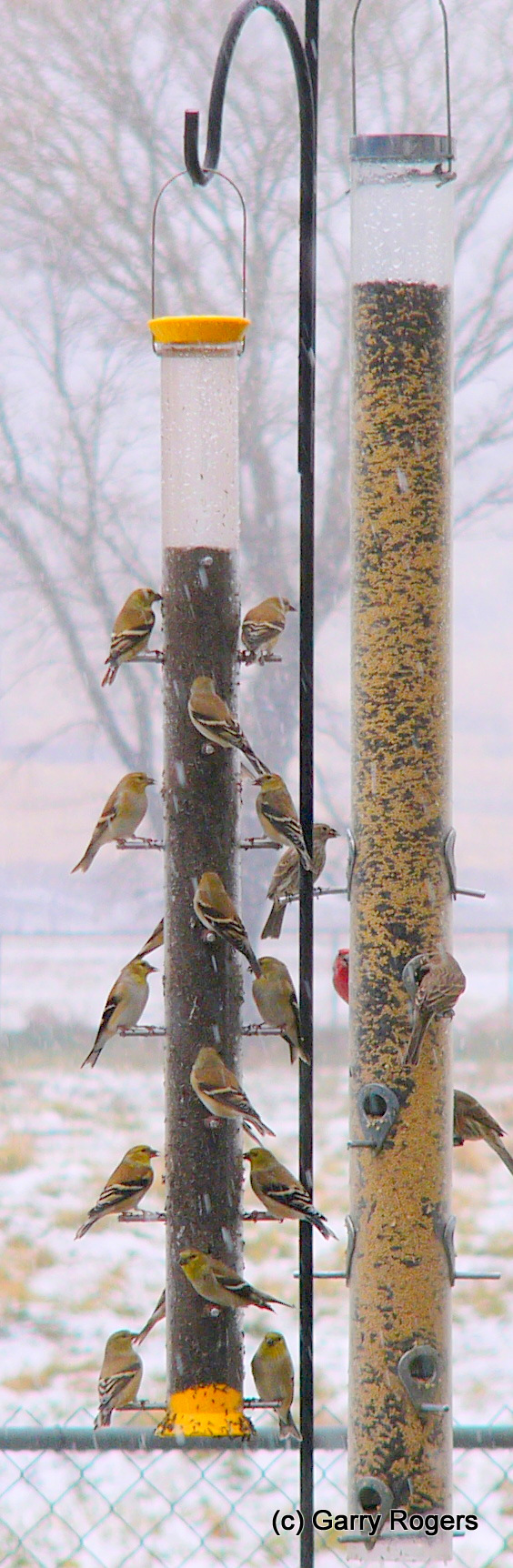
1-B0000254These fussy little birds have been common around my Lesser Goldfinchhouse for years.  I feed them thistle seeds, let Barnyard Grass (usually considered a weed) grow in patches, and I plant lots of native sunflowers. Through summer the finches switch between pecking thistle-seeds and nibbling sunflower leaves, and later they add Barnyard Grass and sunflower seeds. Dozens of birds were always present most of the year, but they have almost disappeared over the past two years.

Photo above:  (December, 2004) I fed goldfinches with this thistle seed feeder (on the left) for several years, but it was so hard to clean I switched to a bag made by my friend Sheila.

In winter the five-pound bag of thistle seeds would last three days.

In winter the birds would empty a five-pound bag of thistle seeds in three days (March, 2007)

Last year (2014), birds visited the thistle bag, but they never emptied it. They pecked only a few sunflower leaves.  No birds came during fall and winter.  This year (2015), I saw goldfinches on the thistle bag only once, and they pecked no leaves.

The Arizona Game and Fish Department ranks Lesser Goldfinches as “common, widespread, and abundant.”  However, this might be changing.  The birds prefer disturbed weedy areas, but the deluge of herbicides sprayed on pastures, crops, yards, and roadsides has wiped out much of this habitat.  Like Monarch Butterflies, the Goldfinches may turn out to be unintended victims of Monsanto’s war on nature.

The editor of my hometown newsletter agreed to run a short note asking if anyone else had noticed a Lesser Goldfinch decline.  The town staff must have considered the note inappropriate.  They removed it, leaving an empty space in its place.

I washed the thistle-seed bag and filled it with fresh seeds. I hope the Goldfinches return and fill the empty spaces on my feeders and sunflowers.

If you have noticed changes in your goldfinch population, please add a comment.

This Christmas (2015) Shattered Heat Records

“There was no white Christmas for the eastern half of the U.S. this year, far from it in fact. Record high holiday temperatures in several states — 86 degrees in Tampa, Florida, 83 degrees in Houston, Texas, 67 degrees in Boston, Massachusetts, 68 degrees in Burlington, Vermont and 66 degrees in New York City, just to name a few — are an exclamation point on the end of what will be the globe’s hottest year to date.

“The heat is adding fuel to severe weather in several states, storms that turned deadly across the South.”  From: thinkprogress.org

GR:  Weather, El Nino, and something more.

A Weapon Against Climate Change May Be Right Under Our Feet

Healthy soil may play a huge role in mitigating global warming and helping us adapt to it.  From: www.huffingtonpost.com

GR:  Healthy soil contains a rich array of microorganisms that are adapted to the site and to the plants and animals growing on the soil. Healthy soil blocks weed invasions, reduces flooding by absorbing precipitation, and produces the most plant growth.  Centuries of farming and livestock grazing have destroyed most soils.  Cows compact the soil, break up the essential surface and subsurface biological crusts. Flooding increases and carries with it the finest soil, the topsoil. Researchers have learned that it takes decades and even a century for damaged soils to recover.  I know of no places that gauge their rest-rotation cycles in decades.  However, that is what is required to restore the soil.  We must begin now restoring our soils. It’s too late to block climate change, but healthy soil is essential if we hope one day to have healthy ecosystems again.

Climate Denial Crock of the Week

As the eerily warm, moist autumn in Eastern North America dribbles into an even eerier, water logged Christmas season, we’ve seen a lot of ham fisted reporting along the lines of, “What about all this warm weather, is it climate change?”, with the teeth grindingly shallow answer being, “why no, it’s El Nino!”.

I asked Mike Mann of Penn State to weigh in.

“Yes, El Nino is part of it. So are the vagaries of weather. But so too is human-caused climate change. We’ve had weather before, we’ve had big El Ninos before. We have never, at least during my adult life,had anything like this before. Near 80F in DC on Christmas Eve day? That’s not “weather” and it’s not “El Nino”. It is something more.” From: climatecrocks.com

GR:  Something more indeed.

What Exxon Knew, Texaco and Other Oil Companies Knew Too

All the Oil Companies Knew

GR:  Hard evidence shows that our major oil companies knew the damage they were doing and it shows that they spent money to hide the evidence. Now if we can prove  damages, we can prosecute the oil companies for reparations. Winning will force energy producers to cut CO2 emissions and to compensate their victims.

The big question is whether the oil businesses have enough money to subvert national legal systems and prevent prosecution of the corporations and their directors. Will this be like the bank bailouts where we gave the criminals financial rewards?

Peter Sinclair of Climate Denial Crocks submitted the following story. The video and the full story linked to Sinclair’s item are well worth watching.

What Exxon Knew, Texaco Knew, Too

“And so did Chevron, Amoco, Phillips, Shell, Sunoco and Sohio.  Newest installment in the incredible and tragic saga of what the oil industry knew about climate change, and when they knew it – the most under-reported story of 2015.

“A snip here, but go to the link for the whole piece. And if you haven’t yet, check the video above, and go to Inside Climate News to follow up on the whole story.”

Inside Climate News:

An InsideClimate News investigative series has shown that Exxon launched its own cutting-edge CO2 sampling program in 1978 in order to understand a phenomenon it suspected could harm its business. About a decade later, Exxon spearheaded campaigns to cast doubt on climate science and stall regulation of greenhouse gases. The previously unpublished papers about the climate task force indicate that API, (American Petroleum Institute) the industry’s most powerful lobbying group, followed a similar arc to Exxon’s in confronting the threat of climate change.

Just as Exxon began tracking climate science in the late 1970s, when only small groups of scientists in academia and the government were engaged in the research, other oil companies did the same, the documents show.”

Decision to declare lions endangered comes just months after the death of ‘Cecil the Lion’

GR:  American trophy hunters just aren’t rich enough to stop this move. In other instances, it is clear that protecting economic interests is more important to the Fish and Wildlife Service than protecting wildlife (e.g., the Greater Sage Grouse: http://www.fws.gov/greatersagegrouse/status.php). That’s the way it is in America. Government agencies that actively harm the wildlife or ecosystems in their care are just one more consequence of a government controlled by money.

Exposing the Big Game's avatarExposing the Big Game

Theo-Bronkhorst-Cecil-lion-Zimbabwe2

“If hunting is part of a conservation strategy, then it’s part of a failing strategy,” said Dan Ashe, director of the U.S. Fish and Wildlife Service, on a conference call for journalists. The rule is “not reacting to Cecil specifically or any other incident specific, but rather an overwhelming body of science that says that lions are threatened.”

Hefty fees paid in the by hunters of big game like lions ostensibly help fund conservation efforts. But some wildlife experts question whether the policies have been effective as implemented. Lion populations have declined by 43% during the last 20 years, according to the FWS.

The endangered listing comes along with a number of new policies, including new permit requirements for hunters hoping to import trophies from lion hunts. The agency said it will only issue permits in accordance with science on how best to conserve lion species. The rules…

View original post 95 more words

What Happened to the Polar Vortex?

“It has been ridiculously warm across the eastern half of the country this month, with many spots likely to see their warmest December on record. New York City may reach as high as 72°F on Christmas Eve. Washington D.C. is forecast to reach the mid-70s, and Miami the mid-80s. One of the factors behind this decidedly un-Christmas-like weather is a feature that came to be associated with the brutally cold winters of the past few years: the infamous polar vortex.

“But if you like warm winter days, enjoy it while you can. Because while the current state of the polar vortex is keeping dreams of a White Christmas at bay, a shift could soon be in the offing, one scientist says, potentially ushering in a more typical winter wonderland in January.”  From: www.climatecentral.org

Paper estimates widespread tree death in Southwestern forests under global warming scenarios

A research paper published today in Nature Climate Change predicts widespread death of needleleaf evergreen trees (NET) within the Southwest United States by the year 2100 under projected global warming scenarios.

From: phys.org

GR:  Dead trees are already a common site across the Southwest.