Wildlife and Fire in Australia and Shrinking Polar Sea Ice

Humans helping other species always seems like good behavior.  In the second part of this post dealing with polar bears, it seems that humans are harming other species.

Eli Spiritweaver's avatarEarth Report

South Australia Wildfires Kill and Injure Many Animals

Some of South Australia’s worst wildfires in 30 years killed or injured an untold number of animals earlier this month in addition to destroying at least 32 human homes and sending 100 people to hospitals.

Many surviving animals have been left without food, water or access to shelter.

Among the more heartbreaking images to come out of the firestorms near Adelaide were photos of koalas being treated for burnt paws.

The head of one animal rescue organization said that when caught in a wildfire, koalas “get to a point where they are in so much pain … they just sit at the bottom of a tree and scream.”

A public appeal for people to make mittens for the burnt marsupials was quickly heeded.

Most of the rescued koalas are expected to recover enough to be returned to the wild.

Ew150116c

Polar Bears Head…

View original post 170 more words

Citizen Naturalist Field Work Opportunities

Citizen Naturalists

be006e79-7518-451d-b25d-393d8641a2a4A reader recently said they liked the opportunities appearing in this blog.  There are opportunities to sign petitions, state opinions, give moral and financial support, and make suggestions.  There are many many more.  In most cities and towns you will find groups to join that regularly make efforts to study natural subjects.  Below are more of the opportunities to help collect information needed to understand and protect wild plants and animals.  Wikipedia, Scientific American, and the National Wildlife Federation list others.  I haven’t investigated the opportunities enough to make recommendations. If you have personal experience, please add a comment.  Thank you.

Citizen Naturalist Projects Table

Others

Oceans 2 Earth–Opportunities worldwide

Opportunities Presented on this Blog

Why 2015 Should be a Good Year for Wildlife

(Photo: David Fettes/Getty Images)

“There’s always plenty of reason to get depressed about the prospects for wildlife at the start of the New Year.  Environmentalists were, for instance, unable to stop last weekend’s predator hunting derby by Idaho’s abundant population of anti-wolf idiots.  But there’s good news, too: They didn’t kill any.  (In fact, it took the sound and fury of 125 hunters to shoot just 30 coyotes).

Better still, a study published last month in the journal Science reported that even if the Idaho effete tremble at the idea of living with their native predators, Europe is handling them just fine.  In fact, the continent that gave us “Little Red Riding Hood” and “the Big Bad Wolf,” is now home to twice as many wolves as the contiguous United States, despite being half the size and more than twice as densely populated.

Source: strangebehaviors.wordpress.com

Generation Wild: Youth and the Battle to Save Biodiversity

“From kindergarten kids to high-schoolers, youth all over the world are recognizing that they’re urgently needed to help save our planet from the disappearance of unique endangered species; the pollution and destruction of wildlands where we play, hike, bike and camp — and even climate change, which could change all our lives, dramatically,forever.  Go to the CBD to use the interactive map to obtain local endangered species lists.

“The Center for Biological Diversity deeply appreciates that young people are caring more and more about our planet and its nonhuman inhabitants, from tiny butterflies and beetles to the great white polar bear and the Arctic seals it preys on — and that some of these youths are taking incredible steps to help protect them. Even just learning about animals and plants, and all that threatens these irreplaceable species, could help ensure their survival. Education is the first step toward action” (Source: www.biologicaldiversity.org).

GR:  The battle to save Earth’s biodiversity will not end soon.  Coming generations must be introduced to the issues so that they can decide whether or not to begin working to protect their environmental future.  This article from CBD offers suggested topics to present to children.

Some creatures use electricity and vibrations in sex (and this can be dangerous)

Most animals use touch, smell, hearing, taste and sight to identify and attract a mate (that goes for humans too).

Source: phys.org

This study confirms that other species suffer from one of the same sexual problems we’ve seen in our own species; male efforts to hook up can be harmful, even lethal.

California’s Environmental Devastation: Waking Up Is Hard to Do

California remains emblematic of the American dream – and of how that has become a nightmare.  Read more.

Source: truth-out.org

GR:  Anyone familiar with natural landscapes recognizes that California has suffered destruction on a grand scale.  So great has been the loss of wildlife and wild habitat, thousands of years will be required for recovery once we are gone.  The longer we remain, the more that is permanently lost.

Squirrels and beavers contributing to global warming more than previously thought

Arctic ground squirrels churn up and warm soil in the Tundra, releasing carbon dioxide, while beavers contributes 200 times more methane than they did 100 years ago

Source: www.telegraph.co.uk

GR:  Lot’s of worthwhile comments for this one.  Here’s mine:  “Squirrels improve soils, beaver reduce flooding, and both species feed predators.  Dynamic balance occurs.  What can balance humans?”

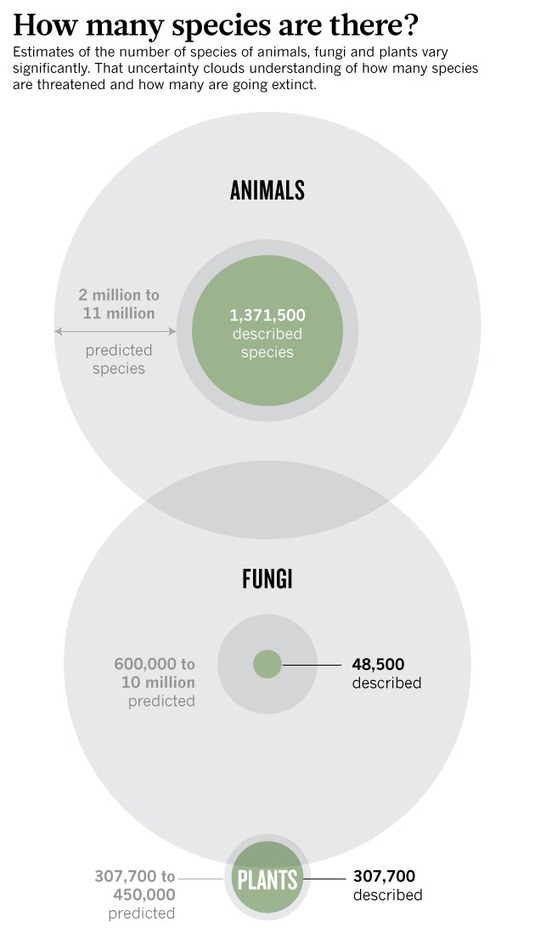
Life ­– a status report

Species are disappearing quickly — researchers can only guess how quickly.

Source: www.nature.com

GR:  The status report on life is only an estimate.  Our lack of knowledge of Earth’s unique creatures would be embarrassing if the great dying we’re causing did not evoke more potent emotions.

Biodiversity and Climate Are Connected

Of Course Biodiversity and Climate are Related

Biodiversity and climate are intertwined in the physical realm though separate in the policy world. But during the ongoing climate Conference of the Parties (COP 20) to the United Nations Framework Convention on Climate Change (UNFCCC) in Lima, a diverse group of scientists and policymakers presented a declaration assessing current knowledge on connections between biodiversity vulnerabilities and climate change with the objective of increased integrated activity on the inter-linked issues.

Source: www.ecosystemmarketplace.com

GR:  We must assume that our leaders know there is a connection.