


Like other predatory birds, this young Cooper’s Hawk, resting near my bird feed station, let me get quite close before leaving to let the Mourning Dove and White-crowned Sparrow flocks return. Continue reading
Tag Archives: Arizona
Roads and Transmission Corridors Aid Plant Invasions
Roads and Transmission Corridors
Any type of construction destroys vegetation and disturbs the surrounding area. Roads and transmission corridors do even more.
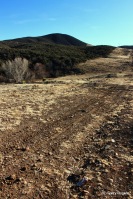
New Pipeline in Central Arizona. Native chaparral removed, heavily grazed, constant traffic.
Throughout human history roads and trails have been the principal routes for long-distance weed dispersal (Cousens and Mortimer 1995). During the past century, power lines and pipelines have spread across the land. Their construction removes vascular plants (Vasek et al. 1975a, 1975b), BSCs (Belnap 2001), and AMFs, and prepares the soil for colonizing weeds. New lines often do not follow existing roads and corridors. Instead, they take direct routes that allow weeds to disperse to areas they would not reach using their own dispersal mechanisms (e.g., Tyser and Worley 1992, Wein et al. 1992, Zink et al. 1995).
Weeds spread with surprising speed along roads and transmission corridors (Macfarlane 1997, Trombulak and Frissell 2000, Pauchard and Alaback 2004, Brisson et al. 2009, Mortensen et al. 2009). The primary dispersal vectors are wind, inspection vehicles, livestock grazing, and recreation vehicles. Continue reading
Outdoor Recreation Aids Invasive Plants
By Garry Rogers
Outdoor Recreation Aids Plant Invasions
 Outdoor recreation does far more than simply transport invasive plants. It disturbs soils and vegetation and takes the lives of animals. Leopold commented on the most violent type of recreation:
“The disquieting thing is the trophy hunter who never grows up. … To enjoy he must invade, possess, appropriate. Hence the wilderness that he cannot personally see has no value to him. Hence the universal assumption that an unused hinterland is rendering no service to society” (Leopold 1949: 176). Continue reading
New Arizona Wildlife Notebook
Arizona Wildlife Notebook, Second edition
 I have completed the second edition of the Arizona Wildlife Notebook! The new Notebook has four more species groups than the first edition, and it has an expanded index. The most important change is in the conservation status for each species. This time, I standardized the information so that future changes will be easier to track. Continue reading
Arizona Damselfly and Dragonfly Conservation Update

Masked Clubskimmer (Brechmorhoga pertinas). Photo from Odonata Central. This species’ conservation status ranking by Arizona Game and Fish Department (AZGFD) is S1, CRITICALLY IMPERILED.
By Garry Rogers
Arizona Damselfly and Dragonfly (Odonata) Conservation
These are my favorite predators. They have been around since before the dinosaurs, much longer than any mammal predator that ever existed. They’ve survived for such a long time because once evolution achieved their form and behavior, it hasn’t been able to find anything better–for over three hundred million years. Continue reading
Arizona Snakes–Checklist and Conservation Status
By Garry Rogers
Arizona Snake Conservation

Kingsnake
Snakes form an important element in the flow of energy through Earth’s web of life. Normally, they help control rodent and amphibian populations while serving as food for larger carnivores. Things aren’t normal anymore. Rodent, snake, and carnivore populations are declining and becoming separated by the assault from human activities ranging from habitat destruction for roads and buildings, to direct predation by domestic cats and dogs. Thus, human activities are severing local and global connections within the web. The total effect is difficult to predict. Continue reading
Arizona Butterfly and Moth Update–November, 2013
By Garry Rogers
Arizona Butterfly and Moth Conservation

Two-tailed Tiger Swallowtail (Papilio multicaudata) Arizona’s butterfly.
Butterflies and moths are pollinators and they are food for other species. I know of no harm they cause to human interests. Nevertheless, many die from insecticide poisoning and others decline due to human removal of caterpillar host plants. The conservation status of these familiar animals is mostly unknown.
Butterflies and moths are not thought of as social insects, but they do interact beyond their feeding and mating behavior. I have watched two Monarch butterflies perched side by side patiently taking turns at a nectar source, and many of us have seen two or more individuals swirling around with members of their own and other species. Continue reading
Arizona Mammals Update–November 2013
By Garry Rogers
Arizona Mammals

I always feel closer to mammals than other species groups. The Rock Squirrel (Spermophilus variegatus) in the photograph is a member of the local colony that lives in the retreating face of eroding lake sediments back of my house. Though they live in burrows and harvest seeds and fallen fruit, these squirrels are great climbers. I often see them in the tops of the pear trees picking fresh fruit and the tops of willow trees eating tender buds. They routinely gather fallen seeds beneath the bird feeders, and it is there that some become nervously tolerant of my presence.
The least skittish of my other neighbors include the raccoons who love to slip in the cat door and eat cat food, the skunks who stroll by brushing my leg in the dark, and the coyotes and deer who often stand and return my stare. Continue reading
Arizona Turtles Update–November, 2013
By Garry Rogers
Arizona Turtles
Turtles have exceptional regenerative powers. Dr. Justin Congdon, a classmate from long ago, managed a study of turtles in the E. S. George Reserve in Michigan for more than 40 years. In the 1980’s Justin made a startling discovery: As they aged, Blanding’s turtles produced more eggs and offspring. In some ways, the turtles became younger as they aged. This reversal of reproductive success with age drew global attention from scientists and others interested in longevity and life extension.
Another interesting trait is resistance to toxic materials. Arizona fish, frogs, and mollusks develop various forms of cancer in response to toxic chemicals in agricultural and urban runoff, and treated waste-water. Turtles do not. Like other species groups, however, Arizona turtles suffer from habitat loss and human harvest.
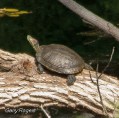 The pond slider (Trachemys scripta) in the photograph is not an Arizona native. It probably arrived as a pet sold by the roadside vendor who comes every summer and sells turtles at a highway intersection upstream from my ponds. There are at least two pond sliders living here. If humans wouldn’t empty the ponds, the pond slider might live at Coldwater Farm long after I’m gone.
(Just after I wrote the above, a visitor harvesting weeds for his sheep, accidentally backed his truck over the pond slider shown in the photograph, killing it instantly.) Continue reading
 GarryRogers Nature Conservation