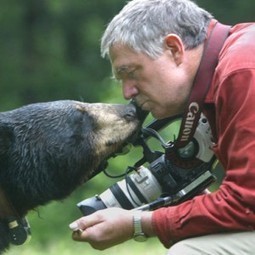
Ben Kilham argues that simple observations are still an important component of conservation science. Everyone can learn to recognize birds and butterflies and note when and where they’re seen. This is the argument I made in the Arizona Wildlife Notebook. The notebook gives Arizona residents and visitors a practical tool for recording animal sightings.
As conservation science increasingly draws from sophisticated models and genomics, does natural history still have relevance? Benjamin Kilham, a dyslexic who has made significant contributions to bear research, builds a powerful case for field observation in his book, “Out on a Limb.”
The second edition of my “Arizona Wildlife Notebook” will be off to the printer (CreateSpace) as soon as I finish the cover. This edition has introductions and checklists for 12 groups of Arizona animal species: Amphibians, ants, bats, birds, butterflies and moths, dragonflies and damselflies, fish, grasshoppers, lizards, mammals, snakes, and turtles. Groups in bold type are new to the Notebook. The introduction to each group covers the group’s conservation issues and provides references for printed and online field guides. The checklist for each group includes scientific and common names and conservation status. I alphabetized each checklist by scientific name, and I included an index for all the common names. Continue reading →
I have completed the second edition of the Arizona Wildlife Notebook! The new Notebook has four more species groups than the first edition, and it has an expanded index. The most important change is in the conservation status for each species. This time, I standardized the information so that future changes will be easier to track. Continue reading →
Butterflies and moths are pollinators and they are food for other species. I know of no harm they cause to human interests. Nevertheless, many die from insecticide poisoning and others decline due to human removal of caterpillar host plants. The conservation status of these familiar animals is mostly unknown.
Butterflies and moths are not thought of as social insects, but they do interact beyond their feeding and mating behavior. I have watched two Monarch butterflies perched side by side patiently taking turns at a nectar source, and many of us have seen two or more individuals swirling around with members of their own and other species. Continue reading →
Grasshoppers, Crickets, and Katydids are familiar to everyone, but there are few records of distribution and conservation status. This report includes a partial checklist for Arizona grasshoppers. Grasshoppers are members of the Orthoptera, one of the most familiar insect orders. Orthoptera includes two suborders: Caelifera (grasshoppers and relatives) and Ensifera (crickets, katydids, and gryllacridoids).
The katydid in the photo is probably Greater Angle-wing Katydid (Microcentrum Rhombifolium). It is common in central Arizona where I live. According to the BugGuide website, the similar California Angle-wing (Microcentrum californicum) also occurs in central Arizona. The two are distinguished chiefly by their songs.
Most singing insects are herbivores. Their occasional population explosions can reduce farm profits, and have led to emphasis on eradication. Protection deserves more consideration. Orthoptera are all important biomass recyclers, and all serve as essential sources of food for other animals. Use of insects for human food is growing in popularity. As the human population continues to swell, the proportion experiencing the culinary delights of bug dinning will grow. We have to wait to see if grasshopper ranches arrive before textured soy protein replaces sirloin.
Orthoptera suffer from habitat loss just as other species groups do. Farms, roads, and buildings are concentrated in valleys near lakes and streams. The selective destruction of natural habitats in these more productive areas alters the size and composition of insect populations. These changes reduce ecosystem diversity, stability, and productivity. The references listed in the Singing Insects of North America website and in the list below are a good place to start to learn more about the ecological importance of these insects.
Grasshoppers
Many of the 400 grasshopper species known to occur in the western U. S. may be present in Arizona, but in the time available to prepare this report I could only verify 59 species from the USDA fact sheets (USDA and Pfadt 2002) and 35 from the Arizona Game and Fish Department (AZGFD–October 2013) website. The list is almost certainly incomplete, and it probably contains outdated names.
I compiled the list from the range maps on the website of the U. S. Department of Agriculture (USDA), and the October 10 species list by AZGFD. The USDA fact sheets include maps, photographs, and the natural history of each species. The Bug Guide provides additional information.
Checklists of plant and animal species one might see in a particular place make useful notebooks for recording sightings. Sometimes called life lists, the species names in such notebooks are comparable to the stamps, coins, and arrowheads collected by others. Though their objects are different, all collectors want to protect their collections. They are all curators or conservationists. Checklists are one of the basic tools for nature conservation.
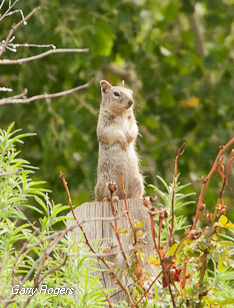
The photograph shows a Rock Squirrel (Spermophilus variegatus) on a fence post. Rock Squirrels prefer rocky areas and we often see them serving as sentries atop boulders. This one lives in a colony near my home on the floodplain of the Agua Fria River in Dewey-Humboldt, AZ. Only one boulder, a stone the size of a large watermelon, can be found anywhere on my 20 acres. So the squirrels lookout from fence posts, tree branches, and tractor seats.
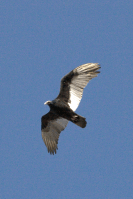
Birds are one of the best known species groups. They are highly visible, and many species are easily identified. Conservationists often refer to birds as indicators of general environmental conditions. The ‘canary in the coal mine’ idea. Recent information form the National Audubon Society suggests the canary may be sagging.
The knowledge of bird species distribution and trends in Arizona is good at state and county levels, but is not so good for smaller areas. A critical need is for an expanded network of repeated observations. Contributions to this blog can help.
The photograph shows a Belted Kingfisher studying a pond near the Agua Fria River in the Town of Dewey-Humboldt. Continue reading →



 GarryRogers Nature Conservation