Florida harbor dredging threatens corals | Summit County Citizens Voice

GR:  This seems like the wrong time to be destroying coral.  Is the pursuit of economic progress driving Florida and U.S. Army Corps of Engineers mad?

Bob Berwyn:

Activists plan lawsuit to win more environmental protection

Staff Report:  Even with coral reefs around the world under the global warming gun, the U.S. Army Corps of Engineers is seeking approval for a controversial Florida dredging project that could smother parts of the only coastal barrier reef in the continental United States.

But a coalition of environmental and community groups have banded together to try and the the Corps to provide mandatory, common-sense protections for reefs near the Port Everglades dredging project near Fort Lauderdale. The project’s goal is to increase coastal access for larger ships.Critics of the project say similar dredging at PortMiami injured and killed Endangered Species Act-listed staghorn corals and buried alive more than 200 football fields of reef habitat. They claim the damage stemmed from the Corps’ failure to collect and use accurate, up-to-date information or adequately account for potential impacts to nearby reefs.  More:  Florida harbor dredging threatens corals | Summit County Citizens Voice

Save

Save

World Environment Day

Environment, Human Impact, & Collapse of Civilization

GR:  The term environment refers to human surroundings. We measure human impact on the environment by the level of pollution of the air, water, and land, and the losses of food, water, and the convenience resources, the fossil fuels, lumber, and concrete.  Human impacts are often quite striking as illustrated below.

Natures-Unraveling-Clear-Cut Here’s a link to more illustrations and discussions of our impacts.

As global warming progresses and weather extremes become stronger and more frequent, the massive human population’s overuse of other animal species and the soils and plants they need for survival will produce deforestation, extinction, and desertification. Consequent human starvation will prompt conflict, death, and mass emigration. As predicted 50 years ago, the end has begun. Like locusts, the humans have fed and now they are dying or moving on.

Sound too doomy and gloomy? Perhaps, but before we ignore the predictions and the current early symptoms of impending collapse, we should look at the earlier models and recent discussions (e.g., Diamond below).

It is always prudent to expect the best and plan for the worst.  Jared Diamond gives a helpful discussion of this in the final chapter of his book Collapse. At the end, Diamond discusses three reasons for hope—hope we can avoid collapse.

Diamond’s first reason for hope is that “. . . realistically, we are not beset by insoluble problems” (521). His second reason “. . . is the increasing diffusion of environmental thinking among the public around the world. Diamond then discusses the crucial choices environmental thinking forces us to make if we are to succeed and not fail. The first is “the courage to practice long-term thinking and to make courageous, anticipatory decisions at a time when problems have become perceptible but before they have reached crisis proportions” (522). The second choice “involves the courage to make painful decisions about values” (523). Treasured values–religious, cultural, and traditional views and practices–are great dangers when they prevent societies from changing to meet new challenges.

Diamond’s third reason for hope is the work of archaeologists and the modern global communications network that let us learn from the mistakes of past peoples and of distant peoples. “My hope in writing this book has been that enough people will choose to profit from that opportunity to make a difference” (Diamond, 2005: 526).

In the 10 years since Diamond published Collapse, there doesn’t seem to have been much progress on the reasons for hope. Yes, population growth, global warming, etc. are soluble problems, but the hour grows late, and the problems continue to grow. Likewise, we have global diffusion of information across the Internet, but governments, politicians, and dictators are succeeding at containing the actions prompted by increased awareness. Are we learning from the mistakes of the past and present? Sure, we are, but now time is of the essence as they say, and we are running out of it.

Diamond, Jared. 2005. Collapse:  How societies choose to fail or succeed. Viking, New York. 576 p.

You might want to read the later edition of Collapse and Diamond’s thoughts on events during the 10 years since first publication.
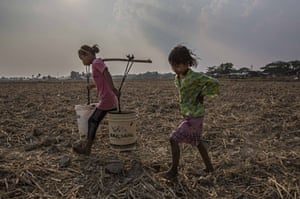
Here is a well-illustrated discussion of World Environment Day from the Guardian:  “More than a quarter of a billion people, half of them children, are suffering the impact of severe drought across three continents. Aid agencies are working to deliver emergency food parcels to prevent people starving, and to help build livelihood resilience to extreme weather events . . . .”  Source: World Environment Day: drought drives global rise in hunger – in pictures | Global development | The Guardian

Save

Save

Save

Save

Save
Deforestation: In India, 23,716 industrial projects replaced forests over 30 years

Indian villagers walk towards the Mahan forest during a protest against a coal mining project in Singrauli district, Madhya Pradesh. Of the 14,000 sq km of forests cleared over the past three decades in India, the largest area was given to mining (4,947 sq km), followed by defence projects (1,549 sq km) and hydroelectric projects (1,351 sq km).

Over the last 30 years, forests nearly two-thirds the size of Haryana have been lost to encroachments (15,000 sq km) and 23,716 industrial projects (14,000 sq km), according to government data, and artificial forests cannot be replacements, as the government recently acknowledged.

The government’s auditor has said conditions under which these projects are given forest land are widely violated, and experts said government data are under-estimates.  Read more:  In India, 23,716 industrial projects replaced forests over 30 years. – Enjeux énergies et environnement

GR:  Deforestation is rampant across the face of the Earth.  Progress, development, and profit–all trump forest.  And if forests aren’t totally cleared to make way for various enterprises, they are cut by timber companies that care nothing for biodiversity, only for sales of logs and lumber.

Save

From floods to forest fires: a warming planet – in pictures | Environment | The Guardian

Photos of Human Impact:  Droughts, floods, forest fires and melting poles – climate change is impacting Earth like never before. From the Australia to Greenland, Ashley Cooper’s work spans 13 years and over 30 countries. This selection, taken from his new book, shows a changing landscape, scarred by pollution and natural disasters – but there is hope too, with the steady rise of renewable energyAshley CooperFriday 3 June 2016 06.05 EDT

Source: From floods to forest fires: a warming planet – in pictures | Environment | The Guardian

Save

Climate Engineering Contributing To Climate Chaos » Climate Engineering Contributing To Climate Chaos | Geoengineering Watch

Dane Wigington, Geoengineeringwatch.org:  “Earth’s former energy balance has been completely derailed, we are now in a free-fall state toward an irreparably altered and very inhospitable planet. The majority of populations (especially in industrialized countries) are even now immersed in total denial in regard to the damage that has been inflicted to the environment and climate systems by human activity. Any form of anthropogenic activity that impacts Earth’s natural processes must be considered a form of geoengineering. The greatest and most destructive form of biosphere interference is the ongoing highly toxic climate engineering/weather warfare global assault. Burning forests, drought, deluge, volcanic eruptions, nuclear contamination and die-off, are already now the norm and this process will accelerate rapidly. Geoengineering is being ramped up to unimaginable levels as the collapse of the biosphere and social structure unfolds. The 9 minute video compilation below is a revealing recent update that covers numerous climate and environmental catastrophes.”  Source: Climate Engineering Contributing To Climate Chaos » Climate Engineering Contributing To Climate Chaos | Geoengineering Watch

Save

Voluntary family planning to minimise and mitigate climate change | The BMJ

What is the relation between population and environmental impact?

During 1971-72, Ehrlich and Holdren identified three factors that create humanity’s environmental (including climatic) impact, related by a simple equation2:Environmental impact, I =P×A×T.  in which A is affluence (material consumption and the concomitant “effluence” of pollutants such as carbon dioxide (CO2) per person); T is technology impact per person (in which fossil fuels measure more highly than solar based energy); and P is population (the number of people).

Population’s effect on the other two factors is multiplicative. Reducing P can reduce environmental impact if the other factors are constant. In fig 1⇓, for example, fewer people requiring food would manifestly reduce the startling 30% of greenhouse gas emissions from agriculture and meat production combined (including CO2 from deforestation, methane from livestock, and nitrous oxide from fertilisers).3 That said, other contributory factors, including the worldwide trend towards higher meat consumption, must also be reversed.

Source: Voluntary family planning to minimise and mitigate climate change | The BMJ

Save

Save

Disappearing West


Construction Eliminating Plants and Animals

Urban Sprawl--Los_Angeles

Every 2.5 minutes, the American West loses a football field worth of natural area to human development. This project maps a rapidly changing landscape, explores what is being lost, and profiles a new movement for conservation that is gaining ground.

Natural areas in the West are going fast. With each flight home, we get a bird’s eye view of sprawling new roads, oil wells, and pipelines. The Oregon woods we explored as kids are now stumps without songbirds. We see fewer stars through Santa Fe’s brightening lights.

Yet, from governors’ mansions to the halls of Congress, questions about land and wildlife conservation command relatively little attention today. The conventional wisdom seems to hold that the most consequential battles over America’s wild places are already settled. President Theodore Roosevelt, Sierra Club founder John Muir, and the environmental activists of the 1960s won protections for national parks, national forests, and wilderness areas. In the eyes of some politicians, the West’s open spaces are not only well protected, but too well protected. An anti-parks caucus in the U.S. Congress, for example, wants to block new national parks and sell off the West’s national forests to private owners.

Natural area loss, by state

State Total area modified by human development, in square miles Natural area lost, in square miles Percent change in area modified by human development
2001 2011 2001-2011 2001-2011
Wyoming 10,378 10,873 496 4.8%
Utah 8,248 8,624 376 4.6%
Oregon 12,431 12,843 412 3.3%
Washington 13,812 14,269 456 3.3%
Arizona 11,560 11,931 371 3.2%
Colorado 18,428 18,953 525 2.9%
California 29,856 30,641 785 2.6%
New Mexico 12,587 12,905 319 2.5%
Nevada 8,345 8,490 145 1.7%
Idaho 11,240 11,391 151 1.3%
Montana 23,485 23,770 285 1.2%
Source: Conservation Science Partners, “Description of the approach, data, and analytical methods used to estimate natural land loss in the western U.S.” (2016), unpublished technical report, available here
Source: Disappearing West

GR:  Go to the Source for more facts on the loss of natural areas to construction in the U.S.

Colorado Parks and Wildlife targets illegally stocked pike in Green Mountain Reservoir with a bounty for anglers | Summit County Citizens Voice

Non-native predators could threaten endangered species in Colorado River.

Colorado wildlife managers will try to curb expansion of non-native northern pike in Summit County’s Green Mountain Reservoir by paying anglers a $20 bounty for each fish they deliver to the Heeney Marina.

The illegally introduced fish are taking a toll on trout in the reservoir north of Silverthorne and could escape to the Blue River and make their way to the Colorado River. That could add to the challenges of trying to recover four endangered native Colorado River fish species, according to Colorado Parks and Wildlife.

Source: Colorado Parks and Wildlife targets illegally stocked pike in Green Mountain Reservoir with a bounty for anglers | Summit County Citizens Voice

Australia scrubbed from UN climate change report after government intervention

Exclusive: All mentions of Australia were removed from the final version of a Unesco report on climate change and world heritage sites after the Australian government objected on the grounds it could impact on tourism.

Guardian Australia can reveal the report “World Heritage and Tourism in a Changing Climate”, which Unesco jointly published with the United Nations environment program and the Union of Concerned Scientists on Friday, initially had a key chapter on the Great Barrier Reef, as well as small sections on Kakadu and the Tasmanian forests.

But when the Australian Department of Environment saw a draft of the report, it objected, and every mention of Australia was removed by Unesco. Will Steffen, one of the scientific reviewers of the axed section on the reef, said Australia’s move was reminiscent of “the old Soviet Union”.

Source: Australia scrubbed from UN climate change report after government intervention | Environment | The Guardian