Norway, India, & Netherlands May Ban Fossil Fuel Vehicles by 2025-2030 | robertscribbler

(Photo:  A Tesla Model S recharges its battery at a solar powered electrical station. A combination that provides a clear path out of a transportation-based hothouse gas emissions trap. Enabled by this technology, a number of countries are considering a complete ban on fossil fuel use for vehicle transport from 2025 through 2030. Image source: Green Car Reports.)

New national policy proposals from the four ruling parties of Norway spurred a flurry of headlines this week as leaders explored the possibility of banning all fossil fuel based vehicle sales by 2025.

The country, which already has a 24 percent national all-electric vehicle sales rate — is pursuing ways to ensure that number grows to 100 percent in very short order. Note that these vehicles are of the all-electric, battery-driven variety and do not include hybrids or plug in hybrids like the Chevy Volt.

Norway’s Push Implies a Big Shift for Fossil Fuel Exporter

Leaders from both parties within Norway were considering the ban which, if enacted, would dramatically reduce Norway’s vehicle fleet carbon emissions. Fully 90 percent of Norway’s electricity is generated by renewable hydro-electric power. And hooking vehicles up to this energy source would push their use and chain of fuel emissions to zero.  More: Norway, India and Netherlands May Ban Fossil Fuel Driven Vehicles by 2025-2030 | robertscribbler

Save

Save

World Environment Day

Environment, Human Impact, & Collapse of Civilization

GR:  The term environment refers to human surroundings. We measure human impact on the environment by the level of pollution of the air, water, and land, and the losses of food, water, and the convenience resources, the fossil fuels, lumber, and concrete.  Human impacts are often quite striking as illustrated below.

Natures-Unraveling-Clear-Cut Here’s a link to more illustrations and discussions of our impacts.

As global warming progresses and weather extremes become stronger and more frequent, the massive human population’s overuse of other animal species and the soils and plants they need for survival will produce deforestation, extinction, and desertification. Consequent human starvation will prompt conflict, death, and mass emigration. As predicted 50 years ago, the end has begun. Like locusts, the humans have fed and now they are dying or moving on.

Sound too doomy and gloomy? Perhaps, but before we ignore the predictions and the current early symptoms of impending collapse, we should look at the earlier models and recent discussions (e.g., Diamond below).

It is always prudent to expect the best and plan for the worst.  Jared Diamond gives a helpful discussion of this in the final chapter of his book Collapse. At the end, Diamond discusses three reasons for hope—hope we can avoid collapse.

Diamond’s first reason for hope is that “. . . realistically, we are not beset by insoluble problems” (521). His second reason “. . . is the increasing diffusion of environmental thinking among the public around the world. Diamond then discusses the crucial choices environmental thinking forces us to make if we are to succeed and not fail. The first is “the courage to practice long-term thinking and to make courageous, anticipatory decisions at a time when problems have become perceptible but before they have reached crisis proportions” (522). The second choice “involves the courage to make painful decisions about values” (523). Treasured values–religious, cultural, and traditional views and practices–are great dangers when they prevent societies from changing to meet new challenges.

Diamond’s third reason for hope is the work of archaeologists and the modern global communications network that let us learn from the mistakes of past peoples and of distant peoples. “My hope in writing this book has been that enough people will choose to profit from that opportunity to make a difference” (Diamond, 2005: 526).

In the 10 years since Diamond published Collapse, there doesn’t seem to have been much progress on the reasons for hope. Yes, population growth, global warming, etc. are soluble problems, but the hour grows late, and the problems continue to grow. Likewise, we have global diffusion of information across the Internet, but governments, politicians, and dictators are succeeding at containing the actions prompted by increased awareness. Are we learning from the mistakes of the past and present? Sure, we are, but now time is of the essence as they say, and we are running out of it.

Diamond, Jared. 2005. Collapse:  How societies choose to fail or succeed. Viking, New York. 576 p.

You might want to read the later edition of Collapse and Diamond’s thoughts on events during the 10 years since first publication.
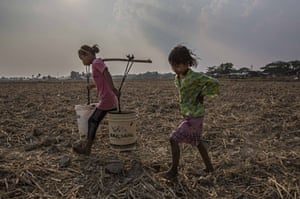
Here is a well-illustrated discussion of World Environment Day from the Guardian:  “More than a quarter of a billion people, half of them children, are suffering the impact of severe drought across three continents. Aid agencies are working to deliver emergency food parcels to prevent people starving, and to help build livelihood resilience to extreme weather events . . . .”  Source: World Environment Day: drought drives global rise in hunger – in pictures | Global development | The Guardian

Save

Save

Save

Save

Save

Newsweek Features Permafrost Video

My 2013 video on permafrost was included with a Newsweek piece on the issue. These videos get watched by, and help educate, the media gatekeepers. That’s the key to changing the conversation.

Newsweek:

Discussions of global warming often center on the release of greenhouse gases like carbon into the atmosphere, mostly from burning fossil fuels. There’s talk of “leaving it in the ground,” locking potential gases up in benign obscurity as untapped coal or oil reserves, but rarely does one see carbon slowly and steadily unlocking itself. In the Goldstream Valley in central Alaska, you can see it almost everywhere you look.

But in one spot, that carbon is still in suspended animation.  Read more:   Newsweek Features Permafrost Video | Climate Denial Crock of the Week

Deforestation: In India, 23,716 industrial projects replaced forests over 30 years

Indian villagers walk towards the Mahan forest during a protest against a coal mining project in Singrauli district, Madhya Pradesh. Of the 14,000 sq km of forests cleared over the past three decades in India, the largest area was given to mining (4,947 sq km), followed by defence projects (1,549 sq km) and hydroelectric projects (1,351 sq km).

Over the last 30 years, forests nearly two-thirds the size of Haryana have been lost to encroachments (15,000 sq km) and 23,716 industrial projects (14,000 sq km), according to government data, and artificial forests cannot be replacements, as the government recently acknowledged.

The government’s auditor has said conditions under which these projects are given forest land are widely violated, and experts said government data are under-estimates.  Read more:  In India, 23,716 industrial projects replaced forests over 30 years. – Enjeux énergies et environnement

GR:  Deforestation is rampant across the face of the Earth.  Progress, development, and profit–all trump forest.  And if forests aren’t totally cleared to make way for various enterprises, they are cut by timber companies that care nothing for biodiversity, only for sales of logs and lumber.

Save

Cataclysmically Bad May BLS Report, Soaring Immigration, Advancing Automation, Set Backs for U.S. Workers | Californians For Population Stabilization

Analysts hoped that the May Bureau of Labor Statistics report would show job creation at 164,000. Instead, BLS reported only a feeble 38,000 new jobs. Save for slight employment upticks in health care and professional services, many of them part-time positions, the BLS data was bad.

Better paying, blue-collar jobs in construction and manufacturing declined by about 33,000. The civilian labor force participation rate decreased by 0.2 percentage point to 62.6 percent as more than 450,000 workers left the labor market in May. People not in the labor force hit a record 94.7 million, 600,000 more than April’s figure.

The number of workers who would like full-time employment, but can find only part-time positions, increased by nearly half a million to 6.4 million. The artificially low 4.7 percent unemployment rate fools no one. Finally, as if the May report is not grim enough, March and April job growth was revised downward from, respectively, 208,000 and 186,000 to 160,000 and 123,000.

Couple the irreversible trend toward automation – “whether you like it or not,” as Rensi put it – with staggering, unsustainable immigration increases, and American workers are under siege.

According to Census Bureau data, legal and illegal immigration increased by 3.1 million, a 39 percent increase during the last two years. Temporary and permanent legal immigrants – all work-authorized – grew from 1.6 million in 2012-2013 to 2 million in 2014-2015. During the same period, the illegal immigrant population, many of whom work off the books, increased from 1.6 million to 2 million.

Source: Cataclysmically Bad May BLS Report, Soaring Immigration, Advancing Automation, Set Backs for U.S. Workers | Californians For Population Stabilization

Save

Spike in Alaska Wildfires is Worsening Global Warming | Climate Central

Northern wildfires must now be recognized as a significant driver of climate change – and not just a side-effect, according to the report from the U.S. Geological Survey.

“This is one of the surprises that we haven’t talked about much,” said Virginia Burkett, chief climate scientist at the USGS. “It has tremendous implications for the carbon that is locked up in Alaska soils and vegetation.”

A record wildfire year – such as 2015 which was the worst in Alaska for a decade – had a measurable effect on the release of carbon dioxide and methane, which are the main drivers of climate change.

“Our scientists found that the balance of carbon storage versus release in Alaska was strongly linked with wildfires,” Burkett said. “In years where there was high wildfire activity the net carbon balance declined dramatically, and then it would rebuild in the absence of fire.”

Source: Spike in Alaska Wildfires is Worsening Global Warming | Climate Central

Save

Fantastic news! Port Augusta’s opportunity to become a world class solar energy hub « Antinuclear

A NEW proposal for a $1.2 billion solar thermal plant at Port Augusta, backed by former federal Liberal leader Dr John Hewson, can be revealed by The Advertiser just weeks after the city was hit with the closure of its power station.

Solastor Australia will next week unveil its plans to build a solar thermal power station with a generation capacity up to 170 megawatts and energy storage capabilities, The Advertiser has discovered.

While details of the project remain secret until an official announcement on Tuesday, a similar proposal from US company SolarReserve would create up to 1000 jobs during construction and about 50 permanent jobs.

Source: Fantastic news! Port Augusta’s opportunity to become a world class solar energy hub « Antinuclear

Save

Save

AZGFD.gov Game and Fish officers euthanize bear that clawed camper

GR:  As the human population grows and expands, encounters with wildlife increase.  We kill any animals that injure a human–usually no questions asked.  We also kill wildlife as we build homes and roads and destroy necessary wildlife habitat.  Research indicates that already half of all animals are gone.  Eventually, there will only be humans, their domestic animals, and a small number of other species.

Do we care enough about other creatures to protect their habitat and reduce our population?  None of the zoning regulations I’ve seen preserve habitat just because wild animals need it.  Certainly there is no effective effort to control our population.  So, is it truly inevitable that humans doom most wild animals to extinction?

black bearPHOENIX — “Arizona Game and Fish Department officers last night trapped and euthanized a black bear that had scratched and injured a camper earlier in the day in a dispersed camping area (not a developed campground) near Cherry Creek in Young, Ariz.

“The subadult (1-1/2 to 2-1/2 year-old) [young] male bear was caught in a culvert trap set by a highly trained team of wildlife officers. They confirmed this was the bear involved in the incident based on descriptions from other campers and because it had a unique hind paw pad that matched tracks found at the scene. The bear was euthanized [killed] per department policy because it attacked a human and was deemed a threat to public safety.

“Officers noted there were unsecured food sources and garbage in the area, and a field necropsy revealed garbage in the bear’s stomach contents. Arizona Game and Fish reminds everyone that leaving food and trash around may be luring an animal to its death.”  Read more: AZGFD.gov Game and Fish officers euthanize bear that clawed camper.

The photo is a Pixabay Free Illustration.

Save

Save

Save

Young bear killed in California may have been mutilated for its body parts | US news | The Guardian

A young bear killed by a vehicle on a California road this week was found by highway maintenance workers to have been mutilated, possibly so that parts of it could be sold on the black market, according to officials.

The bear had injuries consistent with being hit by a car in the early hours of Thursday morning, not shot or poisoned, according to Andrew Hughan, an information officer for the California department of fish and wildlife, who said the black bear, the only species in California, was a “yearling” at two years old and 150 pounds – “something like a teenager”.

However, Hughan said that when the game warden arrived on the scene to retrieve the carcass he discovered that “the paws had been cut off and the gall bladder had been removed, which is pretty disheartening”.  Read more: Young bear killed in California may have been mutilated for its body parts | US news | The Guardian

This sounds like an accident; let’s hope Asian bear-bile poachers don’t open shop in North America.

Save