How Austrailia’s Great Barrier Reef got polluted – from farms and fossil fuels to filthy propaganda | Graham Readfearn | Environment | The Guardian

GR:  This is the best discussion of the cause of coral death in Australia’s Great Barrier Reef I’ve seen–it’s people.

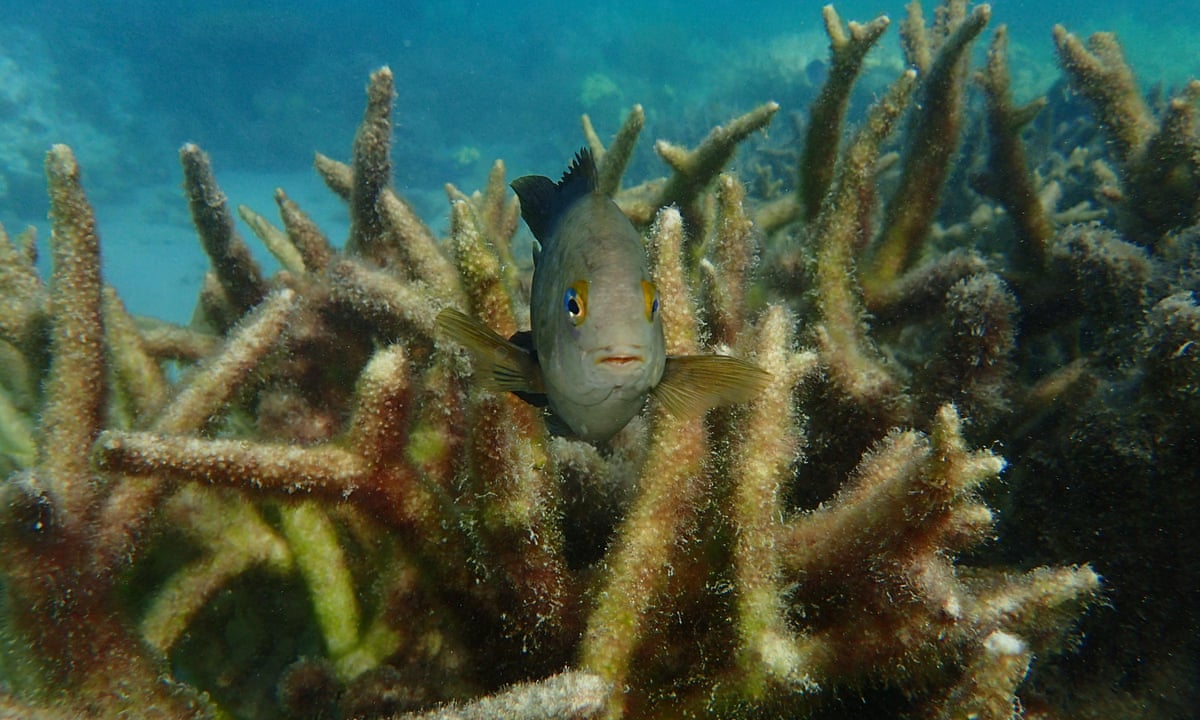
Coral bleaching at Loomis Reef, off Lizard Island, Great Barrier Reef, Australia. Photograph: Essential Median

Graham Readfearn:  In late November 2015, as corals across the northern section of the Great Barrier Reef started to bleach white, the game was finally up.

For years, Australians had been told the country’s jewel in the ocean’s crown was on the mend. Only months earlier the Coalition government had won a two-year fight to keep the reef off a United Nations list of world heritage sites in danger.

The stakes were high. International reputations and tourist dollars were at stake. The foreign minister, Julie Bishop, and the trade minister, Andrew Robb, had even attacked Barack Obama, who feared for the reef’s future.

The reef was not in danger, Bishop insisted. The president was misinformed, claimed Robb.

Conservative commentators hanging around News Corp media have said the dangers to the reef were overblown.

The mining industry cast the views of environmentalists as green propaganda, ignoring how for the most part, conservationists were echoing the findings of the government’s own scientists.

Now, about half the corals bleached in the once pristine northern section are dead or dying.  More– How the Great Barrier Reef got polluted – from farms and fossil fuels to filthy propaganda | Graham Readfearn | Environment | The Guardian

Save

The Guardian view on the Great Barrier Reef: the crisis they prefer to downplay | Opinion | The Guardian

Many of the politicians fighting Australia’s election campaign talk about the economy and immigration but the world is listening for what they say about the impact of climate change.

If the rest of the world could vote in next month’s Australian election, there would almost certainly be one issue that would be raised to the top of the country’s political agenda: saving the Great Barrier Reef. Scientists say this year 93% of its reefs experienced some bleaching, and 22% of all of the reef’s coral was killed by unusually warm waters. Unheard of just three decades ago, large-scale bleaching has become a regular occurrence. Within 20 years the conditions that drove this year’s bleaching in Australia will occur every second year. A Guardian report illustrates in vivid detail the scale of the devastation unfolding beneath the surface. Over the past 34 years the average proportion of the Great Barrier Reef exposed to temperatures where bleaching or even death is likely has increased from about 11% a year to about 27% a year.

It is a constant struggle to motivate most people most of the time about climate change. The evidence accumulates slowly; despite being an emergency, it often . . . more:  The Guardian view on the Great Barrier Reef: the crisis they prefer to downplay | Opinion | The Guardian

Save

To save the Great Barrier Reef ‘we need to start now, right now’ – video | Environment | The Guardian

GR:  The video leaves us with a grim outlook.  Human wastes running into the oceans coupled with global warming will soon destroy all the reefs.  Do enough people care to force our governments to act?  Probably not.  Do you see any answers?

and , theguardian.com:  Jon Brodie from James Cook University says to give the Great Barrier Reef even a fighting chance to survive, Australia needs to spend $1bn a year for the next 10 years to improve water quality. If we don’t do that now, he says, we might need to just give up on the reef. ‘Climate change is happening much more quickly and much more severely than most scientists predicted’•

The Great Barrier Reef: a catastrophe laid bare – special report.    Source: To save the Great Barrier Reef ‘we need to start now, right now’ – video | Environment | The Guardian

Save

Predator Control in Alaska Wildlife Refuges

Pat Lavin:  The state of Alaska is pursuing aggressive predator control measures on our national wildlife refuges, targeting bears, wolves and other wildlife on land that was meant for their conservation.

Alaska is a state unlike any other, home to diverse landscapes from the tundra of the high arctic to temperate rainforests in the south. Polar bears, wolves, and brown bears live here. In many parts of the state, these carnivores live in pristine habitat as they have for thousands of years, hunting their natural prey, including moose, caribou, deer, salmon and more.  More:  Predator Control in Alaska Wildlife Refuges

Save

Save

Great Barrier Reef: diving in the stench of millions of rotting animals – video | Environment | The Guardian

GR:  Watch this short video to get a clear idea of what’s happening to coral.

Richard Vevers from the Ocean Agency had never experienced anything like the devastation he witnessed in May diving around the dead and dying coral reefs off Lizard Island on the Great Barrier Reef. When his team emerged from the water, he says, ‘We realised we just stank – we stank of the smell of rotting animals.’ The reefs around the island have been ravaged by coral bleaching caused by climate change.  Special report by Josh Wall and Michael Slezak, theguardian.com.  Source: Great Barrier Reef: diving in the stench of millions of rotting animals – video | Environment | The Guardian

Save

Rescued whale sharks released back into the ocean – in pictures | Environment | The Guardian

Two whale sharks destined for an ocean theme park in China were rescued after an 18-month investigation by Wildlife Conservation Society, covered by investigative photojournalist Paul Hilton. The operation, supported by Indonesia’s marine police, revealed where the protected species were being illegally caught and kept in sea pens by a major supplier of large marine megafauna to the international wildlife tradePaul HiltonMonday 6 June 2016 06.29 EDT.  More:   Rescued whale sharks released back into the ocean – in pictures | Environment | The Guardian

Save

Experts Prepare to Welcome Black-footed Ferrets Back to Wyoming

Not terribly long ago, the black-footed ferret vanished from the wild. Today, experts are making plans to return this endangered species to the same site where humans once thought we had seen the very last of this iconic prairie creature.

On the early morning of November 2, 1985 I watched a pickup truck crest the ridge of a dusty Wyoming two-track ranch road and disappear over the horizon. Inside it was what I thought at the time might be the last black-footed ferret ever to live in the wild. I was dead tired, having been up for the past week trying to catch that ferret, spending nights of driving laps around prairie dog colonies – the habitat and food source of black-footed ferrets – peering out to the end of the beam of a strong spotlight to find her. It was the end of a tumultuous fall, one that had been filled with bitter accusations and petty politics, and I was really too worn down to be much more than philosophical about her departure. There was no fanfare, no media presence—nothing that would have marked the day as remarkable. Even though it might have been the day that a species went extinct in the wild.  More:  Experts Prepare to Welcome Black-footed Ferrets Back to Wyoming

Save

Save

Help Stop the Wildlife-Killer Bill in Congress 060616 – Defenders of Wildlife

It’s supposedly an energy bill, but the “North American Energy Infrastructure Act of 2016” contains a lethal dose of anti-wildlife amendments that will lead to dead wolves, dead bears and the destruction of many important wildlife protections.

And while pro-oil, pro-coal, climate change denying provisions are despicable, the anti-wildlife measures are equally catastrophic.

Tell your senators to protect wildlife and oppose this deadly bill!

More: Help Stop the Wildlife-Killer Bill in Congress 060616 – Defenders of Wildlife

Save

AZGFD.gov Game and Fish officers euthanize bear that clawed camper

GR:  As the human population grows and expands, encounters with wildlife increase.  We kill any animals that injure a human–usually no questions asked.  We also kill wildlife as we build homes and roads and destroy necessary wildlife habitat.  Research indicates that already half of all animals are gone.  Eventually, there will only be humans, their domestic animals, and a small number of other species.

Do we care enough about other creatures to protect their habitat and reduce our population?  None of the zoning regulations I’ve seen preserve habitat just because wild animals need it.  Certainly there is no effective effort to control our population.  So, is it truly inevitable that humans doom most wild animals to extinction?

black bearPHOENIX — “Arizona Game and Fish Department officers last night trapped and euthanized a black bear that had scratched and injured a camper earlier in the day in a dispersed camping area (not a developed campground) near Cherry Creek in Young, Ariz.

“The subadult (1-1/2 to 2-1/2 year-old) [young] male bear was caught in a culvert trap set by a highly trained team of wildlife officers. They confirmed this was the bear involved in the incident based on descriptions from other campers and because it had a unique hind paw pad that matched tracks found at the scene. The bear was euthanized [killed] per department policy because it attacked a human and was deemed a threat to public safety.

“Officers noted there were unsecured food sources and garbage in the area, and a field necropsy revealed garbage in the bear’s stomach contents. Arizona Game and Fish reminds everyone that leaving food and trash around may be luring an animal to its death.”  Read more: AZGFD.gov Game and Fish officers euthanize bear that clawed camper.

The photo is a Pixabay Free Illustration.

Save

Save

Save