Barn Owl Roost Falls
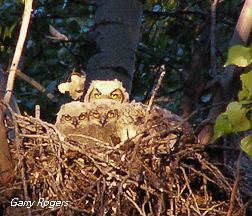
 Nine years ago I found a Barn Owl feather lying in the front yard. Since then I have often seen the owl’s silhouette sitting in trees and sailing silently across the yard. Four years ago a second feather turned up. Two years ago, I brushed the spruce tree beside the house and a Barn Owl flapped out. It perched in a nearby Cottonwood tree and watched nervously while I took the
  photograph at left.
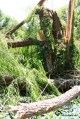
Last summer a windstorm toppled two of the tall willow trees shading my driveway. We had seen a Common Barn Owl (Tyto alba) roosting in the thickest tangle of overlapping bra nches between the trees. It’s been seven months since the trees fell, and I have seen no signs of the owl.
About the Barn Owl
 Barn Owls are the most widely distributed of all owl species. They are only absent from Antarctica and the coldest and hottest places elsewhere. They live on small rodents, and never take anything as large as a house cat or dog. Barn Owls range from 10″ to 18″ in height. The one in the picture at left is 15″ from crown to wing tips. If you have a Barn Owl living nearby, you have probably heard its “shree” call that’s nothing like the hoots and toots of other common owls.
Barn Owls hunt at dusk and during the night. Though they have excellent nighttime vision, their hearing is so good they can find prey by sound alone. This lets them detect and capture rodents beneath snow, grass, and brush. The Barn Owl practices elaborate courting and parenting behavior that involves dancing, singing, nest-building and decorating, and surplus food storage. I recommend the beautifully detailed account of Barn Owl behavior by Anita Albus (2005) .
Barn Owl Benefits
A single Barn Owl family will consume thousands of rodents every year, making the owl one of the most beneficial predators a farmer can attract. Rodent control benefits everyone. We humans are mouse magnets. Our dwellings are like tiny rodent resorts with walls that provide shade and narrow strips of moist soil and vegetation where rainwater collects. Without owls and other mouse predators, our gardens would become toxic or they would become walled fortresses, and our houses would be besieged in winter by hoards of wild mice looking for a warm bed.
Barn Owl Conservation
Over the past half century, Barn Owls have declined. Belfries and lofts where owls once nested are now mostly screened and closed (Albus 2005). The leading causes of the owl decline, however, are the toxic pesticides in the air, water, and tissues of rodents. Some people recognize the dangers of pesticides, but heavy use continues in most yards and farms. The pesticides might do a more thorough job than the owls, but when all the mice and owls are gone, we might find that our produce has lost its flavor.
Barn Owls are nearing extinction in some places (World Owl Trust, Dear Kitty, Doward 2013). Seven U. S. states recognize the owl is endangered, and this status is spreading. You might be able to help the owls by developing neighborhood support. If you can convince your neighbors to drop pesticides, it would be worth your effort to attract a Barn Owl family. Click here to learn how to invite barn owls to your neighborhood.
Barn Owl References
Albus, A. 2005. On rare birds. Lyons Press, Guilford, CN. 276 p.
Arizona Bird Conservation.
Cornell Lab of Ornithology: http://www.allaboutbirds.org/guide/Barn_Owl/id/ac
Doward, Jamie. 2013. Battle to save barn owl after freak weather kills thousands. http://www.theguardian.com/environment/2013/dec/14/barn-owls-threatened-freak-weather
Konig, C., J-H. Becking, F. Weick. 1999. Owls: A guide to the owls of the world. Yale University Press, New Haven, CN. 462 p.
The Owl Pages: http://www.owlpages.com/owls.php?genus=Tyto&species=alba.
Wikipedia. http://en.wikipedia.org/wiki/Barn_Owl.
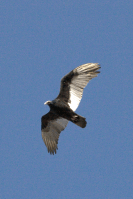



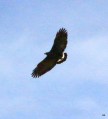 Yesterday (04/02/13), a Common Black-Hawk (Buteogallus anthracinus) raided the two Great Blue Heron nests over my stock pound. I heard the screams and croaks, and later saw the hawk sitting in one of the heron nests. Today, I saw the hawk flying through the cottonwood grove beyond the heron nests, but the herons are gone.


 GarryRogers Nature Conservation