More than half of the lizard species found in the U. S. are present in Arizona. They are a colorful group with fascinating life histories. Lizards help control ants, termites, and other insects, and with only one exception, the Gila Monster, they are not venomous. Field guides are available online (Arizona Herpetological Association, Brennan, 2008), and in print (Jones and Lovich, 2009, and Stebbins, 1966).
Plateau Fence Lizard
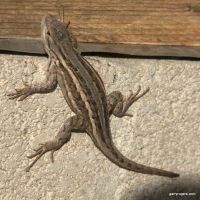
The photograph shows a Plateau Fence Lizard. These lizards do like fences, but they will sit on any convenient object that gives them an elevated view. They are found throughout central and northern Arizona.
Lizards are not descended from dinosaurs. They appeared about the same time and lived with dinosaurs, but they are not closely related. Lizard legs extend to the sides of the body rather than projecting downward or forward. Lizards became a separate group in the Late Triassic, over 200 million years ago. Continue reading →
Big Brown Bat from Smithsonian North American Mammals
The most important change since my last post about Arizona bats is the increased risk of white-nose syndrome. The disease continues to spread west from its point of introduction on the U. S. Atlantic coast despite research and quarantine efforts. In September, 2013, researchers confirmed the disease had reached Oklahoma and South Dakota (http://whitenosesyndrome.org/resources/map).
Small stretches of the Agua Fria River in central Arizona are perennial. The water is polluted by farm fertilizer and mine tailings. Invasive species are abundant.
The U. S. State of Arizona occupies a dry region with limited precipitation, high evaporation, and not much surface water. Widespread winter rain and snow, and heavy summer rain can escape evaporation by penetrating the soil and accumulating in fractured rocks and sediments on slopes and in valley floors. The moisture soaks down slope through the sediments, and appears in springs, intermittent streams, and a few perennial streams and small lakes. Many isolated endemic and rare species are present in these small moist habitats across the state. (The header image is a Beautiful Shiner (Cyprinella formosa) photographed by René Reyes of the U. S. Bureau of Reclamation.)
Grasshoppers, Crickets, and Katydids are familiar to everyone, but there are few records of distribution and conservation status. This report includes a partial checklist for Arizona grasshoppers. Grasshoppers are members of the Orthoptera, one of the most familiar insect orders. Orthoptera includes two suborders: Caelifera (grasshoppers and relatives) and Ensifera (crickets, katydids, and gryllacridoids).
The katydid in the photo is probably Greater Angle-wing Katydid (Microcentrum Rhombifolium). It is common in central Arizona where I live. According to the BugGuide website, the similar California Angle-wing (Microcentrum californicum) also occurs in central Arizona. The two are distinguished chiefly by their songs.
Most singing insects are herbivores. Their occasional population explosions can reduce farm profits, and have led to emphasis on eradication. Protection deserves more consideration. Orthoptera are all important biomass recyclers, and all serve as essential sources of food for other animals. Use of insects for human food is growing in popularity. As the human population continues to swell, the proportion experiencing the culinary delights of bug dinning will grow. We have to wait to see if grasshopper ranches arrive before textured soy protein replaces sirloin.
Orthoptera suffer from habitat loss just as other species groups do. Farms, roads, and buildings are concentrated in valleys near lakes and streams. The selective destruction of natural habitats in these more productive areas alters the size and composition of insect populations. These changes reduce ecosystem diversity, stability, and productivity. The references listed in the Singing Insects of North America website and in the list below are a good place to start to learn more about the ecological importance of these insects.
Grasshoppers
Many of the 400 grasshopper species known to occur in the western U. S. may be present in Arizona, but in the time available to prepare this report I could only verify 59 species from the USDA fact sheets (USDA and Pfadt 2002) and 35 from the Arizona Game and Fish Department (AZGFD–October 2013) website. The list is almost certainly incomplete, and it probably contains outdated names.
I compiled the list from the range maps on the website of the U. S. Department of Agriculture (USDA), and the October 10 species list by AZGFD. The USDA fact sheets include maps, photographs, and the natural history of each species. The Bug Guide provides additional information.
“Baby animals you see are probably not orphans; parents are usually nearby.”
Wildlife Rescue in Arizona is licensed by the Arizona Game and Fish Department. Visit the AZGFD website for a list with contact information and taxa treated. A second list includes other animal charities in Arizona. Find more information from local veterinarians and animal control departments of local governments.
These organizations provide additional information:
Corr Syl the Warrior is a finalist in the Arizona Authors Association 2013 Literary Contest. Places will be announced at the annual awards banquet in November. Wish me luck.
Noel M. Burkhead of the U. S. Geological Survey, recently performed an analysis of the extinction rate for North American fish (Burkhead 2012). Burkhead used the fossil record to determine that throughout geological history, one fish species went extinct about every three million years. During the past century, 57 fish became extinct, making the modern rate almost 900 times as fast as the historical rate. Extinctions may have been abrupt in Earth’s past, but probably none were as abrupt as the current event.
The growing probability of extinction of Arizona’s native fish is easy to explain. The exploding human population has caused widespread degradation and elimination of water habitats. We have dammed and diverted streams, depleted the groundwater that created springs, and dumped wastes in or near stream channels. We have introduced exotic species such as carp, bass, and trout that compete with natives, and we have damaged or destroyed the protective vegetation of the watersheds. We call it progress when we replace natural habitats with houses and roads. And we ignore the impact on watersheds by introduced fire-prone alien weeds, forest removal, and livestock grazing.
Gila Trout –
About 50 years ago, two Arizona scientists, Robert Miller and Charles Lowe, analyzed the status of Arizona fish. They reported that elimination of habitats and introduction of exotic species was threatening many species and might soon extinguish the native gila trout (Salmo gilae), humpback chub (Gila cypha), Colorado squawfish (Ptychocheilus lucius), Little Colorado spinedace (Lepidomeda vittata, restricted to Arizona), desert pupfish (Cyprinodon macularius), and Gila topminnow (Poeciliopsis occidentalis) (Miller and Lowe 1964: 133). Continue reading →
Damselflies and Dragonflies belong to the order Odonata (“toothed ones”). They are carnivorous predators whose earliest fossils occur in Pennsylvanian sediments deposited about 325 million years ago. Evolution chanced upon an efficient form for these creatures; only small changes have occurred for the last 200 million years. Compare that to mammal predators, most of which have persisted less than 50 million years.
Damselflies and Dragonflies are easy to distinguish because they hold their wings differently when perched. Damselflies perch with their wings together above their back. Dragonflies perch with their wings extended (both photographs). Continue reading →




 Damselflies and Dragonflies belong to the order Odonata (“toothed ones”). They are carnivorous predators whose earliest fossils occur in Pennsylvanian sediments deposited about 325 million years ago. Evolution chanced upon an efficient form for these creatures; only small changes have occurred for the last 200 million years. Compare that to mammal predators, most of which have persisted less than 50 million years.
 GarryRogers Nature Conservation