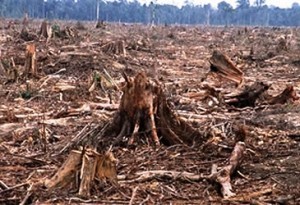
Deforestation Climate Risk Bigger Than Carbon

Deforestation

Peer-reviewed report says that clearing tropical rainforests distorts Earth’s wind and water systems and has impacts far beyond the implications for carbon dioxide. Farmers and food supply potentially at risk as global warming and skewed rainfall could wreak havoc with crops—from coffee to corn—in world’s breadbaskets

“A new study presents powerful evidence that clearing trees not only spews carbon into the atmosphere, but also triggers major shifts in rainfall and increased temperatures worldwide that are just as potent as those caused by current carbon pollution. Further, the study finds that future agricultural productivity across the globe is at risk from deforestation-induced warming and altered rainfall patterns.

“The report, “Effects of Tropical Deforestation on Climate Change and Agriculture,” published today in Nature Climate Change and released in collaboration with Climate Focus provides the most comprehensive analysis to date of the climate impacts of tropical forest destruction on agriculture in the tropics and thousands of miles away. Specifically, the study finds that deforestation in South America, Southeast Asia and Africa may alter growing conditions in agricultural areas in the tropics and as far away as the US Midwest, Europe and China.”  Source: www.reportingclimatescience.com

GR:  This research is bad news for Earth ecosystems.  As with invasive plants, deforestation is having a more immediate impact than CO2 accumulation in the atmosphere.  The human impact has many facets, but its root is human population growth.  Construction, invasive species, deforestation, toxic chemicals, and greenhouse gas are all increasing along with our population.

Roads Benefit People But Can Have Massive Environmental Costs

“Road-killed tapir in Peninsular Malaysia (photo © WWF-Malaysia/Lau Ching Fong).  Located in the wrong places, roads can open a Pandora’s Box of problems,” says William F. Laurance.

“In a recent Opinion in National Geographic News (14 October 2014), U.S. Ambassador Kenneth M. Quinn makes a compelling case that roads can have major benefits for rural people—improving access to modern farming technologies, education, and healthcare, and even limiting the influence of extremist groups that prey on isolated communities.

“However, Ambassador Quinn tells only half of the story. Yes, many roads or road improvements can yield major economic and social benefits. But other roads become environmental disasters—opening a Pandora’s Box of problems such as illegal logging, poaching, wildfires, and land speculation.”

Source: newswatch.nationalgeographic.com

GR:  Roads open areas to invasive species; they raise wildlife-disturbing noise levels, and they block wildlife movements.  In some areas, roads lead to ecosystem disruption by encouraging tourism, recreational travel, and hunting.  According to RoadFree.org, keeping wild areas free of roads is a remarkably cost-efficient way of preventing deforestation and protecting biodiversity.  Read more about road impacts.

WildLeaks – Wildlife Crime Stories

Wildlife and Forest Crimes can be better understood in their complexity and disastrous effects through stories and case studies.

Source: wildleaks.org

Wildleaks gives whistleblowers and witnesses of wildlife crime a secure place to report their evidence.

Ghana: Endangered Species Near Extinction

Monkeys carry their young ones to safety in the morning rain, while squirrels and other rodents flee across ravaged portions of Accra’s only forest reserve being cleared into demarcated streets ready to be developed into estates.

GR:  The law can be made to save the forest if enough people take action.

See on allafrica.com