Why Killing Wildlife Is Very Bad For Our Health

“A just-published study in the online journal PLOS Biology says that shrinking biodiversity means a rise in tropical diseases including malaria and dengue fever.

“One-third of the world’s species are now threatened with extinction. It is a massive loss of biodiversity that has serious implications for our health and for the earth’s health: A just-published study in the online journal PLOS Biology says that shrinking biodiversity could mean a rise in tropical diseases including malaria and dengue fever. The study makes a case for why, in fighting human disease, ecological preservation is just as important as medicine and vaccines.

“As more and more species of animals and plants face extinction, humans are at greater risk of being affected by parasitic and vector-borne diseases. The latter term refers to bacterial and viral diseases transmitted by mosquitos, ticks and fleas. The reason for the rising risk is that, with a decreasing variety of animal carriers for a disease, an illness’ “life cycle” is less likely to be disrupted, as Matthew Bonds, a researcher at Harvard Medical School and the study‘s lead author, explains to NPR.”

Source: www.care2.com

GR:  I suppose that the surviving wildlife species will also have to tolerate more and more diseases.  That is one creepy sign.  So don’t go down to the woods today, because you won’t be alone.

Save Rhinos from Rampant Poaching

Target: President Barack Obama and U.S. Government Goal: Save the last remaining rhinos from poachers before these amazing animals go extinct *This petition is in collaboration with Care2, thereby allowing all signatures to appear in a single…

From the petition description:  “The Western black rhino species has been declared extinct and the two other rhino species found in Africa are close on its heels towards disappearing from the face of the planet. All this for a lucrative black market where poachers make millions of dollars from people who buy the illegally traded rhino horn, falsely believing it can cure cancer and other ailments.

“Amidst this bleak news, there is a ray of hope. The U.S. government is making moves to list rhinos as threatened under the Endangered Species Act. The listing closes a loophole that was being abused by traffickers, and strengthens the anti-poaching efforts being undertaken by African governments and conservation partners such as the African Wildlife Foundation.”

Source: forcechange.com

Tiger Day starts an Avaaz petition to close Chinese tiger farms

“No tiger cub deserves to be born into a life of suffering and eventually be killed for its fur, and other parts used for “chinese magic” or bogus potions.

“China is allowing the sale of captive-bred tiger skins and body parts. They are denying a UN agreement which calls for such trade to be banned. The conditions in these farms are horrible!Images appeared on in our mailbox showing deceased tigers from these camps. Our staff was shocked but decided to publish them. Warning, these images are not for the weak-hearted.

“Something needs to be done! There are just 3200 wild tigers living in the wild and over 5000 held captive in these tiger farms! These creatures deserve a worthy life and we want to give it to them. If we move as one, we can make a change! ”

Source: tigerday.org

GR:  During the past century we lost 97% of all wild tigers. Habitat loss and hunting eliminated 97,000 of the 100,000 tigers we had a century ago.  At this rate, all tigers living in the wild will be extinct in 10 years! Please sign the petition.

International Tiger Day

The official International Tiger Day Poster for 2014.

Source: tigerday.org

GR:  During the past century, we lost 97% of all wild tigers. Habitat loss and hunting eliminated 97,000 of the 100,000 tigers we had a century ago.  At this rate, all tigers living in the wild will be extinct in 10 years! Celebrate International Tiger Day and encourage others to join in.

Don’t Forget Butterflies! Our Pollination Crisis Is About More Than Honeybees

When the White House signed an order on pollinator health last week, it included all pollinators — not just honeybees.

“Obama announces plan to save honeybees,” CNN proclaimed. “White House creates new honeybee task force,” the Wire echoed. “White House task force charged with saving bees from mysterious decline,” the Guardian added, referencing the colony collapse disorder that contributed to the death of 23 percent of managed honeybees last winter.

“But those headlines overlooked the most important part of the presidential order: it encompassed all pollinators, including birds, bats, native bees, and butterflies — not just honeybees. The memorandum will spur the creation, within the next 180 days, of a National Pollinator Health Strategy that will lay out ways for the U.S. to better study and better tackle the problems facing pollinators, both wild and managed. While the plight of bees has gotten deserved attention of late, many species of pollinators face the same threats: habitat destruction, climate-induced changes in flowering and weather patterns, and in some cases, pesticides.”

Source: thinkprogress.org

GR:  Dropping pesticides and interspersing food plants with crops will help pollinators, but there are other things to consider.  Construction, farming, logging, livestock grazing, invasive species, and toxic pollutants (including greenhouse gasses) are eliminating habitat much faster than farmers are recovering it.  Until humans control their population and correct the ways they use resources, pollinators and other species will continue to decline.

Military-style attacks in DRC result in 68 elephant deaths

Elephant Poaching in DRC

“African Parks has intensified its anti-poaching efforts in eastern Democratic Republic of Congo to counter the poaching onslaught that has beset Garamba National Park in the past two months.  (The first photo is from Reuters.com)
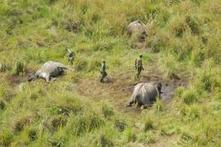
“A total of 68 elephants have been poached since mid-April, representing about 4 per cent of the total population.”

GR:  At this rate, DRC elephants will be extirpated in four years.

See on www.wildlifeextra.com

To save Australia’s mammals we need a change of heart

Twenty-nine Australian land mammals have become extinct over the last 200 years, and 56 are currently facing extinction. These losses and potential losses represent over a third of the 315 species present…

See on theconversation.com

Invading species can extinguish native plants

Invasive Plants

Nature Conservation & Science Fiction: #EcoSciFi

Ecologists at the University of Toronto and the Swiss Federal Institute of Technology Zurich (ETH Zurich) have found that, given time, invading exotic plants will likely eliminate native plants growing in the wild despite recent reports to the…

Creating native enclaves might save a plant species from extinction, but the species’ decline over a large area will have tremendous negative effect on the species’ herbivore/detritivore and sheltering associates (GR).

See on phys.org